Overview
Lizard is an AI-native cloud deployment platform purpose-built for the new generation of coding agents and agentic development workflows. Instead of retrofitting traditional Platform-as-a-Service (PaaS) offerings to accommodate automated assistants, Lizard was architected from the ground up around the agent loop—the cycle of write, deploy, observe, and iterate that tools like Claude Code, Codex, and Cursor increasingly drive. The result is a cohesive platform that combines managed infrastructure, containerized application hosting, and observability into a single command-line interface that is equally readable by humans and machines.
Positioned as a challenger to established platforms such as Railway, Render, and Fly.io, Lizard differentiates itself through its focus on agent-readable output and measured resource billing. The website makes the bold claim that other clouds "bolt AI onto a human workflow," whereas Lizard was designed for autonomous operation from day one. This philosophy manifests in features like schema-typed command responses, sandboxes that return structured results instead of raw stdout, and automatic rollback and restore capabilities. While many developers will first encounter Lizard through an AI coding assistant, the platform also offers a conventional web dashboard, making it a hybrid that serves both manual and automated operations.
For anyone evaluating modern deployment infrastructure, Lizard's product blog offers transparency into its roadmap and technical decisions, reinforcing the platform's commitment to a developer-first, agent-friendly experience.
Key Features
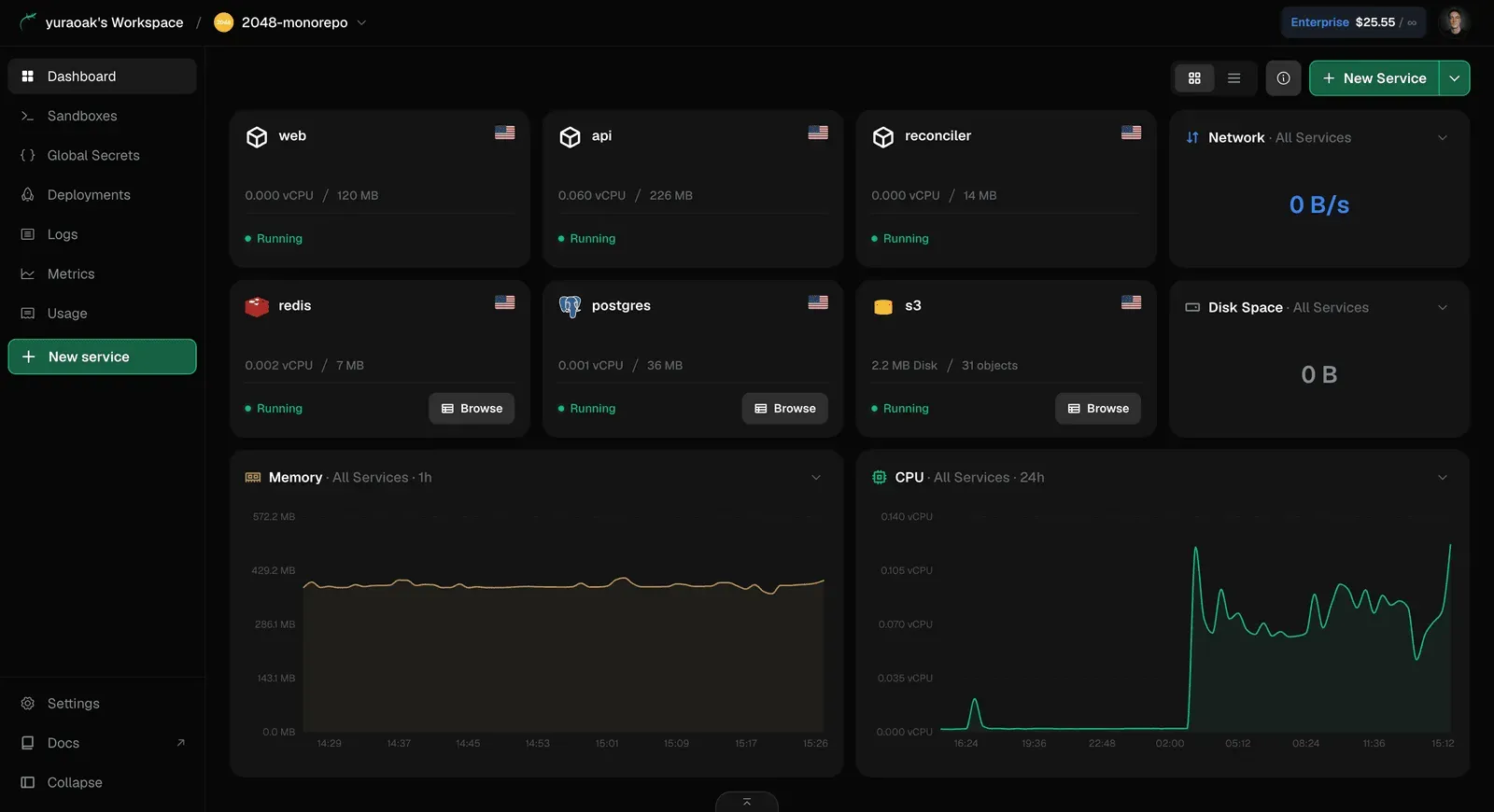
- One-Command Managed Resources: Lizard enables developers to provision managed Postgres, Redis, and S3 buckets with a single command. These resources are automatically connected to the deployed application, eliminating the need to manually provision, configure, and wire cloud services. The dashboard displays resource usage, connection details, and cost in real time.
- Per-Second Billing on Measured Usage: Instead of paying for reserved virtual machine instances, Lizard bills for the actual vCPU, memory, and egress consumed by each deployment. Idle applications see CPU usage drop to near zero, and memory pages that are not actively touched are evicted from RAM, so users pay only for the working set. The homepage demonstrates a typical app and database costing $32.57 per month on Lizard compared to $55.66 on AWS—a 41% reduction driven by this metered approach.
- Agent-First CLI with Machine-Readable Output: The Lizard CLI is designed for both humans and software agents. Every command, deploy event, and log line is emitted in a schema-typed format that coding agents can parse and react to without ambiguity. This allows Claude Code, Codex, or Cursor to install the CLI, run
lizard up, and autonomously diagnose and fix deployment failures, making the agent a true deployment engineer rather than a code generator. - Lizardpack Build Planner: On every deployment, Lizard's build planner reads the repository, detects the language, framework, and package manager—covering Node, Python, Go, Rust, Ruby, PHP, Java, and static sites—and generates a readable multi-stage Dockerfile. Unlike opaque build systems that compile into hidden plans, Lizardpack leaves a Dockerfile that developers and agents can inspect, edit, and port to any other platform, preserving transparency and control.
- Isolated Containerized Deployments: Each deployment runs in its own secure pod, ensuring isolation between services and preventing interference. The dashboard shows per-service CPU and memory usage, replica counts, and region placement, with support for multiple replicas and automatic scaling. This architecture simplifies debugging and enhances security for multi-service applications.
- Live Logs and Metrics: Built-in observability provides streaming logs and request metrics for every service, accessible from both the web dashboard and the CLI. The log viewer includes timestamps, service names, and severity levels, while metrics charts display CPU and memory utilization over time. This integrated monitoring removes the need for external logging and APM tools in many cases.
- Instant Rollbacks and Restore: Deployments can be rolled back instantly, and deleted services, databases, and projects can be restored—a critical safety net when an agent makes a mistake. The homepage notes that competitors offer only partial or no restore capabilities, making this a differentiator for teams that value resilience.
How It Works
The Lizard platform is designed to be as frictionless as possible, whether a developer works directly in a terminal or delegates operations to an AI agent. The typical user journey begins with signing up for an account and either connecting a Git repository through the web dashboard or installing the CLI via a single npm command: npm i -g @lizard-build/cli. The web dashboard accepts deployments from GitHub and other Git providers, while the CLI can be invoked directly from any local checkout.
Once a project is connected, the user (or their agent) runs lizard up. Lizardpack immediately scans the repository to identify the language, framework, and package manager, then generates a multi-stage Dockerfile tailored to the stack. The build is executed in an isolated environment, and the resulting image is deployed to a secure pod. Managed resources are added in the same session; for example, lizard postgres create provisions a Postgres instance and automatically injects the connection string into the application's environment variables.
After deployment, developers and agents can monitor the service through the dashboard or the CLI. Logs are streamed in real time, and metrics such as CPU and memory usage are displayed on per-service charts. If a deploy fails, the machine-readable output provides the reason, allowing an agent to diagnose and fix the issue autonomously. The platform also supports previews, staging environments, and instant rollbacks, all with the same schema-typed commands. Detailed instructions and command references can be found in the official documentation.
Use Cases
- Low-Cost Side Project Hosting: Individual developers can host a personal website or API for as little as $5 per month on the Hobby plan, and per-second billing means an idle app costs almost nothing. Lizard's metered pricing aligns costs with actual usage, making it an attractive alternative to reserved-instance clouds that charge 24/7 regardless of load.
- Agent-Driven Development for Startups: For startups building with AI coding assistants, Lizard acts as the deployment backbone for an agent-led engineering workflow. A coding agent can push code, provision databases, and roll back failed releases—all through the CLI—reducing the need for a dedicated DevOps engineer in the early stages.
- Migrating from Railway, Render, or Heroku: Teams already using other PaaS providers can leverage Lizard's skill system (
npx skills add lizard-build/skill -g) to automatically migrate an entire application: services are redeployed, secrets and domains are carried over, data is imported, and databases and object storage are recreated. This makes switching cost-effective and less error-prone. - Multi-Service Applications: Lizard supports deploying multiple services—web frontends, APIs, workers, and cron jobs—within a single project. The dashboard provides a unified view of all services, their resource usage, and their interconnections, simplifying the management of complex architectures.
- Ephemeral Sandboxes for Agents: The platform's code interpreter sandboxes return typed results rather than raw stdout, enabling agents to execute code, test algorithms, and integrate data transformations in a controlled environment. This is particularly useful for data analysis, automation scripts, and agentic workflows that require reliable execution.
Pricing & Value
Lizard offers a free tier that includes $5 of credit for the first month with no credit card required, allowing users to experiment before committing. The Hobby plan starts at $5 per month, which the homepage states "covers a typical side project with room to spare." Paid plans introduce per-second billing on measured CPU, memory, and egress, so costs scale directly with workload. The pricing page (check out their pricing) provides more details about higher tiers, including Pro and Enterprise, which add features like SOC 2 and HIPAA compliance, SSO/SAML, role-based access control, and audit logs.
Compared to traditional cloud providers, Lizard's value proposition is compelling for low-utilization workloads because it eliminates the fixed cost of reserved instances. However, the actual savings depend on the workload pattern; high-utilization services may see costs similar to or higher than AWS or Fly.io when accounting for the per-second metering. The cost comparison tool on the homepage is transparent about its assumptions (e.g., using list prices from August 2026 and a 20 GB database) but provides a useful starting point for estimating monthly expenses. Overall, Lizard represents good value for developers, startups, and AI-driven teams that prioritize flexibility, transparency, and efficient use of resources.
Final Verdict
Lizard is a thoughtfully designed deployment platform that aligns with the emerging paradigm of AI-augmented software development. Its agent-first CLI, machine-readable output, and schema-typed results set it apart from traditional PaaS offerings, and it delivers on the promise of per-second billing with a genuinely transparent cost model. The platform's strengths lie in its ease of use, robust managed resources, and strong observability, all of which lower the barrier to production deployment for individual developers and small teams.
That said, Lizard is still establishing itself in a competitive market. Its ecosystem is less mature than AWS's or even Railway's, and the heavy emphasis on agentic workflows may not resonate with developers who prefer a conventional, human-centric interface. The cost advantages are real but workload-dependent, and some teams might find the per-second metering harder to budget for than a predictable monthly instance fee. Despite these trade-offs, Lizard is an impressive and forward-looking platform, especially for those building with AI coding assistants. For developers willing to embrace an agent-native workflow, Lizard offers a compelling preview of the future of cloud deployment.