Overview
StartupKit, branded simply as Kit, is a consolidated operations platform for early-stage companies that would otherwise assemble hiring, vulnerability disclosure, security training, and outbound prospecting from four separate vendors. The company's argument is structural rather than feature-based: a candidate's offer, a security researcher's bounty payout, an employee's compliance certificate, and an AI agent's tool call all describe the same organisation, so isolating them in disconnected systems produces duplicated records and unclear accountability. Kit places all four inside a single workspace with a shared audit trail.
The product sits between cheap point solutions and enterprise compliance suites. It does not attempt to match a dedicated applicant tracking system on depth, nor a mature bug bounty platform on researcher reach. Instead it offers a credible subset of each, plus a distinctive bet on agent interoperability: more than 190 Model Context Protocol tools that expose Kit's records to assistants such as Claude Code, ChatGPT, Cursor, and GitHub Copilot, with annotations distinguishing read-only operations from destructive ones and from actions that email a real person.
Commercial terms are unusually transparent. Seats cost €6,99 per month (also listed as $8, 29,99 zł, or £5.99), the trial runs 30 days, and Outreach is the only separately priced module at €17,99 per month. Customer data is stored on EU infrastructure, a DPA is available to every customer, and the interface ships in English, German, French, Spanish, and Polish.
Key Features
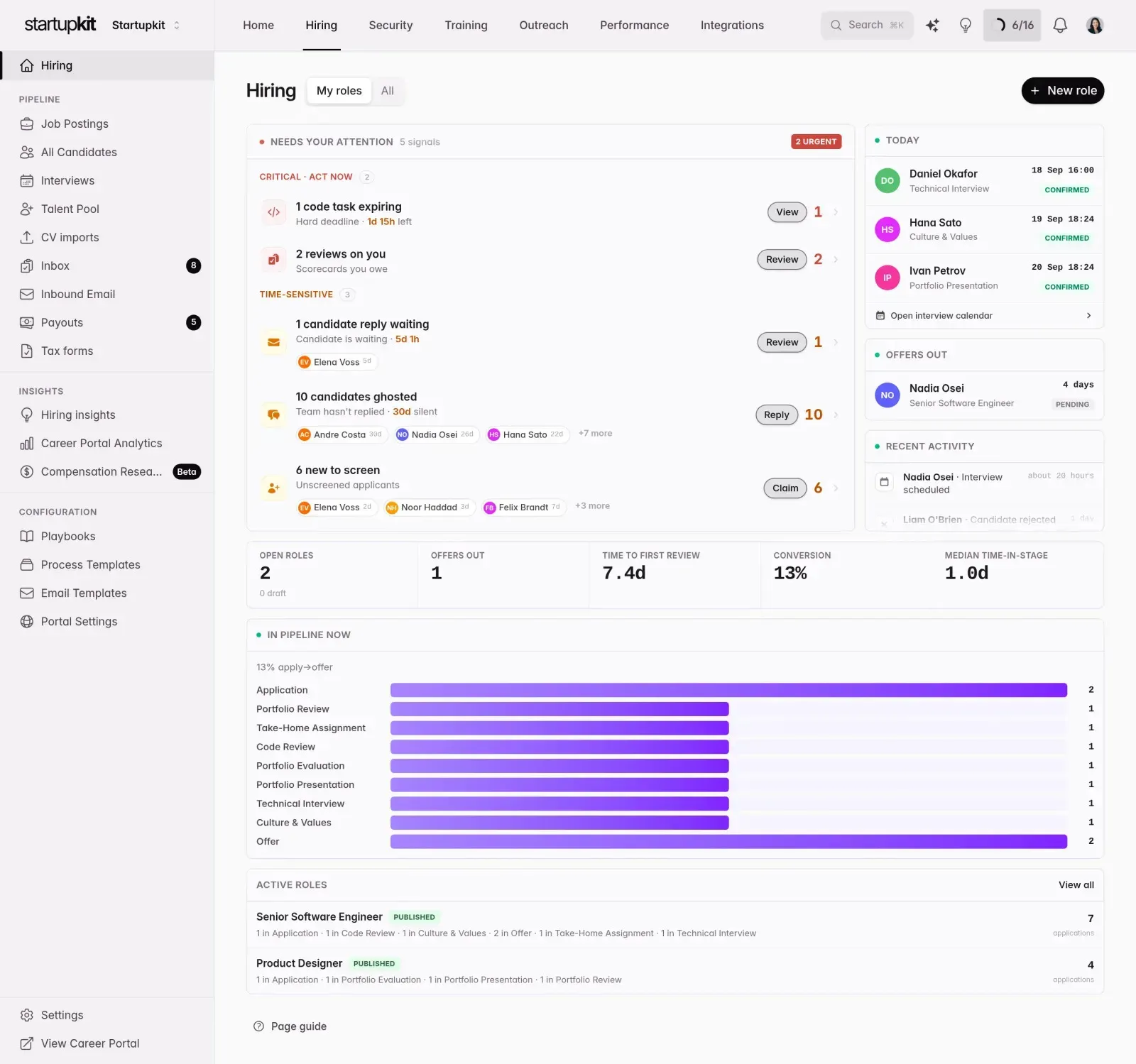
Unified Hiring Pipeline — Kit handles role-specific pipelines with resume extraction, GitHub code assignments, structured team reviews, and interview scheduling. Candidates interact through a magic link on the customer's own careers domain rather than creating an account, while an operator dashboard surfaces what needs attention: reviews awaiting a decision, code tasks nearing expiry, and candidates still without a reply. Twenty prebuilt process templates spanning seven categories give teams a starting structure instead of an empty board.
Vulnerability Disclosure and Bug Bounty Workflow — The security module covers the full disclosure lifecycle: report intake, triage, acknowledgement SLAs, severity assessment, duplicate checks, bounty approval, and audit exports. A worked example on the marketing site shows a stored XSS report with 17 hours remaining on its acknowledgement SLA, a researcher appeal requiring an accept-or-reject decision, and a $1,500 bounty that, once approved, writes a ledger credit and notifies the researcher. Researchers get a portal showing report status, payout state, tax document upload, and appeal options.
Compliance Training with Tamper-Evident Records — Kit ships SOC 2, ISO 27001, GDPR, and HIPAA course decks and records completion in a register with one row per person, including employee ID, department, role, and completion date. Trainees submit their own evidence — for example a screenshot of a locked screen with capture date and device name — through the same magic-link pattern used elsewhere. Registers export to CSV or PDF, and individual evidence bundles can be downloaded for auditors. The company states there are no per-learner fees.
AI-Powered Outreach with Mandatory Approval — Outreach researches prospects one at a time using LinkedIn, company sites, and the customer's own knowledge base, then drafts an email that must be approved before Kit sends it. Replies from every campaign land in a single priority-ordered inbox with detected sentiment, and a silver-medalist tool matches campaign prospects against previous applicants so teams avoid re-contacting people they already turned down.
Agent Access via Model Context Protocol — More than 190 MCP tools let assistants read applications, move stages, approve bounties, check training completion, and inspect campaigns. Each tool declares its behaviour, so a client can tell whether a call merely reads data, makes a destructive change, or contacts someone outside the company, and confirmation prompts appear before consequential actions. A public MCP server is available even before signup.
Included Interview Scheduling — Candidates pick from slots where interviewers are genuinely free, booked through the same link as their application. Interviews attach to the candidate record alongside team feedback, and scheduling can also be triggered by asking an agent to check availability and book on the team's behalf.
Compensation Research (Beta) — Advertised salary ranges are collected from live job postings and refreshed daily, allowing teams to track roles and regions, compare ranges, and export the results. Coverage varies by role and geography, and the company labels the feature beta.
How It Works
A typical deployment begins with account creation and a 30-day trial; a card is captured at signup but not charged during the trial period. From there, an operator selects a hiring template matching the role — for instance software engineer, product designer, or registered nurse — and edits stages, candidate instructions, and timing before publishing. Candidates then receive a private link that opens their own application on the customer's careers domain, where they can check their stage, book an interview, and respond to an offer without registering.
Security follows a parallel path. Reports arrive through the vulnerability disclosure portal, are triaged against severity and duplicate criteria, and are tracked against acknowledgement SLAs. Approved bounties write a ledger credit and notify the researcher, who can follow the same thread, update payout details, and upload tax documentation without emailing the security team.
Training operates on enrolment rather than request. Personnel receive a course link, complete lessons, and submit proof where a checkpoint requires it; the operator watches the completion register fill in and can export it for an auditor. Outreach, when enabled, researches a prospect, drafts a message, and waits for human approval before anything leaves the customer's domain.
Throughout, an assistant connected over MCP can perform the same operations conversationally — listing reports that need attention, checking who has finished training, or advancing a candidate's stage — subject to whatever scopes the customer grants and can revoke.
Use Cases
Founding team scaling past ten employees — A company with no dedicated recruiter copies a junior engineer pipeline template, assigns GitHub code tasks, and routes reviews to engineers through Slack. The operator dashboard flags candidates waiting for a reply, reducing the silent rejections that damage employer brand.
SaaS company running a vulnerability disclosure programme — Instead of a shared security@ inbox, reports land in a triage queue with SLAs, duplicate detection, and severity scoring. When a fix is verified, the bounty is approved and a ledger credit recorded; the researcher sees payout status and tax requirements in their portal, cutting the email back-and-forth that typically surrounds a $1,500 payout.
Compliance-driven organisation preparing for SOC 2 or ISO 27001 — Security awareness training is assigned, completion evidence is captured per person, and the register exports to CSV or PDF on demand. Because evidence bundles include capture date and device, the material survives auditor scrutiny better than an attestation spreadsheet.
Sales or recruiting team running targeted outbound — Outreach researches a defined prospect list, drafts personalised emails that require approval, and consolidates replies with sentiment tags. Silver-medalist matching prevents the awkward case of re-approaching someone who already went through a hiring process.
Engineering organisations delegating routine operations to an AI assistant — An operator asks a connected assistant which reports are approaching their SLA or how many people have completed training. Read-only tools answer without risk; destructive tools require explicit confirmation, and the client is warned when a call would email someone.
Pricing & Value
Kit's seat price is €6,99 per month per team member, with equivalent rates published in dollars, zloty, and pounds. The first 30 days are free, though a payment card is required at signup; billing begins on day 30 unless the subscription is cancelled, and seats can be added or removed with automatic adjustment. Hiring, the full Security workflow, Training, and Compensation Research (beta) are included at that rate. Outreach is the single exception, priced at €17,99 per month as an add-on.
The value proposition rests on consolidation. Teams comparing Kit against a standalone ATS, a bug bounty platform, and a training LMS will usually find the combined seat cost lower, particularly because training carries no per-learner fee and scheduling is bundled rather than sold separately. The trade-off is depth: organisations with mature, specialised requirements in any one area — advanced sourcing analytics, large researcher communities, or detailed LMS certification tracking — may still need a dedicated tool. Startups evaluating current pricing and trial terms should weigh the Outreach add-on explicitly, since it changes the effective cost of the bundle. There is no free tier and no separate startup discount.
Final Verdict
Kit is a well-considered consolidation play rather than a best-in-class point solution. Its strongest asset is the coherence of the underlying model: candidates, researchers, trainees, and agents all operate against the same records, with audit trails and permission scoping applied consistently. The hiring module is unusually complete for the price, training evidence capture is genuinely audit-oriented, and the MCP integration layer is more mature than most competitor offerings, particularly in how it flags destructive operations before execution.
Areas for improvement are equally clear. Outreach sits outside the headline price, the card requirement at signup adds friction to what is otherwise a straightforward trial, and Compensation Research remains beta with uneven coverage. Teams needing deep specialisation in any single discipline will notice the gaps.
For a company of roughly five to fifty people that wants hiring, disclosure handling, compliance training, and light outbound in one place — and that intends to drive it partly through an AI assistant — Kit is a defensible choice. Organisations with existing enterprise contracts in any of the four areas should pilot one module before replacing anything.