Overview
ProspectHalo is a purpose-built AI sales engagement platform that positions itself as a full replacement for a human Sales Development Representative (SDR). Instead of giving users another CRM or dialer, it combines prospect discovery, multichannel outreach, lead scoring, and LinkedIn content publishing into a single autonomous agent that acts from the user’s own LinkedIn and email accounts. The core value proposition is simple: enter a website URL, and the system learns the business, identifies ideal prospects, writes personalized messages, and executes a cadence of LinkedIn connection requests, follow-ups, and email touches.
The product addresses a common pain point for founders, agencies, and small sales teams: the weekly grind of finding leads, verifying fit, writing cold messages, and chasing replies. The website highlights a breakdown of 25+ hours per week spent on manual sales tasks—hours that could go to client work or product development. ProspectHalo competes with tools like Apollo.io and ZoomInfo (the page explicitly lists them as alternatives), but its differentiation lies in being more than a database or enrichment tool. It actively executes outreach and creates content, positioning itself as an AI employee rather than a software utility.
Market positioning is also notable: it integrates with AI agents like Claude, ChatGPT, Cursor, and others via the Model Context Protocol (MCP), enabling users to manage their sales pipeline from within their preferred AI assistant. This forward-looking integration strategy suggests ProspectHalo is aiming not only at traditional sales stacks but also at the emerging ecosystem of agentic AI tools.
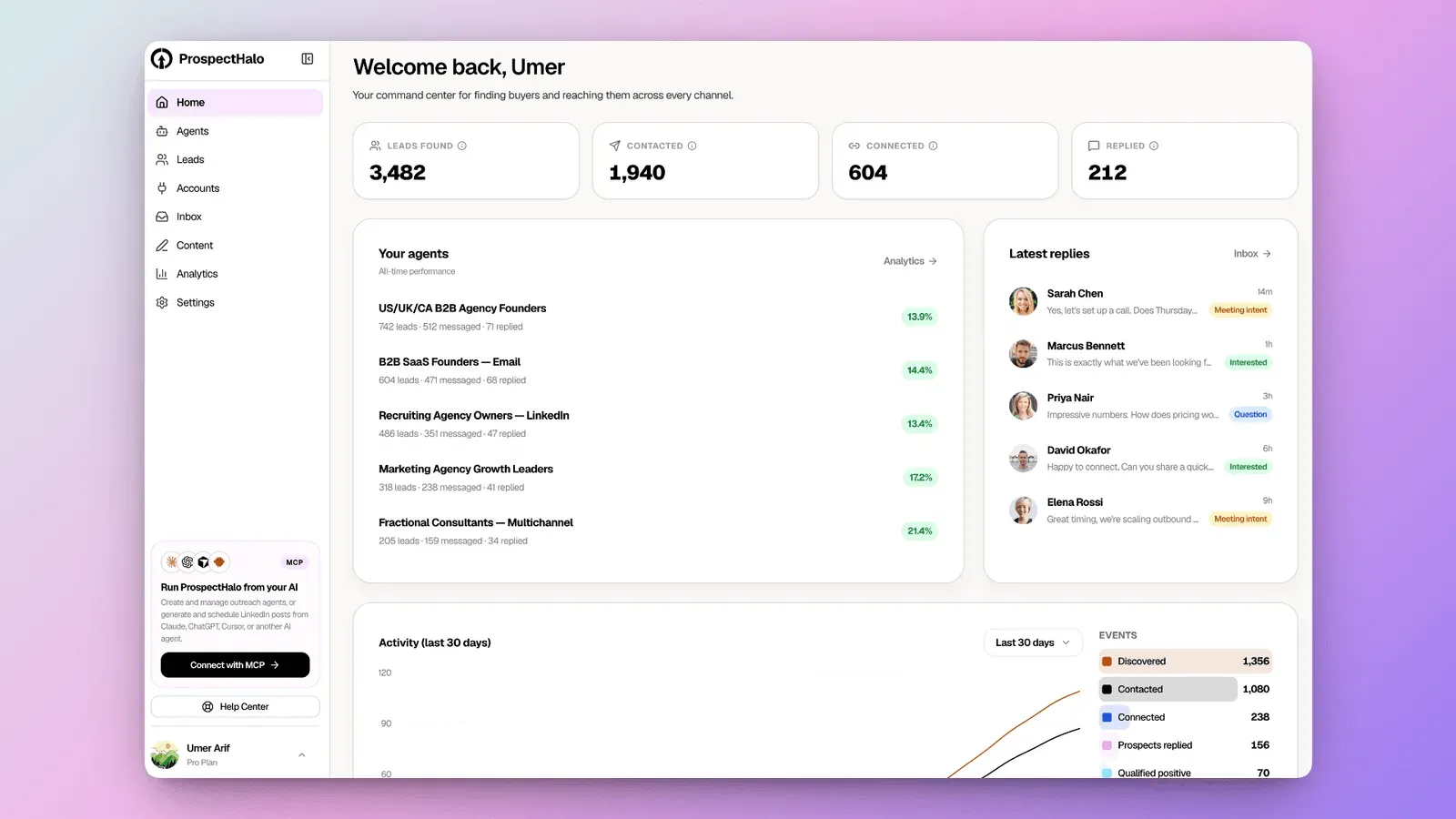
While the platform shares many mechanics with other AI SDRs—like personalized email sequences, intent signals, and automatic follow-up—its tight focus on LinkedIn as the primary source of prospects and its dual inbound/outbound approach (sending cold messages while also publishing content that attracts buyers) sets it apart. The interface is clean, modern, and emphasizes dashboards that show lead scoring, conversation statuses, and campaign outcomes.
Key Features
AI Agent Setup from Website URL — After a user submits their website, ProspectHalo runs an analysis to extract what the company sells, whom it targets, and how to pitch it. This “business understanding” step is designed to eliminate manual configuration. The agent then uses that profile to construct ideal customer profiles and generate messaging. It’s a fast onboarding approach that feels like a dramatic time-saver compared to legacy tools that require importing lists and building complex templates.
Lead Discovery and Scoring via LinkedIn — Rather than relying on purchased contact databases, ProspectHalo pulls prospects from the user’s own LinkedIn account or Sales Navigator. It matches connections, followers, and search results against the ideal customer profile and scores each lead on an intent scale from 0 to 100. The system tracks 18 buying-signal families—hiring SDRs, job changes, competitor engagement, posting about outbound, and similar triggers—to help prioritize prospects who are actively researching or expanding.
Personalized Multichannel Outreach — ProspectHalo sends connection requests and messages on LinkedIn, plus emails through Gmail, Outlook, or Google Workspace. Each message is generated based on the prospect’s individual context and the triggering signal. The platform supports multi-step sequences (e.g., LinkedIn on day 0, email on day 2, follow-up on day 4) and allows users to set safety caps and warmup rules to reduce account ban risk. This is a significant step beyond generic spray-and-pray outreach.
AI LinkedIn Post Generation — For inbound lead generation, ProspectHalo transforms a user’s own writing samples into original LinkedIn posts. The system learns the user’s voice, tone, and vocabulary, then drafts posts on a scheduled cadence. When prospects engage with these posts, they are automatically qualified and added to the pipeline as leads. The platform also links engagement back to the agent, using that context to tailor future outreach messages.
Unified Reply Inbox and Autopilot — All replies from LinkedIn and email land in one inbox, sorted by lead status: Interested, Question, Not Now, and so on. For hot leads, ProspectHalo’s Autopilot can instantly craft a response, propose a meeting time, and share a booking link. If an urgent, high-intent reply requires human attention, the user receives an email alert within the hour. This feature effectively closes the loop between generation and conversion.
MCP Server for AI Agent Integration — A distinguishing technical feature is the built-in Model Context Protocol (MCP) server. This allows users to connect ProspectHalo to Claude, ChatGPT, Cursor, Gemini, or Perplexity, then ask questions like “Which leads engaged last week?” or “Send a follow-up to the opportunity at Acme.” The integration is included on all plans and positions the tool as a backend for AI-powered sales operations.
Safety and Compliance Controls — Sending is paced to mimic human behavior, and accounts are connected through official integrations (no browser automation). Users can set working hours, daily caps, and choose to approve every message before it goes out. The platform also includes disclaimers that users are responsible for following LinkedIn, Google, and CAN-SPAM rules. This pragmatic approach may reassure users concerned about account bans or regulatory compliance.
How It Works
ProspectHalo’s workflow is structured in four distinct phases, all of which operate concurrently once the agent is live.
1. Setup — The user enters their website URL. ProspectHalo scrapes the site and builds a business profile: product category, target personas, and sales pitch. The user can also manually refine the ideal customer profile (ICP) if desired. This setup takes a few minutes and requires no technical skill.
2. Outbound — Every day the agent searches the user’s LinkedIn connections and Sales Navigator results for people matching the ICP. It scores them based on 18 intent signals and then creates personalized LinkedIn and email sequences for new prospects. The user can choose the level of autonomy: approve every message, approve the first touch, or let the agent run all touches automatically. Safety limits (daily caps, working hours, warmup) prevent spamming.
3. Inbound — Simultaneously, the agent generates LinkedIn posts aimed at the ICP, using the user’s writing style. It publishes them on a pre-set schedule. When an ICP engages with a post (likes, comments, clicks), that person becomes a scored lead and enters the pipeline. This creates a compounding source of warm prospects.
4. Closed-Loop Reply Management — Incoming replies from LinkedIn and email are aggregated into a single inbox. Each thread is tagged with a purpose such as “Interested,” “Question,” or “Not Now.” Autopilot can respond to prospects, answer questions, and book meetings directly on the user’s calendar. If a lead seems ready to buy, the user gets notified quickly to take over.
This four-step cycle is designed to be continuous. The agent never sleeps, but controls remain in the hands of the user. It is important to note that the platform depends on LinkedIn’s available search API endpoints; Sales Navigator expands the pool but is not mandatory. In practice, this means account age and connection health can affect results—though the dashboard’s analytics help monitor delivery and reply rates.
Use Cases
Founders of B2B service businesses — Consider a fractional CFO consultancy. A founder can connect LinkedIn and specify a niche like “VC-backed fintech startups going through seed rounds.” ProspectHalo finds founders matching that profile who have recently hired a CFO or announced funding, sends personalized connection requests with that context, and follows up with a message about financial modeling. The service business no longer needs a full-time sales rep to keep appointments full. A testimonial on the site claims a $3,000 client closed within nine days of subscribing to the $59 plan, a 50x return.
Agencies with recurring retainer targets — A web design agency that usually relies on referrals can use ProspectHalo as a consistent lead engine. The outbound agent approaches marketing managers who just published a job for a new brand project, while the inbound agent publishes posts about conversion rate optimization. When a CEO of an e-commerce brand reacts to one of those posts, the system flags that executive as an active lead. The agency can then focus its proposal writing on a handful of warm, signal-driven opportunities rather than mass cold emails.
Consultants and sales coaches — For individual consultants, the cost of a junior SDR is prohibitive, but ProspectHalo’s pricing model aligns with solo operations. A GTM consultant, for instance, can generate LinkedIn posts about sales playbooks and simultaneously send messages to founders of SaaS companies who recently followed a competitor or mentioned “outbound” on LinkedIn. The unified inbox keeps all conversations in one place, eliminating the need for a separate CRM in the early days.
Small sales teams extending capacity — Even when a company has two or three AEs, they can use ProspectHalo to feed top-of-funnel leads to the SDR. Because the agent handles monotonous work—list building, first touches, follow-ups—the sales team spends time only on qualified conversations and closing. The platform’s team plan (Growth) adds shared workspace features and unlimited team members, which enables managers to see a unified view of campaigns.
Marketing professionals building a brand from sales activity — Some users may not want to run high-volume cold outreach at all. ProspectHalo can be configured to focus purely on LinkedIn content creation and lead capture from engagement. The AI-written posts still drive leads into the pipeline. This hybrid model provides an entry point for marketers who want to test the tool without turning on aggressive outbound.
Pricing & Value
ProspectHalo offers three pricing tiers, all of which include access to every core feature and an MCP server. The Pro plan is priced at $59 per month, but with annual billing it drops to $47.20 per month. Pro includes 2,000 discovered prospects per month, 2 sending accounts (LinkedIn and email combined), 2 AI agents, 35 LinkedIn posts, 24/7 prospecting, lead scoring, email waterfall enrichment, and a unified inbox. The Growth plan costs $100 per month monthly or $80 per month annually. It doubles nearly every limit: 4,000 prospects, 4 senders, 4 agents, and 100 LinkedIn posts, and also allows unlimited team members. A Custom plan starts at $160 per month and introduces custom agent counts, prospect volume, post volume, and dedicated success management. All paid plans begin with a 7-day free trial for Pro and Growth, after which the requirement to supply a credit card is unclear (the page states “Cancel before your trial ends and you will not be charged”).
Compared to hiring even a part-time SDR—let alone a full-time one at $5,000 per month—the pricing is attractive. However, the limits on prospect discovery and sending accounts may constrain teams that handle more than a few hundred leads per month. For companies that use Sales Navigator, note that the cost of that subscription isn’t included in the plan. Also, the tool’s capacity is driven by the number of AI agents: each agent works a different targeting angle; a Pro plan’s two agents can be used for separate ICPs. There are no explicit overage charges, which is a fair policy—when a limit is hit, the agent pauses until the next billing cycle.
For a solo founder or small agency, Pro offers a clear ROI, as illustrated by testimonials. For larger teams, Growth unlocks more capacity and may still be cheaper than a cheap overseas SDR. The main value is not just in lead generation but in time savings: the platform automates research, writing, and part of the follow-up process. Check out their pricing page for more details.
Final Verdict
ProspectHalo is a sophisticated AI sales agent that compresses multiple sales functions into one autonomous workflow. Its key differentiators—website-based setup, LinkedIn as a primary source, intent-based scoring, inbound content engine, and MCP integration—are all designed with current sales pain points in mind. For founders and small sales teams that already live on LinkedIn, the platform offers an exceptionally practical way to manage outbound and inbound simultaneously without outsourcing or hiring. Testimonials from recognizable agencies and SaaS companies give credibility to its effectiveness, and the safety controls are a pragmatic answer to users’ fears about account suspension.
Weaknesses are also apparent. The product’s reliance on LinkedIn means that results are inherently constrained by the quality and connection depth of a user’s network. Buyers outside B2B (e.g., local service businesses or consumers) will find little value. The AI-generated content and messaging—though personalized—may occasionally miss complex cultural or industry nuances, requiring oversight. Pricing is transparent, but the volume limits can quickly become insufficient for firms with larger growth plans, which pushes users toward more expensive tiers. Additionally, the platform does not appear to offer outbound phone calls or multi-channel chat (e.g., SMS), so it is not a complete full-funnel solution.
Overall, ProspectHalo is a powerful example of how AI is transforming the sales development role. It is best suited for B2B founders and revenue teams that want to systematize their lead generation and maintain a presence on LinkedIn without devoting half of their working week to manual tasks. For anyone evaluating an AI SDR substitute, it’s worth a closer look at their feature list and integration options.