Overview
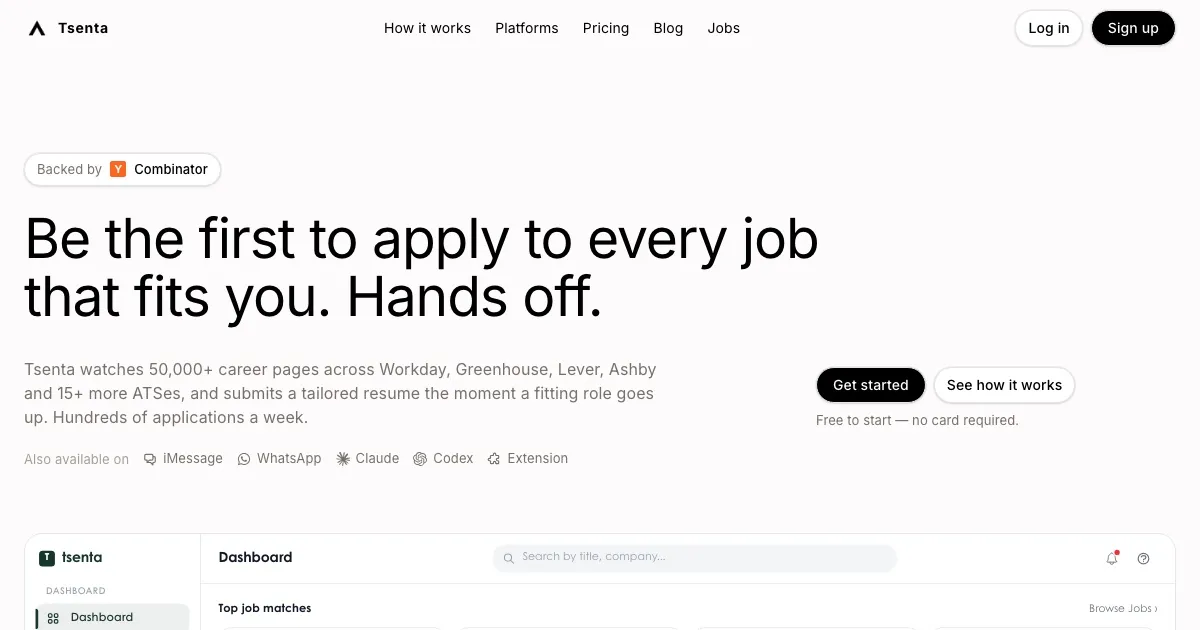
Tsenta is an AI-powered job application agent designed to automate the entire job application process. It monitors over 50,000 company career pages and 15+ applicant tracking systems (ATS) including Workday, Greenhouse, Lever, and Ashby. When a matching role appears, Tsenta tailors a resume and cover letter, fills out the application form, and submits it—all without manual intervention. The product is backed by Y Combinator and targets job seekers who want to be among the first applicants for relevant positions. Tsenta operates across multiple platforms: a web dashboard, iMessage, WhatsApp, a Chrome extension, and an MCP/CLI interface for developer agents like Claude Code. The service offers a free tier with 25 applications and paid plans starting at $19/month for 600 applications.
Key Features
Automated Job Discovery: Tsenta continuously scans 50,000+ company career pages. When a new role matches the user's resume and preferences (location, salary, experience, role type), it appears in the match feed within seconds with a match percentage and explanation. Users can also paste any job URL to add it to their queue.
Tailored Resume and Cover Letter: For each application, Tsenta reads the job description, identifies keywords and skills, and rewrites the user's resume to align with the role—using only factual information from the uploaded resume. Changes are shown as a diff (additions/removals) before submission. Cover letters are generated in the user's voice based on provided context.
Multi-ATS Application Submission: Tsenta supports 19 ATS platforms including Workday, Greenhouse, Lever, and Ashby. It logs into the system, fills every field (including open-ended questions), uploads the tailored resume, and submits the application. Users receive a receipt showing exactly what was sent.
Cross-Platform Access: The service is available via a web dashboard, iMessage/WhatsApp messaging (users can reply "yes" to apply), a Chrome extension that auto-fills job postings, and an MCP server/CLI for AI agents like Claude Code and OpenClaw.
Application Tracking and Inbox Management: Tsenta automatically routes recruiter emails to the correct application, updates statuses (applied, viewed, replied, interview), and provides a pipeline view. Users can see how many applications are in each stage without manual filing.
Approval Workflow: Before any application is sent, Tsenta shows the tailored resume changes and allows users to edit or approve. Nothing is sent silently—users have control over each submission.
How It Works
The user journey begins by signing up on the Tsenta dashboard and uploading a resume. The user sets preferences such as desired roles, locations, salary range, and work authorization status (e.g., OPT, H-1B sponsorship needed). Tsenta then starts scanning 50,000+ career pages in real time.
When a matching job is found, it appears in the user's feed with a match score. The user can review the job and choose to apply. Tsenta then reads the job description, tailors the resume and cover letter, and presents the changes as a diff. The user can edit or approve the materials.
Once approved, Tsenta opens the ATS form (e.g., Workday), fills in all fields—name, email, LinkedIn, resume upload, work authorization, and open-ended questions—and submits. The user receives a receipt showing exactly what was sent and the time taken. Recruiter replies are automatically routed back to the correct application in the dashboard.
Use Cases
Active Job Seeker: A software engineer looking for a new role can set up Tsenta to monitor hundreds of company career pages. Within days, they receive matches and can approve applications. The system submits tailored applications while the user focuses on interview prep.
Laid-off Professional: Someone who lost their job and needs to apply broadly can use the Pro plan (1,500 applications/month) to blast applications to every fitting role. Tsenta handles the volume, ensuring the user is among the first 100 applicants.
OPT/International Student: A student on OPT needing sponsorship can set work authorization filters. Tsenta automatically answers work authorization questions correctly and filters out roles that don't sponsor, saving time and reducing errors.
Developer Using AI Agents: A developer using Claude Code or similar tools can integrate Tsenta via MCP/CLI. They can type "apply to the new Stripe role" and the agent submits the application in seconds, updating the tracker automatically.
Passive Job Seeker: Someone not actively looking but open to opportunities can use the iMessage integration. Tsenta texts them when a high-match role appears; they reply "yes" and the application is submitted without opening a browser.
Pricing & Value
Tsenta offers three paid tiers: Starter ($19/month for 600 applications), Pro ($39/month for 1,500 applications), and Power ($99/month for 4,500 applications). All plans include the full feature set—only the application volume differs. There is also a free tier with 25 applications, no credit card required. Users can cancel anytime. The pricing is competitive compared to manual application services or virtual assistants. For active job seekers, the Pro plan at $39/month offers good value given the time saved. However, the cost scales with volume, and heavy users may find the Power plan necessary.
Final Verdict
Tsenta is a powerful tool for automating job applications, particularly for tech roles. Its strength lies in its broad ATS coverage, real-time monitoring, and transparent approval workflow. The multi-platform support (web, iMessage, Chrome, CLI) makes it flexible for different user preferences. However, the service is primarily designed for software engineers and similar roles—non-tech job seekers may find fewer matching opportunities. Additionally, the reliance on AI for resume tailoring may occasionally produce less-than-ideal phrasing, though the approval step mitigates this. Overall, Tsenta is a solid choice for anyone looking to scale their job search efficiently. For more details, check out their pricing or see how it works. You can also read their blog for updates.