Overview
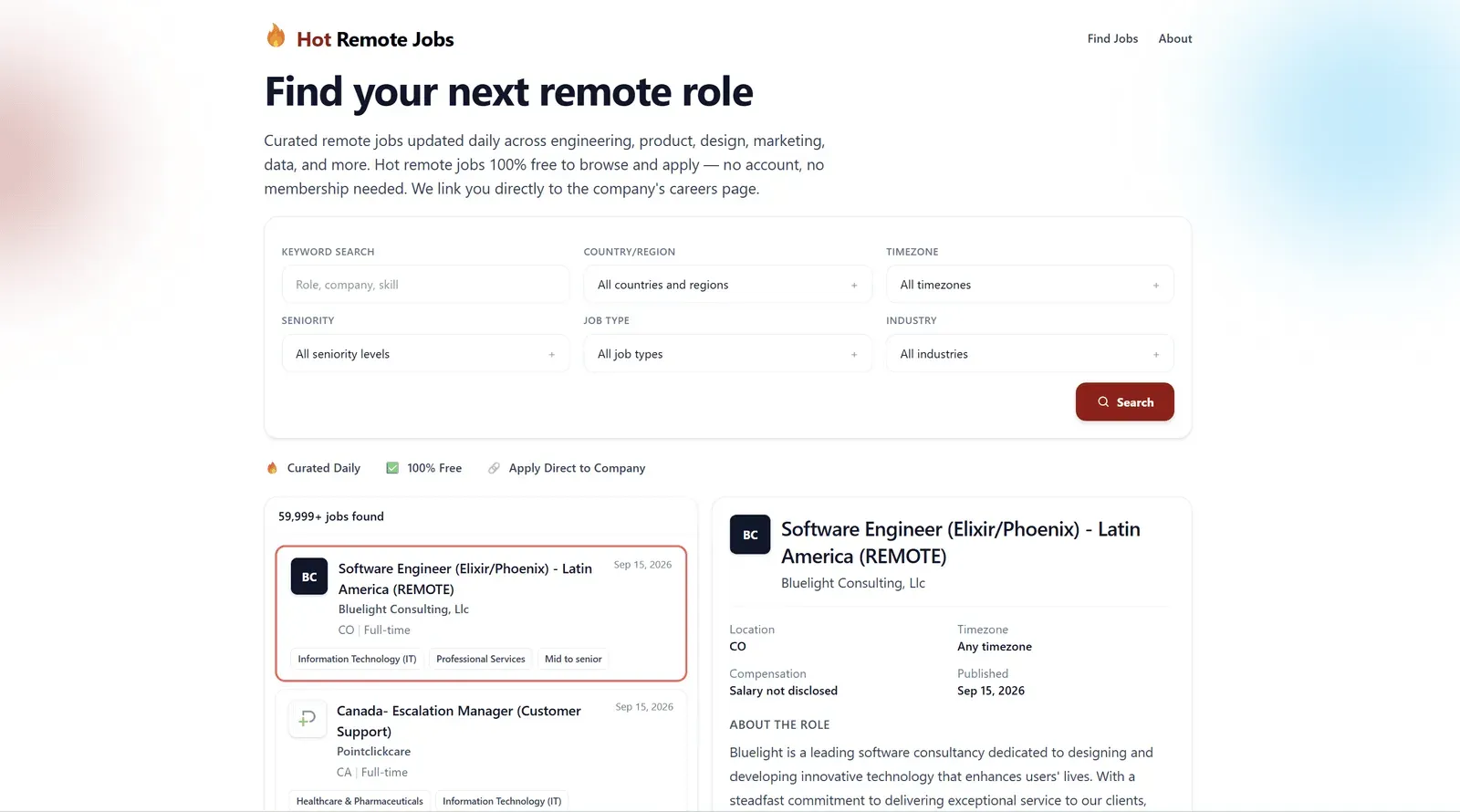
Hot Remote Jobs is a browser-based job board devoted entirely to remote positions, operating from hotremotejobs.co. It presents a claimed pool of more than 59,999 open roles through a filter-driven interface and requires no account, no subscription, and no paywall to browse or apply. The premise is deliberately narrow: help candidates locate a remote role quickly, then hand them off directly to the hiring company's own careers flow rather than trapping the application inside a proprietary portal.
The underlying problem is familiar to anyone who has searched for remote work. The landscape is fragmented across employer career pages, generalist aggregators padded with expired postings, and premium boards that hide contact details behind recurring fees. Hot Remote Jobs competes on two vectors instead. The first is openness — every listing is visible on arrival. The second is cadence: the index is described as curated and refreshed daily, and role families are split into dedicated collections so that candidates do not have to sift through irrelevant functions.
Positioning-wise, the site sits in the broad-spectrum category rather than a vertical niche. Coverage spans engineering, product, design, marketing, data, customer service, finance, legal, and even skilled trades, with geographic segmentation into Europe, the United States, and worldwide-eligible roles. That breadth matters, because a board that only indexes software engineering candidates eventually runs out of inventory for career switchers and non-technical professionals.
Equally important is what the product is not. There is no résumé builder, no application status tracking, and no employer dashboard described anywhere on the surface. Hot Remote Jobs is a discovery and routing layer, not an applicant tracking system — a distinction that shapes both its strengths and its limits.
Key Features
Daily-curated index of roughly 60,000 roles. The homepage displays a live counter above the results (59,999+ at the time of review) and labels the collection "Curated Daily." The volume is less interesting than the range: alongside the expected engineering and data roles, the reviewed page returned a journeyman plumber, a commercial/transactional lawyer, a senior accountant, and several AI trainer positions.
Six-axis smart filter panel. A single form combines a keyword field ("Role, company, skill") with dropdowns for Country/Region, Timezone, Seniority, Job Type, and Industry. The panel collapses behind a "Show filters" toggle on narrow viewports, which keeps mobile scanning fast. The timezone selector is the most distinctive control here: for distributed candidates it is often more actionable than a country filter, since many employers hire across borders but constrain overlapping working hours.
Direct application handoff. Every listing carries an explicit link that pushes the candidate toward the employer's own application path, and the interface states plainly that applications are routed to the company's careers page. Candidates therefore do not rebuild a profile for each board they visit, and scheduling remains under the employer's control.
Data-rich detail views. Each role exposes Location, Timezone, Compensation (where supplied), and Published date, followed by an "About the role" excerpt. In the sample reviewed, a Senior Accountant posting at Binance.US carried a $130,000/yr compensation figure and an "Any timezone" designation, while location-scoped roles were tagged as US or UA. These structured fields make the board useful for comparison shopping, not just browsing.
Role-, location-, and demand-based landing pages. Footer navigation points to pre-filtered collections such as Software Engineer, Product Manager, Product Designer, DevOps & Cloud Engineer, Paid Media & Growth, and AI Prompt Engineer roles, alongside regional hubs. These pages function as SEO entry points that capture long-tail queries, and they give candidates a shortcut into the taxonomy without configuring filters manually.
Industry classification on every card. Listings carry vertical tags — Information Technology, Banking & Finance, Biotechnology, Healthcare & Pharmaceuticals, Retail, Entertainment & Media, Professional Services — so job seekers can screen for sector fit rather than function alone.
Frictionless access model. There is no sign-up wall, no free-trial gate, and no per-application credit system. The entire catalog is reachable within a single page load or two clicks, which is unusual in a market where most boards meter access to contact details.
How It Works
The typical journey begins on the homepage, where a hero section ("Find your next remote role") states the value proposition and a paginated results grid sits immediately below it. Listings are rendered client-side — a "Loading jobs..." placeholder occupies the results container in the initial HTML — so the visible catalog depends on JavaScript execution rather than static markup. Each result card shows the employer name, an abbreviated region (US, Worldwide, UA), employment type (the sample set was uniformly Full-time), a publish date, and one to three industry chips.
From the grid, a candidate can either expand the smart filter panel or open an individual role. Filtering happens in place: keyword, country/region, timezone, seniority, job type, and industry can be combined before a search is submitted, and the footer's pre-built collections serve as shortcuts into the same dataset for anyone who would rather not configure controls.
Opening a listing reveals the structured detail panel described above, a truncated role summary, and the application affordance. Two calls to action appear: an "Apply via Email" link that routes through a third-party onboarding page, and a "Full Details" permalink back onto the board itself. The permalink pattern is slug-based and includes a unique identifier along with a region prefix, which makes individual postings shareable and indexable.
Finally, pagination at the bottom of the results set moves through the catalog a page at a time, with numbered buttons and a "Next" control. There is no evident saved-search mechanism, alert subscription, or candidate profile, so the workflow terminates once a candidate leaves for the employer's site.
Use Cases
Timezone-constrained senior engineers. A developer who needs a role overlapping US business hours can filter by both Country/Region and Timezone, then scan only postings tagged Full-time and Mid-to-senior, cutting a 60,000-item index down to a shortlist in a few interactions.
Career switchers entering AI-adjacent work. The reviewed results included multiple "Biology Expert – AI Trainer" positions at Anyone Ai, scoped separately to Chile and Denmark but listed as worldwide-eligible. This illustrates a concrete outcome: subject-matter specialists can find domain-expertise roles in AI without holding a machine-learning title.
Compensation benchmarking for recruiters and analysts. Because detail pages surface pay where available — the $130,000/yr Senior Accountant example being a case in point — talent teams and researchers can sample advertised remote salaries by function and region without contacting employers.
Non-technical remote candidates. Accountants, transactional lawyers, plumbers, SEO specialists, and growth marketers all appeared in a single page of results, which means professionals outside software can use the board as a primary source rather than an afterthought.
Market mapping for job-board builders. The distribution of tags, regions, and industries across listings offers a readable snapshot of where remote hiring is concentrated, useful for anyone studying the remote-work economy or building remote jobs by location style collections of their own.
Pricing & Value
Hot Remote Jobs is free in the most literal sense: no tiers, no membership, no paid unlock, and no account creation are described anywhere in the product. For pure discovery, the value-for-money calculation is therefore trivially favorable — nothing is charged for functionality that competing boards frequently place behind a subscription.
The caveat worth noting is monetization opacity. The "Apply via Email" action routes to a third-party onboarding site (hosted on a separate subdomain) that offers to "Automatically send your Resume to the hiring managers." That is a lead-generation funnel layered on top of the free board, and candidates should understand the exchange before submitting personal data. The browse-and-apply-directly path remains genuinely costless; the value proposition only changes once a job seeker steps into that assisted-application flow.
Final Verdict
Hot Remote Jobs does one thing and mostly does it well: it makes a large, frequently refreshed pool of remote roles reachable without cost or friction. The six-dimension filter set, structured detail pages with compensation data, and broad functional coverage make it credible for both technical and non-technical candidates. The direct handoff to employer career pages is the right architectural decision — it avoids ghost applications and keeps candidate data out of yet another proprietary silo.
The limitations are structural rather than cosmetic. There is no saved search, alert, or candidate profile, so the tool functions as a recurring manual visit rather than a passive pipeline. Listings are aggregated without a visible verification layer, and the presence of future-dated timestamps (several postings were stamped Sep 18, 2026) alongside a 2026 copyright line hints at feed-synchronization quirks that could confuse users about freshness. The assisted-application funnel also deserves clearer disclosure.
For job seekers who prefer to scan, filter, and apply directly, Hot Remote Jobs is a practical daily-use resource — particularly for career switchers and non-engineering roles that specialized boards overlook. Those who need alerts, tracking, and curated employer verification should pair it with a second tool; those who want an unfiltered view of the remote market can start here. Anyone curious about the project's stated principles can read the site's about page, and candidates who want a faster entry point can browse remote roles by function instead of configuring filters manually.