Overview
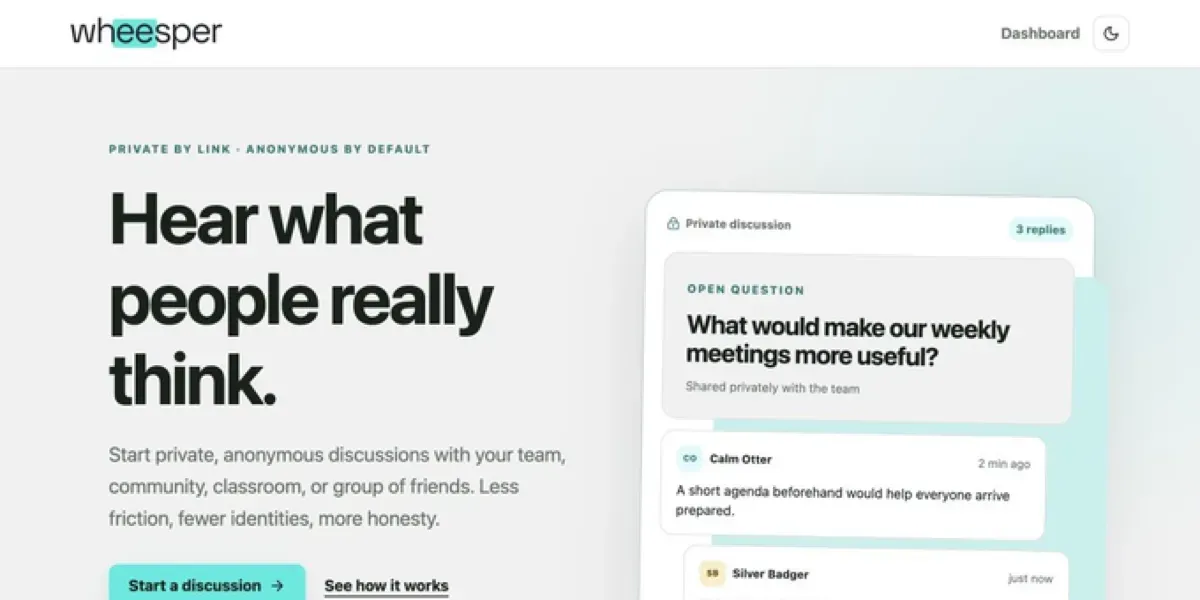
Wheesper addresses a fundamental challenge in online discourse: the chilling effect of persistent identity. In traditional forums, even pseudonymous usernames accumulate a history that can discourage candid participation. Wheesper solves this by creating fully isolated discussion spaces where each participant receives a fresh, disposable pseudonym per thread. There are no user accounts, no public profiles, and no searchable posting history. The platform is designed for situations where honest feedback is critical but social or professional risks inhibit openness—such as workplace retrospectives, classroom Q&A sessions, community feedback, or creative critique.
Wheesper positions itself as a lightweight, purpose-built tool rather than a full-featured community platform. It does not compete with Slack, Discord, or Reddit; instead, it fills a niche for ephemeral, anonymous conversations that need to happen once and then disappear. The interface is minimal, focusing on threaded replies and creator controls. The service appears to be free, with no pricing information on the landing page, suggesting a straightforward, accessible model. Its market positioning emphasizes privacy by design and simplicity, appealing to teams, educators, and creators who need occasional anonymous input without the overhead of managing accounts or permissions.
Key Features
Private Link Sharing: Each discussion is accessed via an unguessable URL. No posts appear in public feeds, search engines, or directories. The only way to participate is to receive the link directly from the creator. This ensures conversations remain contained to intended participants.
Fresh Pseudonyms Per Thread: Participants are automatically assigned a random pseudonym when they join a discussion. This pseudonym is unique to that thread and cannot be traced back to a user or across different discussions. The feature directly addresses the problem of posting history making pseudonyms identifiable over time.
Threaded Replies: Responses are organized in threaded format, making it easy to follow sub-conversations. This structure is critical for discussions with multiple topics or where follow-up questions arise. The interface uses simple refresh to load new replies, keeping the experience lightweight.
No Account Required: Participants do not need to sign up or log in. The discussion creator simply generates a link and shares it. This eliminates barriers to entry and ensures that anonymity is baked into the experience from the start—no email, password, or profile creation.
Creator Controls: The person who starts a discussion has the ability to moderate or manage the conversation. Though details are sparse on the landing page, the inclusion of a dashboard suggests creators can view active discussions, possibly delete threads, or manage links.
Use Case-Specific Prompts: The website explicitly suggests example questions for teams, communities, classrooms, artists, and friends. These prompts are not a feature per se but reflect the platform’s design philosophy—helping users frame questions that elicit honest responses.
Minimalist Interface: The design prioritizes clarity. A clean header with navigation to FAQ, Dashboard, and Start a discussion, plus a theme toggle. The main content uses large headings and short paragraphs, making it easy to understand the value proposition quickly.
How It Works
The user journey on Wheesper is intentionally straightforward. First, a creator visits the homepage and clicks the call-to-action button "Start an anonymous discussion" or navigates directly to /start. There, they likely compose a question or topic and generate a unique link. The landing page does not detail the exact form, but the flow logically involves typing a question and receiving a shareable URL.
Second, the creator shares this link with intended participants—via email, messaging apps, or embedding in a private document. There is no public listing, so distribution relies entirely on the creator. Recipients click the link and land on the discussion page. They see the question and a text input to reply. They are automatically assigned a pseudonym (e.g., "BlueFox42") that is displayed alongside their comment. They can also reply to others’ comments using the threading system.
Third, the conversation unfolds in real-time. Participants refresh the page to see new replies. The creator can monitor the discussion from the dashboard, though the extent of control (e.g., deleting comments, closing the thread) is not explained on the landing page. Once the conversation concludes, the link can be discarded. Since there is no persistent profile, there is no record of participation across different discussions.
The entire flow requires no technical setup, integration, or account creation. This low friction is central to the product’s appeal: it takes less than a minute to start a discussion and share it.
For more details, you can check their FAQ page, which likely answers questions about anonymity, data retention, and moderation.
Use Cases
Workplace Retrospectives: A team manager wants honest feedback about a recently completed project. Using Wheesper, they create a discussion with questions like "What could we have done better?" or "What issues did you encounter but not report?" Team members reply under fresh pseudonyms, eliminating fear of reprisal. The manager receives candid insights that might otherwise be suppressed in a meeting or shared document.
Classroom Q&A: A professor notices students are hesitant to ask clarifying questions in class. They start a Wheesper discussion after each lecture, asking "Which concept from today is still confusing?" Students can answer anonymously, without worrying about appearing unintelligent. The professor adapts the next lesson based on the aggregated responses.
Community Feedback: A local community group wants to gauge satisfaction with a recent event. The organizer creates a discussion titled "What should we change about our next event?" Members contribute opinions without fear of social judgment. The anonymity encourages more critical and constructive feedback than a public survey would.
Creative Critique: An artist shares a draft of a song or painting with a select group. Instead of receiving polite praise influenced by the critic’s relationship to the artist, Wheesper allows raw, honest reactions. The artist gains unfiltered perspectives that genuinely inform revisions.
Friend Group Planning: A group of friends planning a trip wants to know everyone’s budget and preferences without awkwardness. One person creates a discussion with questions like "What can everyone comfortably spend?" and "Which activities excite you most?" Friends answer truthfully, leading to a plan that respects everyone’s limits.
Pricing & Value
As of the landing page analysis, Wheesper appears to offer its service for free. There is no pricing page or mention of paid tiers. The absence of monetization signals suggests the platform may be in an early stage, supported by alternative funding, or plans to introduce premium features later. For users, this makes the value proposition extremely strong: unlimited anonymous discussions with no upfront cost.
However, the lack of pricing transparency raises questions about long-term sustainability. Users should verify current pricing on the website or check for any subscription models that may have been introduced since this review. If the service remains free, it is an exceptional tool for spontaneous anonymous conversations. Even if a paid plan emerges later, the core functionality—private links, fresh pseudonyms, and threaded replies—is likely to remain accessible at a low cost.
For comparison, similar tools like Grapevine or Poll Everywhere offer anonymous feedback but often require per-user licensing or poll credits. Wheesper’s approach is simpler and more open-ended, which may provide better value for teams that need ongoing, unstructured discussions rather than one-off polls.
Visit the start a discussion page to experience the flow firsthand.
Final Verdict
Wheesper succeeds in its mission: creating a frictionless, truly anonymous space for honest conversation. Its strengths lie in simplicity, privacy by design, and the clever use of per-thread pseudonyms to break the link between identity and posting history. The platform is ideal for teams, educators, and creators who need occasional, candid feedback without the overhead of accounts or complex setup.
That said, the platform has clear limitations. There are no moderation tools visible, which could lead to abuse or spam in open discussions. The lack of integrations (Slack, email notifications, etc.) means users must manually check for new replies. And because discussions are only accessible via shared links, they are not discoverable—this is a feature for privacy but a drawback for building ongoing communities.
For its intended use cases—one-off or infrequent anonymous discussions—Wheesper is highly effective and offers excellent value, especially while it remains free. It is a thoughtful alternative to traditional forums and survey tools, putting anonymity front and center.
For more about how the platform handles your data, review their privacy policy.