Overview
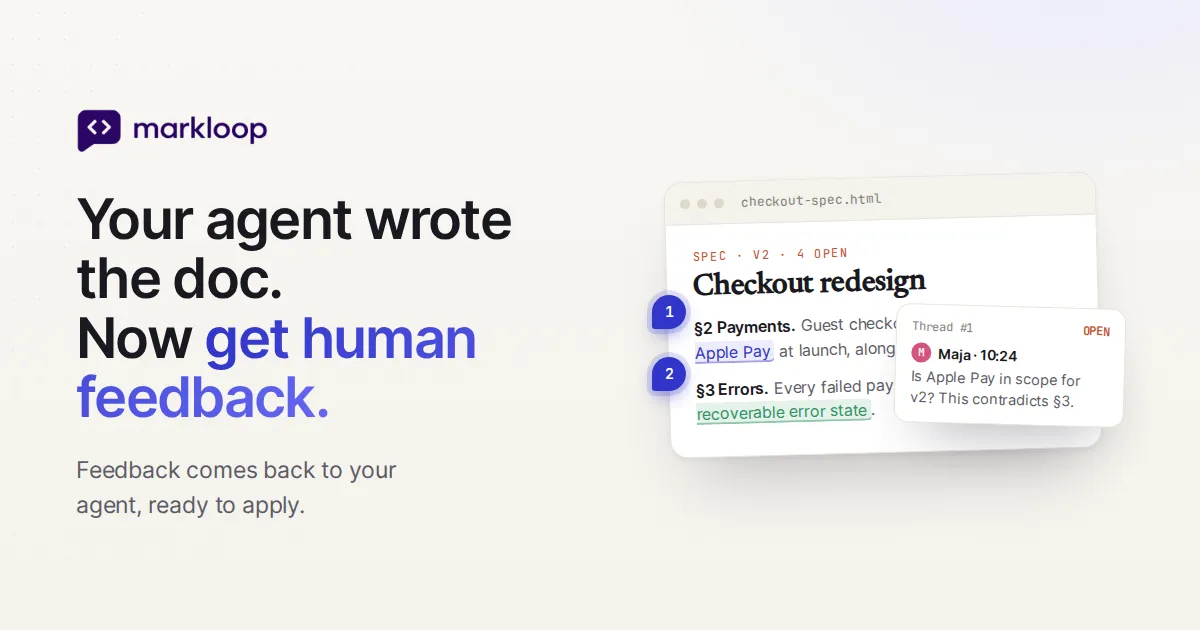
Markloop is a specialized web application designed to bridge the gap between AI coding agents and human reviewers. As AI agents increasingly produce not just code but also documentation, specifications, reports, and proposals in HTML format, the need for a structured feedback loop has become critical. Markloop addresses this by providing a platform where these agent-generated HTML documents can be shared with human reviewers, who can then leave anchored comments and answer embedded questions directly in context. The feedback is then packaged into a structured format that the AI agent can consume—either via MCP (Model Context Protocol) for Claude Code and Codex, or as plain files for any other agent. This eliminates the common pain points of formatting loss when pasting HTML into Google Docs, scattered feedback across Slack and email, and the manual effort of translating comments back into prompts for the agent.
Markloop positions itself as a niche tool for a growing workflow: developers and teams who rely on AI agents to draft technical documents and need a streamlined way to get human sign-off. It competes indirectly with general-purpose collaboration tools like Google Docs and Notion, but differentiates by preserving the original HTML structure, anchoring comments to specific elements and text quotes, and providing an agent-ready export format. The product is built by a small team and is currently in its early stages, offering founding pricing for early adopters.
Key Features
Anchored Comments – Markloop allows reviewers to pin comments to specific sections or even individual sentences within an HTML document. Comments remain attached to the exact version they were made on, ensuring context is preserved even as the document evolves. This is particularly valuable for dense technical specs where precision matters.
Agent-Ready Feedback Package – Every comment is exported with its CSS selector, exact text quote, reviewer intent, surrounding context, and version number. This structured data can be consumed by AI agents via MCP or as a plain markdown file, enabling the agent to understand and apply feedback without manual interpretation.
Version Tracking with Address Status – Each upload creates a new version in a chain. Comments are tied to the version they were made on, and as new versions are published, Markloop tracks which comments have been addressed. Open questions remain visible for the next review round, creating a clear audit trail.
Unlimited Free Reviewers – Unlike many collaboration tools that charge per reviewer, Markloop allows unlimited viewers to comment and answer questions at no additional cost. This makes it practical for involving clients, stakeholders, or external partners without worrying about seat licenses.
MCP Integration for Claude Code and Codex – Native support for the Model Context Protocol allows AI agents to push documents to Markloop and pull feedback directly from the terminal. This tight integration reduces friction for developers already using these coding agents.
Read-Only Sharing with Access Controls – Documents can be shared as private or public read-only links with optional expiry dates and version visibility controls. Reviewers see the rendered document in the browser, not the raw HTML source, providing a layer of security.
Embedded Questions and Decisions – Creators can embed open questions directly into the document for reviewers to answer. These answers are then included in the feedback package sent back to the agent, helping resolve ambiguities without back-and-forth emails.
How It Works
The typical workflow in Markloop follows a five-step loop: Add, Share, Collect, Pull, Apply.
First, the user uploads an HTML document—either manually through the web interface or via MCP from their AI agent. The document becomes a versioned artifact within a project. Projects serve as containers for related files, versions, comments, and invited viewers.
Next, the user shares the document with reviewers. They can invite people to a project as Viewers, who can comment and answer questions, or share a single read-only link for those who only need to review. Access controls allow setting expiry dates and version visibility.
Reviewers then interact with the document directly in their browser. They can pin comments to specific elements, answer embedded questions, and see the discussion in context. No agent or special software is required on their side.
Once feedback is collected, the user's AI agent pulls the structured feedback package over MCP or as plain files. The agent receives each comment with its target selector, quote, intent, and version context, enabling it to understand and apply changes locally.
Finally, the agent applies the changes and publishes a new version back to Markloop. The platform marks addressed comments and leaves open questions for the next iteration, completing the loop.
Use Cases
Product Managers and Founders – When an AI agent drafts a product requirements document (PRD) or specification, the PM can share it with stakeholders for sign-off. Reviewers comment on specific sections, answer embedded questions about scope or priorities, and the agent incorporates the feedback into the next version. This accelerates the specification review cycle.
Engineering Teams – Technical design documents, RFCs, and architecture proposals generated by AI agents can be reviewed by senior engineers. Anchored comments allow precise feedback on complex topics like system flows or API designs. Version tracking ensures that all concerns are addressed before implementation begins.
Consultants and Agencies – Client deliverables such as audit reports, proposals, or strategy documents can be shared as polished HTML artifacts. Clients comment and answer questions in context, and the feedback is packaged for the agent to apply. This maintains a professional presentation while streamlining revisions.
Solo Developers and Freelancers – Individual developers using AI coding agents can share agent-generated documentation with clients or collaborators without losing formatting. The unlimited free reviewer model means they can involve multiple stakeholders without additional cost.
Research and Analysis – AI-generated research reports, market analyses, or competitive intelligence documents can be reviewed by subject matter experts. Embedded questions help clarify assumptions, and the structured feedback ensures the agent can refine the analysis accurately.
Pricing & Value
Markloop offers two paid tiers: Solo at $19/month (or $15/month billed annually) and Team at $49/month (or $39/month billed annually). Both plans include a 14-day free trial with no credit card required. The Solo plan provides one creator seat, unlimited projects, documents, versions, and reviewers, plus MCP integration. The Team plan adds up to five creator seats, a shared workspace, team roles and permissions, removal of Markloop branding, and priority support.
For early adopters, Markloop offers founding prices that are locked in. Given that reviewers are always free, the pricing is competitive compared to tools like Notion or Google Workspace, especially for teams that need to involve many external reviewers. The main cost consideration is the number of creator seats—users who need more than five creators may need to contact sales for custom pricing.
Final Verdict
Markloop fills a genuine niche for teams and individuals who regularly use AI agents to generate HTML documents and need a structured human review process. Its strengths lie in preserving document fidelity, providing anchored comments, and packaging feedback in an agent-consumable format. The MCP integration for Claude Code and Codex is a standout feature that reduces friction in the workflow.
However, the product is still early-stage, which means some polish and features may be missing. The requirement for documents to be self-contained HTML files limits its applicability to live websites or multi-page applications. Additionally, teams that do not use AI coding agents extensively may find the tool less relevant.
Overall, Markloop is a well-conceived solution for a specific problem. It is recommended for developers, product managers, and consultants who want to close the loop between AI-generated drafts and human approval without becoming the middleman.