Overview
LeadExec is a specialized lead distribution platform developed by ClickPoint Software, designed to solve a fundamental challenge in the lead generation ecosystem: efficiently routing, managing, and monetizing leads across multiple buyers, sellers, and distribution channels. Unlike generic CRM systems or marketing automation platforms that treat lead management as a secondary feature, LeadExec is purpose-built for organizations where lead distribution is the core business function. The platform addresses the complex operational problem of matching incoming leads with the right buyers in real time, based on criteria such as geography, lead attributes, pricing, capacity limits, and performance history.
The target audience for LeadExec is highly specific and includes lead sellers and brokers who aggregate leads from multiple sources and need to distribute them to networks of buyers; lead buyers such as insurance agencies, mortgage lenders, solar installers, and home service companies that purchase leads from multiple vendors; call centers that handle inbound and outbound lead distribution; and lead marketplaces that operate ping/post exchanges. These organizations typically manage hundreds to millions of leads per month and require automation to replace manual routing, spreadsheet-based buyer management, and fragmented delivery methods.
The competitive landscape for lead distribution software includes platforms like LeadConduit, ActiveProspect, and various custom-built solutions, as well as CRM systems like Salesforce and HubSpot that offer limited lead routing capabilities. LeadExec differentiates itself through its comprehensive approach to the entire lead lifecycle—from capture and validation to routing, delivery, reporting, and optimization—all within a single platform. The platform’s support for ping/post workflows, real-time API delivery, and integrations with compliance providers like TrustedForm and Trestle gives it a distinct advantage for organizations operating in regulated industries such as insurance, mortgage, and healthcare. This review examines whether LeadExec delivers on its promise of helping organizations maximize lead value and scale operations efficiently, based on the product’s feature set, design, and positioning in the market.
Key Features
- Real-Time Lead Distribution and Routing: LeadExec’s core functionality revolves around distributing leads to the right buyers in real time, using advanced routing rules that consider lead attributes, buyer criteria, geography, schedules, capacity limits, and performance metrics. The platform evaluates each incoming lead against a configurable set of rules to determine the optimal destination, whether that is a single buyer for exclusive distribution or multiple buyers in a sequential or parallel model. This feature eliminates the manual effort of sorting and assigning leads, reducing latency from minutes to milliseconds, which is critical for industries where lead freshness directly impacts conversion rates. The routing engine supports complex logic, including fallback rules when primary buyers are unavailable, ensuring that no lead goes undelivered.
- Ping/Post Lead Marketplace Management: For organizations operating lead marketplaces or acting as intermediaries between lead sellers and buyers, LeadExec provides a complete ping/post workflow. In a ping transaction, the platform sends a request to potential buyers with lead summary data to gauge interest and receive a bid or acceptance signal. In the post transaction, the full lead data is delivered to the winning buyer. This feature supports real-time bidding, buyer filtering based on lead quality scores, and automated pricing rules that maximize revenue per lead. The ping/post system is configurable for different industries and lead types, allowing sellers to set minimum prices, caps on daily purchases, and buyer performance thresholds. This capability is essential for lead brokers who need to balance buyer demand with lead supply while maintaining profitability.
- Buyer Management and Filtering: LeadExec includes a comprehensive buyer management system that allows organizations to define detailed criteria for each buyer, including geographic targeting, lead type preferences, pricing rules, daily and hourly caps, and schedule-based availability. Buyers can be organized into groups or tiers, and the platform supports both exclusive and shared distribution models. The filtering engine evaluates each lead against buyer criteria in real time, ensuring that only qualified leads are sent to each buyer. This reduces waste from rejected leads and improves buyer satisfaction by delivering higher-quality matches. The system also tracks buyer performance metrics, such as acceptance rates, response times, and conversion data, which can be used to automatically adjust routing priorities over time.
- Lead Validation and Compliance Integrations: LeadExec integrates with leading compliance and data verification providers, including TrustedForm for call recording and consent verification, Trestle for TCPA compliance, IPQS for fraud detection, Twilio for phone number validation, Pure Caller ID for caller identification, and Smarty for address verification. These integrations run automatically during the lead ingestion process, flagging or rejecting leads that fail validation checks. For organizations in regulated industries like insurance, mortgage, and healthcare, this feature is critical for reducing legal risk and ensuring that leads meet regulatory requirements before distribution. The platform also supports custom validation rules and data enrichment workflows, allowing organizations to append additional data points to leads before routing them to buyers.
- Multiple Delivery Methods: LeadExec supports a wide range of delivery methods to accommodate different buyer preferences and technical capabilities. Leads can be delivered in real time through REST APIs, webhooks, email, direct CRM integrations, FTP/SFTP, and custom connectors. The platform handles the complexity of maintaining multiple delivery channels simultaneously, automatically selecting the appropriate method for each buyer based on their configuration. This flexibility is particularly valuable for organizations that work with a diverse buyer network, where some buyers may require API integration while others prefer email or CRM-based delivery. The system also includes retry logic and delivery confirmation tracking to ensure that leads are successfully received.
- Real-Time Reporting and Analytics: The platform provides a real-time analytics dashboard that tracks key metrics including lead volume, distribution rates, buyer acceptance rates, revenue per lead, ping/post response times, and delivery success rates. Reports can be filtered by date range, buyer, lead source, campaign, and other dimensions, allowing organizations to identify trends and optimize their distribution strategies. The analytics module supports both pre-built reports and custom report creation, with data exportable to CSV or accessible via API for integration with external BI tools. For lead sellers, this feature provides visibility into which buyers are performing best and which lead sources generate the highest revenue, enabling data-driven decisions about pricing and buyer relationships.
- Enterprise Cloud Infrastructure: LeadExec runs on enterprise-grade cloud infrastructure designed for high availability, scalability, and security. The platform can handle millions of leads per month with sub-second routing times, and its architecture supports horizontal scaling to accommodate traffic spikes during peak lead generation periods. Security features include role-based access control, audit logging, data encryption at rest and in transit, and SOC 2 compliance. For organizations with strict data residency requirements, the platform offers deployment options in multiple geographic regions. This infrastructure foundation ensures that LeadExec can support both small operations distributing hundreds of leads per month and large enterprises managing millions of leads across multiple verticals.
How It Works
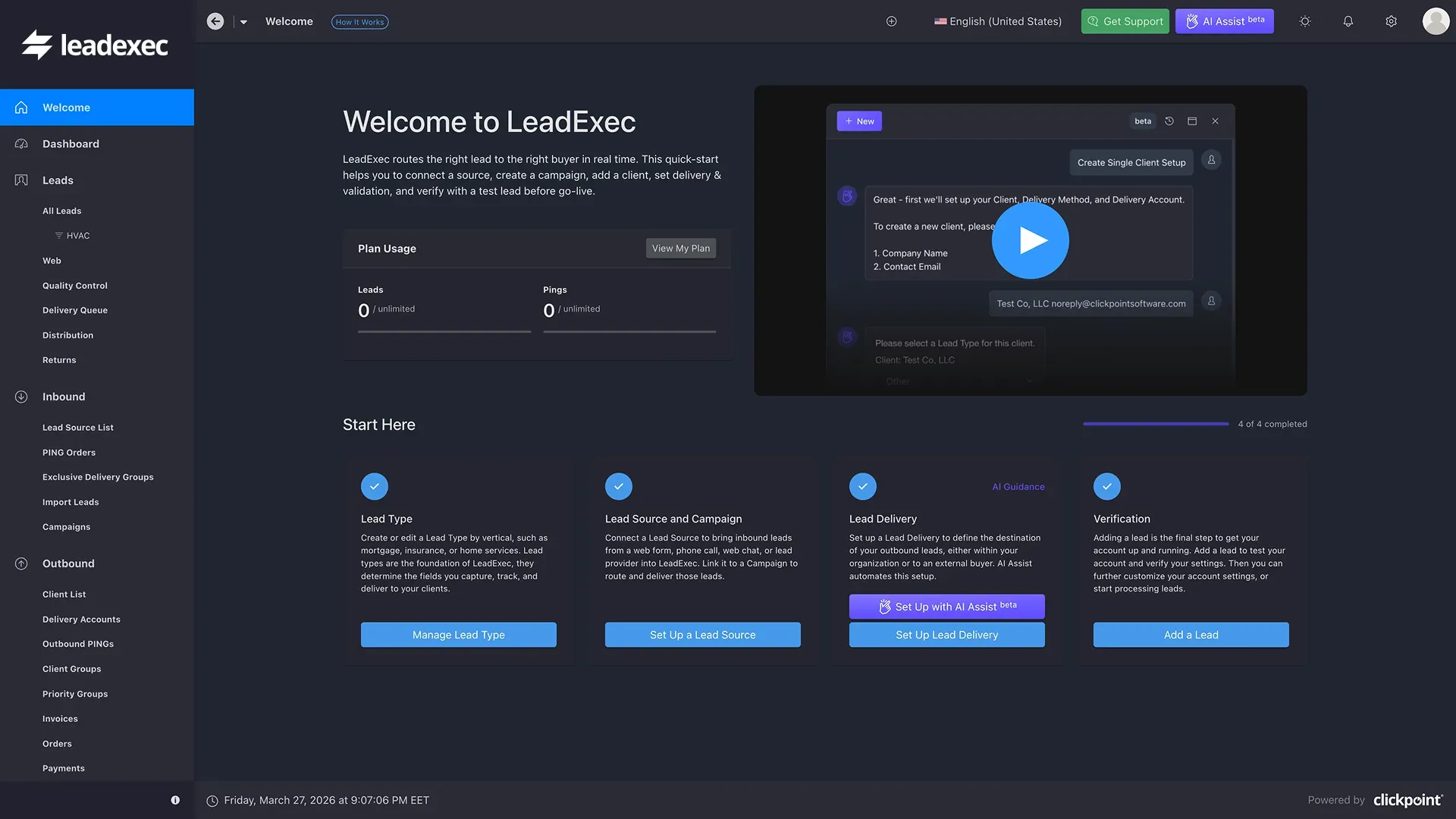
The user journey with LeadExec begins with account setup and workspace configuration. New users typically start by defining their organization’s structure, including the roles and permissions for team members who will manage lead distribution, buyer relationships, and reporting. The onboarding process involves configuring lead sources, which can include web forms, API endpoints, email ingestion, or integrations with lead generation platforms. Users then define their buyer network by adding each buyer’s contact information, delivery preferences, and routing criteria.
Once the basic infrastructure is in place, users configure routing rules that determine how leads flow from sources to buyers. This involves setting up distribution models—whether exclusive, shared, or ping/post—and defining the criteria that trigger each routing decision. For example, a lead seller in the insurance vertical might configure rules that route auto insurance leads to buyers in specific states, with higher-priced buyers receiving priority during business hours and lower-priced buyers serving as fallback options. The platform’s rule builder uses a visual interface where users can drag and drop conditions, set priority levels, and test routing logic before going live.
Day-to-day operations involve monitoring the real-time dashboard to track lead volume, distribution rates, and buyer performance. When a lead enters the system, LeadExec automatically validates it against compliance and data quality checks, applies the configured routing rules, and delivers it to the appropriate buyer through the specified delivery method. Users can view detailed logs of each lead’s journey, including validation results, routing decisions, and delivery status. The platform also handles edge cases such as buyer unavailability, delivery failures, and lead rejection, automatically triggering fallback routing or notifying administrators.
Integrations play a central role in the workflow. LeadExec connects with lead generation tools, CRM systems, and compliance providers through APIs and pre-built connectors. For example, a lead seller using a web form to capture leads can integrate that form with LeadExec’s API, which then processes and distributes the lead in real time. Similarly, buyers can receive leads directly into their CRM or dialer system through webhooks or API calls. The platform’s ping/post functionality adds an additional layer of complexity, where leads are first offered to buyers for bidding before full data is delivered, creating a marketplace dynamic that maximizes revenue.
Use Cases
- A national insurance lead broker managing 500,000 leads per month across 50+ buyers: This organization needs to distribute auto, home, and life insurance leads to a network of independent agents and call centers, each with specific geographic and product preferences. Using LeadExec, the broker configures routing rules that match leads to buyers based on state, coverage type, and lead quality score. The ping/post feature allows buyers to bid on high-value leads in real time, while exclusive distribution ensures that premium leads go to top-performing buyers. The broker uses the analytics dashboard to track buyer acceptance rates and adjust pricing dynamically, resulting in a 20% increase in revenue per lead and a 15% reduction in undelivered leads.
- A solar installation company purchasing leads from multiple vendors: This buyer receives leads from 10 different lead generation sources and needs to route them to regional sales teams based on zip code and property type. LeadExec ingests leads from each vendor through API integrations, validates them against compliance checks using TrustedForm and Smarty, and routes them to the appropriate sales team’s CRM. The platform’s capacity management feature ensures that no sales team receives more leads than they can handle in a day, preventing lead fatigue and improving follow-up rates. The company reports a 30% improvement in lead-to-appointment conversion rates after implementing LeadExec.
- A lead marketplace connecting home service providers with homeowners: This platform operates a ping/post exchange where multiple home service companies bid on leads for plumbing, electrical, and HVAC services. LeadExec handles the real-time bidding process, sending lead summaries to qualified buyers and collecting bids within a configurable time window. The platform automatically awards the lead to the highest bidder and delivers the full lead data. The marketplace uses LeadExec’s buyer management tools to enforce quality standards, such as minimum response times and maximum lead caps, ensuring a fair and efficient marketplace for both buyers and sellers.
- A call center handling inbound and outbound lead distribution for multiple clients: This call center receives leads from various sources, including web forms, phone calls, and third-party lead generators. LeadExec routes leads to specific agent groups based on lead type, client requirements, and agent availability. The platform integrates with the call center’s dialer system to automatically push leads to agents’ screens as they become available. Real-time reporting allows the call center manager to monitor lead volume, agent productivity, and client satisfaction metrics. The call center uses LeadExec’s compliance integrations to ensure that all leads meet TCPA requirements before being contacted, reducing legal risk.
- A mortgage lender scaling its lead generation operations: This lender generates leads through digital marketing campaigns and needs to distribute them to loan officers based on loan type, state licensing, and current workload. LeadExec routes leads to the appropriate loan officer’s CRM in real time, with automated follow-up reminders and lead status tracking. The platform’s analytics help the lender identify which marketing channels generate the highest-quality leads and which loan officers have the best conversion rates. By automating lead distribution, the lender reduces lead response time from hours to seconds, resulting in a 25% increase in loan application completions.
Design & User Experience
Based on the information available through the ClickPoint Software website, LeadExec presents a professional, enterprise-oriented design that prioritizes functionality over flashy aesthetics. The website uses a clean layout with a blue and white color scheme, clear typography, and well-organized navigation that guides visitors through the product’s capabilities. The design language suggests a focus on clarity and information density, which is appropriate for a B2B platform where users need to quickly understand complex features and workflows.
The navigation structure appears intuitive, with main sections covering lead distribution, ping/post capabilities, and integrations. The use of icons and visual elements helps break up text-heavy sections, though the design is more utilitarian than modern SaaS platforms like Notion or Figma. This trade-off is understandable given the technical nature of the product—users are likely operations managers and IT professionals who prioritize efficiency over visual polish.
The apparent learning curve for LeadExec is moderate to steep, given the complexity of the platform’s feature set. New users will need to invest time in understanding routing rules, buyer management, and ping/post workflows. However, the platform’s documentation and support resources appear comprehensive, and the logical organization of features should help users build proficiency over time. The website does not provide clear evidence of mobile responsiveness, which is a potential limitation for users who need to monitor lead distribution on the go. Overall, the design serves its purpose effectively for the target audience, though there is room for improvement in onboarding guidance and mobile accessibility.
Pricing & Value
The ClickPoint Software website does not publicly display specific pricing tiers for LeadExec, which is common for enterprise-grade B2B software where pricing is typically customized based on lead volume, feature requirements, and deployment complexity. This approach allows ClickPoint to tailor solutions to each organization’s specific needs, but it also means that potential customers cannot easily compare pricing with alternatives without engaging in a sales conversation.
Based on industry standards for lead distribution platforms, LeadExec likely follows a usage-based pricing model, with costs scaling based on the number of leads processed per month, the number of buyers managed, and the specific features required. Organizations processing hundreds of thousands of leads per month with complex ping/post workflows can expect to pay several thousand dollars per month, while smaller operations may find more affordable entry points.
The value proposition of LeadExec is strongest for organizations where lead distribution is a core business function and where manual processes or generic CRM tools are creating operational bottlenecks. For these users, the platform’s automation capabilities, compliance integrations, and real-time analytics can deliver significant ROI through increased lead revenue, reduced operational costs, and improved buyer relationships. However, organizations with simpler lead distribution needs or limited budgets may find the platform’s complexity and potential cost to be prohibitive. Prospective buyers should request a demo and pricing quote to evaluate whether the investment aligns with their scale and requirements.
Who Is LeadExec Best For?
LeadExec is best suited for three primary user segments. First, lead sellers and brokers who aggregate leads from multiple sources and distribute them to networks of buyers will benefit most from the platform’s ping/post capabilities, buyer management tools, and real-time analytics. These organizations typically process high volumes of leads and need automation to maximize revenue and maintain buyer relationships. Second, lead buyers such as insurance agencies, mortgage lenders, and home service companies that purchase leads from multiple vendors will find value in LeadExec’s lead validation, compliance integrations, and routing capabilities that ensure they receive only qualified, compliant leads. Third, call centers and sales operations that handle inbound lead distribution across multiple clients or campaigns will appreciate the platform’s ability to route leads to specific agents or teams based on complex criteria.
LeadExec is less suitable for small businesses or solo entrepreneurs who generate a low volume of leads and have simple distribution needs. These users may find the platform’s feature set overwhelming and its pricing prohibitive compared to simpler alternatives like CRM-based lead routing or manual email distribution. Additionally, organizations that do not operate in regulated industries or that have straightforward lead distribution workflows may not need the compliance integrations and advanced routing logic that LeadExec offers. For these users, a lighter-weight solution like a CRM with basic lead assignment rules or a simple email-based distribution system may be more appropriate and cost-effective.