Overview
Commune positions itself as a dedicated home base for founders, makers, and builders—a purpose-built alternative to the noise of general social media platforms. The platform addresses a specific and persistent pain point: the difficulty of finding meaningful, focused conversations about product building amid the cacophony of Twitter, LinkedIn, and Reddit. For solo founders, indie hackers, and early-stage startup teams, the problem is acute. Sharing a milestone on Twitter might generate a few likes, but it rarely leads to substantive feedback or genuine collaboration. LinkedIn is increasingly dominated by thought leadership theater, and Reddit’s subreddits, while useful, lack the structured tools for project showcasing and peer matching.
Commune solves this by creating a walled garden where every post, interaction, and feature is oriented around the act of building. The target audience is clear: anyone actively working on a digital product, from a solo developer coding a SaaS in their spare time to a small team preparing a launch. The competitive landscape includes platforms like Product Hunt, which excels at launch-day visibility but offers little for ongoing community engagement; Indie Hackers, which provides forums and revenue sharing but lacks modern matching and gamification; and niche Slack or Discord communities, which suffer from fragmentation and poor discoverability. Commune differentiates itself by integrating structured posting, topic-based feeds, builder matching, project showcases, and gamified engagement into a single, cohesive experience. The thesis of this review is that Commune offers a compelling, well-designed environment for builders seeking depth over breadth, but its ultimate value hinges on achieving critical mass in its user base.
Key Features
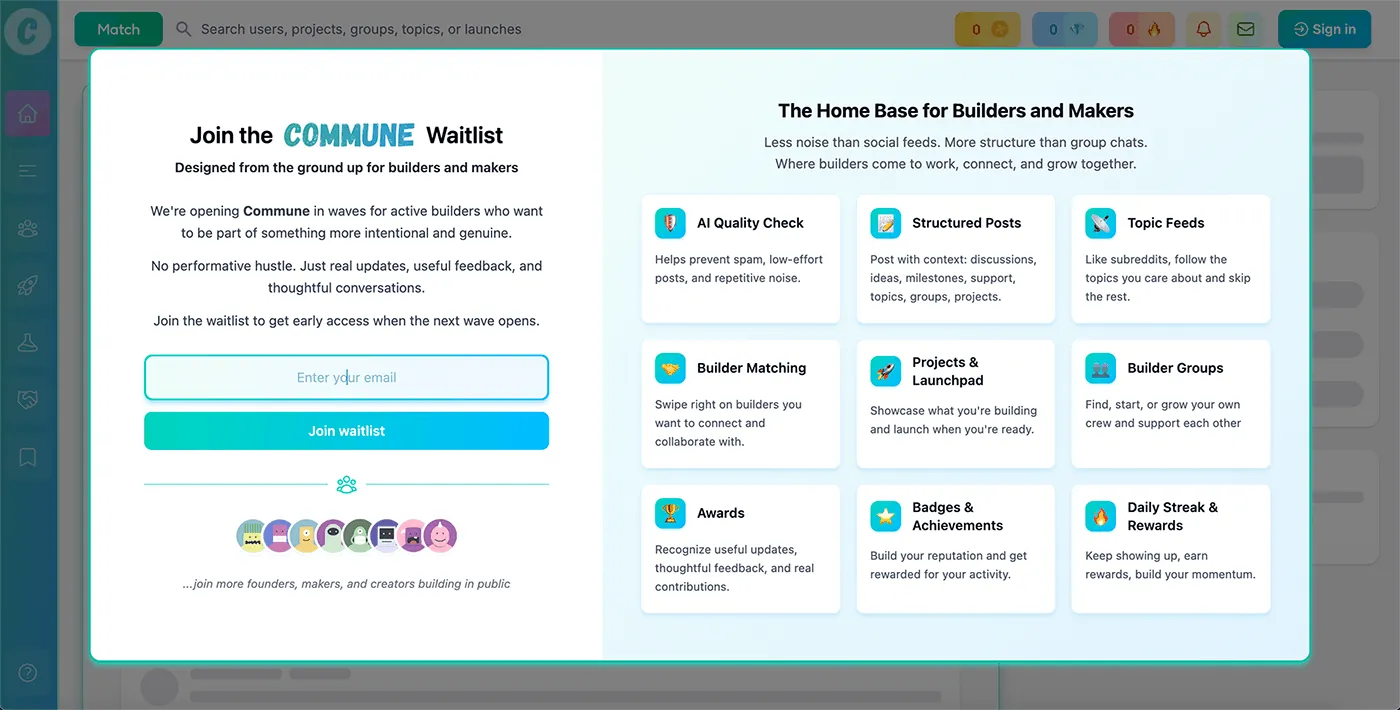
- Structured Posts with Context Categories: Unlike the freeform chaos of a Twitter timeline, Commune forces posts into predefined categories: discussions, ideas, milestones, support, topics, groups, and projects. This is not a minor UI tweak—it fundamentally changes how content is consumed. When a user posts a milestone, the community immediately understands the context and can respond appropriately with encouragement or tactical advice. When someone posts a support request, it doesn’t get buried under promotional content. In practice, the user selects a category from a dropdown when composing a post, and the feed displays a visual badge indicating the post type. This structure reduces cognitive load for readers and increases the likelihood that posts receive relevant engagement. The value is clear: builders spend less time filtering noise and more time interacting with content that matches their current needs.
- Topic Feeds for Curated Discovery: Commune implements a topic-based feed system that functions similarly to subreddits but with a cleaner, more modern interface. Users select topics of interest during onboarding—such as AI, SaaS, mobile apps, or design—and the main feed surfaces posts from those topics. This is a significant improvement over algorithmic feeds that prioritize engagement metrics over relevance. The user can also browse individual topic pages to dive deep into a specific area. The practical workflow involves following 5-10 topics initially, then adjusting as interests evolve. The value proposition is that a builder interested in AI tools doesn’t have to wade through posts about e-commerce stores or crypto projects. This targeted filtering is essential for a platform that aims to serve a diverse builder ecosystem without overwhelming any single user.
- Builder Matching with Swipe Interface: Perhaps Commune’s most distinctive feature is its swipe-based matching system for discovering other builders. Borrowing the familiar Tinder paradigm, users are presented with profiles of other builders and can swipe right to connect or left to pass. Each profile includes the builder’s topics of interest, current projects, and skills. When two users swipe right on each other, a match is created, and they can start a direct conversation. This feature directly addresses the networking problem that plagues many online communities—finding someone with complementary skills who is actively looking to collaborate. For example, a developer seeking a designer can filter by design-related topics and swipe through potential matches. The value is immediate and practical: it transforms passive community membership into active, intentional networking.
- Projects & Launchpad: Commune provides a dedicated space for users to showcase their projects, complete with descriptions, links, and status updates. The Launchpad section specifically highlights new launches, functioning as a curated feed of recently released products. This is distinct from Product Hunt’s daily leaderboard format; Commune’s Launchpad is a continuous stream, allowing builders to announce their product at any time without competing for a single day’s spotlight. Users can browse projects by topic, view detailed pages with screenshots and descriptions, and leave feedback. For a builder, this means having a persistent, always-available landing page for their project within the community, rather than relying on a single launch day. The value is sustained visibility and the opportunity to gather feedback from a relevant audience over time.
- Builder Groups for Niche Communities: Beyond topic feeds, Commune allows users to create and join groups focused on specific interests, technologies, or goals. These groups function as mini-communities within the larger platform, with their own feeds, discussions, and member lists. A group might focus on “Rust for WebAssembly” or “B2B SaaS Pricing Strategies.” The group creator can set rules, moderate discussions, and pin important resources. For users, groups provide a more intimate setting for deep discussions compared to the main feed. The value is that builders can find their tribe—a small, focused group of peers working on similar problems—without the overhead of managing a separate Slack server or Discord channel.
- Awards & Badges Reputation System: Commune implements a recognition system where users can award points to posts they find valuable. These awards translate into badges and reputation scores displayed on user profiles. The system is designed to incentivize quality contributions—thoughtful feedback, helpful support responses, and insightful discussions. In practice, a user who consistently provides valuable feedback will accumulate badges that signal their expertise to others. This is a more nuanced reputation system than simple upvote counts, as awards can be given for specific qualities like “helpful” or “insightful.” The value is twofold: it encourages high-quality participation and helps users identify trusted voices within the community.
- Daily Streak & Gamified Rewards: To combat the common problem of sporadic engagement, Commune introduces a daily streak system. Users earn rewards for logging in and participating each day, with streaks tracked visibly on their profile. The rewards might include profile customization options, increased visibility for posts, or exclusive badges. This gamification element is borrowed from apps like Duolingo and Snapchat, and it serves a clear purpose: building momentum. For a platform that relies on active participation to generate value, daily streaks encourage users to make Commune a habit rather than a occasional visit. The value is that consistent engagement leads to a more vibrant community, which benefits all users.
How It Works
The user journey on Commune begins with a straightforward signup process. New users can register using an email address or social login via Google or X (formerly Twitter). The onboarding flow immediately asks users to select topics of interest from a curated list—this is the critical first step that shapes the entire experience. Users can choose from categories like AI/ML, SaaS, mobile apps, design, marketing, hardware, and more. After selecting topics, users are prompted to create a profile, including a bio, links to their projects or social profiles, and their primary skills or roles (developer, designer, marketer, founder, etc.).
Once onboarded, the user lands on the main feed, which displays posts from their selected topics and followed users. The feed is chronological by default, with an option to view top posts. Creating a post involves clicking a prominent “Create Post” button, then selecting a category from the structured options (discussion, idea, milestone, support, topic, group, or project). The user writes their content, adds relevant tags, and publishes. Posts appear in the appropriate topic feeds and on the user’s profile.
Day-to-day usage involves checking the feed for relevant updates, engaging with posts through comments and awards, and browsing the Launchpad for new projects. The builder matching feature is accessed via a separate tab, where users see a card-based interface with profile photos, skills, and project descriptions. Swiping right initiates a connection request; if the other user also swipes right, a match is made and a direct message channel opens.
Groups are discoverable through a search interface or by browsing categories. Joining a group adds its posts to the user’s feed. Creating a group requires setting a name, description, and topic tags, after which the group gets its own dedicated feed and member management tools.
The daily streak is tracked automatically based on login activity. Users see their current streak displayed in the header or profile section, along with any rewards earned. The platform also employs AI quality checks to flag low-effort or spammy content, though the specifics of this moderation system are not fully detailed on the website.
Currently, Commune does not appear to offer direct integrations with external tools like GitHub, Slack, or Notion. The platform is self-contained, which simplifies the experience but may limit its utility for users who want to sync their activity across tools.
Use Cases
- A solo founder building a B2B SaaS product for project management: This founder uses Commune to post daily development updates under the “milestones” category. They receive feedback on feature prioritization from other builders who have faced similar challenges. Using the builder matching feature, they connect with a freelance designer who specializes in B2B interfaces. Within two weeks, they have a design partner and early feedback on their MVP. The outcome is accelerated development and a validated product direction, achieved without spending money on consultants or advertising.
- An indie maker launching a mobile habit-tracking app: The maker creates a project page on Commune with screenshots, a demo video, and a waitlist link. They post the project to the Launchpad section, where it gains visibility among the mobile app topic followers. Over the next week, they receive 50 sign-ups for the waitlist and detailed feedback on the onboarding flow from five community members. The outcome is a pre-launch audience and actionable UX improvements, all generated organically within the community.
- A developer seeking a technical co-founder for an AI-powered analytics tool: The developer sets their profile to highlight their skills in Python and machine learning, and specifies that they are looking for a co-founder with frontend experience. Using the builder matching feature, they swipe through profiles filtered by “frontend development” and “AI” topics. They match with three candidates, have video calls with two, and eventually partner with one who has complementary skills and shared vision. The outcome is a co-founder match that would have been difficult to find on LinkedIn or Twitter, where the signal-to-noise ratio is far lower.
- A community manager building a niche group around Web3 development: The manager creates a group called “Web3 Builders” on Commune, sets rules for constructive discussion, and begins posting curated resources and weekly discussion prompts. Within a month, the group has 200 members who share job postings, project feedback, and technical tutorials. The outcome is a thriving niche community that provides ongoing value to its members, without the overhead of managing a separate Discord server or mailing list.
- A content creator building an audience around no-code tools: The creator posts educational content under the “discussion” category, sharing tutorials and tool comparisons. They use the awards system to recognize community members who contribute helpful comments, which encourages further engagement. Over three months, they build a following of 1,000 users within Commune, which translates into newsletter subscribers and early access sign-ups for their own no-code course. The outcome is a targeted, engaged audience that is more valuable than a larger but less relevant social media following.
Design & User Experience
Based on the visual elements visible on the Commune website, the design language is modern, clean, and professional. The interface employs a muted color palette with accent colors for interactive elements, avoiding the visual clutter that plagues many community platforms. Typography is legible and well-spaced, with clear hierarchy between post titles, metadata, and body text. The navigation appears to follow a logical structure: a top bar with links to the feed, topics, groups, launchpad, and matching, with user profile and settings accessible from a dropdown menu.
The structured post creation flow is a standout design decision. By forcing users to categorize their posts, Commune reduces the cognitive load on readers and creates a more organized feed. This is a deliberate trade-off—it adds friction to posting but dramatically improves consumption. The swipe-based matching interface borrows a familiar interaction pattern, which lowers the learning curve for new users.
However, there are potential rough edges. The platform appears to be a single-page application built with modern JavaScript frameworks (as evidenced by the discovered subpages referencing .js and .css build assets). This means fast navigation once loaded, but initial load times may be slower on poor connections. The mobile experience is not explicitly documented, but given the swipe-based matching feature, it is likely designed with mobile-first considerations. The learning curve is moderate—the structured posting and topic feeds are intuitive, but new users may need a few sessions to understand how groups, matching, and awards interact.
One notable absence is a visible onboarding tutorial or tooltip system. Users are expected to explore and learn through use, which may lead to initial confusion about features like awards or daily streaks. A more guided onboarding flow could improve retention for less technically inclined users.
Pricing & Value
Commune currently offers free sign-up with no upfront cost. The platform is free to use, with premium features available but not explicitly detailed on the main website. This freemium model is common among community platforms, where the value is driven by network effects rather than per-user pricing.
The free tier appears to include full access to the feed, topic subscriptions, post creation, builder matching, groups, and the Launchpad. This is a generous offering—users can experience the core value of the platform without any financial commitment. The premium features, which are hinted at but not fully described, likely include enhanced analytics, priority visibility for posts, advanced matching filters, or custom branding for groups.
Compared to alternatives, Commune’s pricing is competitive. Product Hunt’s Maker Pro subscription costs $20/month and offers analytics and early access. Indie Hackers is free but lacks premium features entirely. Slack and Discord communities are free to join but often require paid subscriptions for advanced features. Commune’s free tier is more generous than Product Hunt’s, and its premium features, if priced reasonably, could offer good value for power users.
The upgrade path is unclear from the website, which is a minor weakness. Users who want to understand what they get by paying need to dig deeper or wait for the platform to publish detailed pricing. For now, the free tier is sufficient for most builders, and the value proposition is strong: a focused, structured community at no cost.
Who Is Commune Best For?
Commune is best suited for three primary user segments. First, solo founders and indie hackers who are building digital products and need a supportive, focused community for feedback, accountability, and networking. These users benefit most from the milestone posts, builder matching, and Launchpad features. Second, developers and designers seeking collaborators for side projects or startups. The swipe-based matching system is uniquely effective for finding complementary skills, which is difficult on general platforms. Third, community managers building niche groups around specific technologies or industries. The group creation tools and structured feeds provide a turnkey solution for fostering discussions without managing separate infrastructure.
Conversely, Commune is less suitable for two user types. Enterprise teams or large organizations will find the platform too focused on individual builders and small teams. The lack of team accounts, advanced analytics, or integration with enterprise tools makes it a poor fit for corporate innovation programs. Content creators seeking broad reach—such as YouTubers or newsletter writers targeting a general audience—will find Commune’s niche focus limiting. They are better served by Twitter, LinkedIn, or YouTube, where the potential audience is orders of magnitude larger. For these users, Commune can be a supplementary channel but not a primary growth driver.