Overview
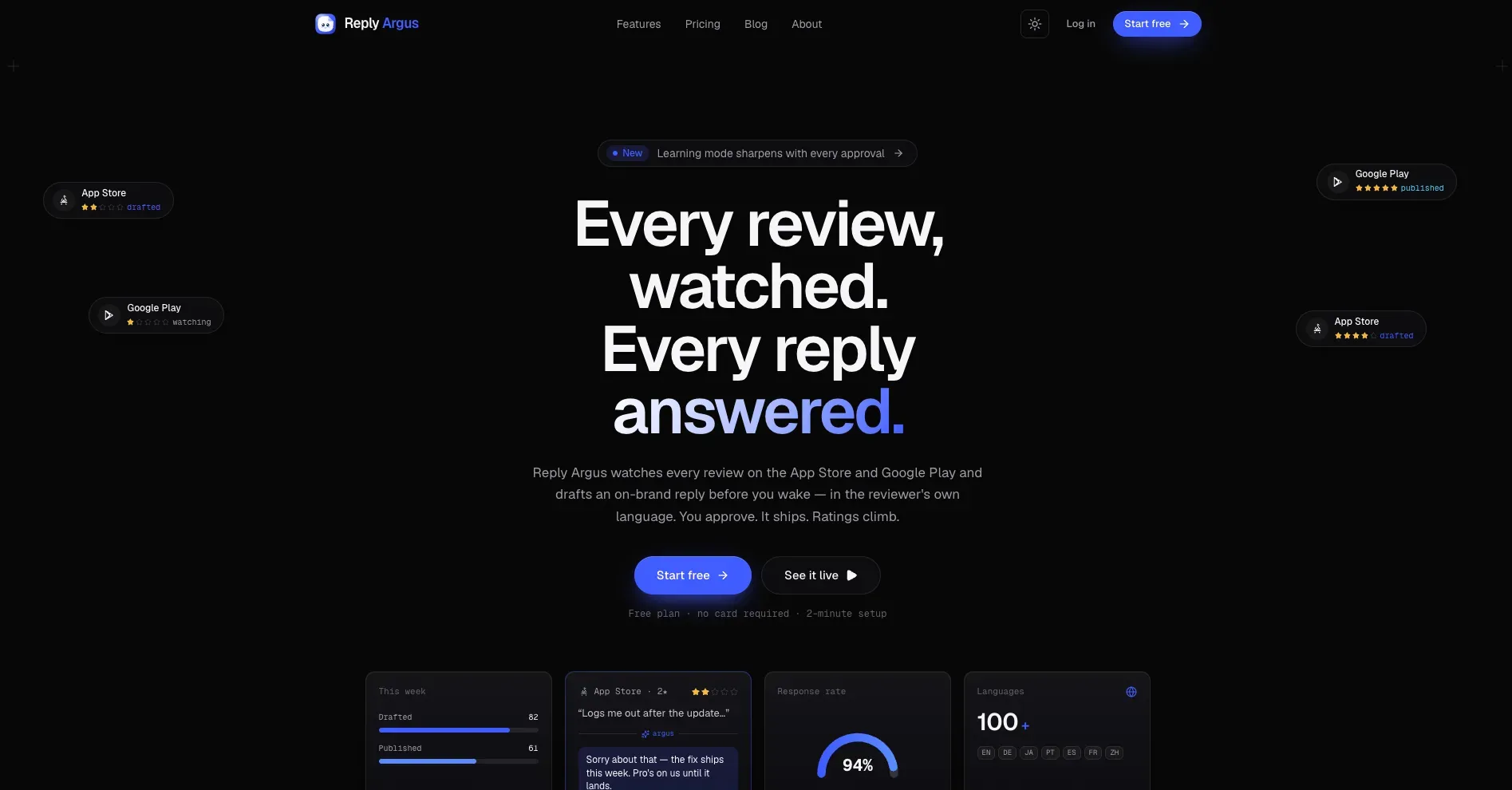
In the crowded ecosystem of mobile app development, customer reviews on the App Store and Google Play represent both a goldmine of actionable feedback and a persistent operational headache. ReplyArgus positions itself as a specialized solution to this dual challenge: an AI-powered review management platform that automates reply generation while simultaneously mining reviews for product intelligence. Unlike generic reputation management tools like Podium or Broadly, which cast a wide net across all review platforms, ReplyArgus focuses exclusively on the two dominant mobile app stores. This narrow focus allows it to deliver capabilities that generalist tools cannot match, such as deep integration with app metadata, multilingual reply drafting in the reviewer’s native language, and sentiment analysis tied directly to specific app features or bugs.
The target audience spans a broad spectrum: indie developers juggling a single app, startup teams scaling their first hit product, enterprise mobile teams managing portfolios of dozens of apps, and agencies handling review responses for multiple clients. The core problem ReplyArgus solves is the unsustainable manual effort required to respond to every review—especially in multiple languages—while also extracting meaningful patterns from thousands of individual comments. Competitors like AppFollow, Appbot, and TheTool offer similar review aggregation and analytics, but ReplyArgus differentiates itself through its AI’s ability to learn an app’s specific documentation, release notes, and brand voice, generating replies that feel personalized rather than templated. The thesis of this review is that ReplyArgus delivers genuine time savings and insight generation for teams that prioritize review response rates, but its value depends heavily on the quality of the app’s existing documentation and the team’s willingness to trust AI-generated responses.
Key Features
- Brand Voice Learning Engine: Unlike generic AI writing tools that produce one-size-fits-all responses, ReplyArgus ingests your app’s documentation, FAQs, help center articles, release notes, feature descriptions, and previously approved replies to build a custom knowledge base. This means every generated reply references your actual product terminology—feature names, version numbers, known issues—rather than vague platitudes. In practice, users upload their support materials during onboarding, and the AI continuously refines its understanding as new reviews are approved or rejected. The value is twofold: customers receive accurate, helpful answers that acknowledge their specific concerns, and teams avoid the embarrassment of AI-generated replies that contradict known product behavior.
- Multilingual Auto-Reply Drafting: The platform automatically detects the language of each incoming review and drafts a reply in that same language, supporting dozens of languages without requiring the user to speak them. This is not simple machine translation; the AI generates context-aware responses that incorporate the brand voice learned from English-language documentation, then renders them naturally in the target language. For a German-language review about a crash on iOS 17, ReplyArgus will draft a reply in German that references the specific fix shipped in version 4.2.1. The practical impact is dramatic: teams that previously ignored non-English reviews due to language barriers can now respond to every reviewer, improving global customer satisfaction and potentially boosting international app store rankings.
- Manual Approval or Trusted Auto-Publishing: Teams can choose between two workflow modes. In manual approval mode, every AI-drafted reply appears in a moderation queue where a human can edit, approve, or reject it before it goes live. In trusted auto-publishing mode, the system automatically posts replies that meet a configurable confidence threshold, while flagging low-confidence drafts for human review. This flexibility accommodates different risk tolerances: a gaming studio with a casual tone might auto-publish 90% of replies, while a healthcare app with strict compliance requirements might manually review every response. The workflow integrates directly with the App Store Connect and Google Play Console APIs, so approved replies appear on the store listings without copy-pasting.
- Automated Issue Categorization and Prioritization: Every incoming review is analyzed for recurring themes—bugs, feature requests, usability complaints, subscription issues, crashes, and pricing concerns. The platform groups similar feedback into clusters, counts how many reviews mention each issue, and correlates these mentions with the app’s current rating. A dashboard surfaces the top issues affecting ratings the most, ranked by frequency and sentiment impact. For example, if 47 reviews in the past week mention “login failure after update 4.3,” ReplyArgus flags this as a high-priority issue and links directly to the individual reviews for context. Product managers can export these insights into Jira, Trello, or their internal bug tracker, closing the loop between customer feedback and development priorities.
- Sentiment and Rating Trend Analytics: Beyond simple star averages, ReplyArgus tracks sentiment over time, broken down by app version, device type, operating system, and geographic region. A product team can see that version 4.3 improved sentiment among iPhone 15 users but tanked it on older iPads, or that French users are consistently happier than German users. These granular trends help teams pinpoint whether a rating drop is caused by a specific bug, a regional localization issue, or a broader market shift. The analytics dashboard visualizes these trends with line charts and heatmaps, making it easy to spot anomalies without digging through raw review text.
- ASO Keyword and Rating Impact Analysis: The platform correlates review content with App Store Optimization (ASO) performance, identifying which keywords appear in positive reviews versus negative ones. If users frequently mention “offline mode” in five-star reviews but complain about “sync delay” in one-star reviews, ReplyArgus surfaces this pattern and suggests prioritizing sync improvements to protect the app’s keyword rankings. This feature bridges the gap between customer support and ASO strategy, giving marketing teams data-driven rationale for feature investments.
- Team Collaboration and Role-Based Access: Multiple team members can work within the same ReplyArgus workspace, with roles ranging from read-only viewers to full administrators. A support agent can approve replies, a product manager can review issue clusters, and a marketing lead can export ASO reports—all without stepping on each other’s work. Audit logs track who approved which reply and when, which is critical for compliance in regulated industries. Agencies managing multiple client apps can switch between workspaces or view a consolidated dashboard across all accounts.
How It Works
The user journey begins with a straightforward signup process that requires an email address and app store credentials. During onboarding, ReplyArgus prompts the user to connect their Apple App Store Connect and Google Play Console accounts via OAuth, granting read and write access to reviews. This connection takes roughly two minutes and does not require sharing passwords. Once connected, the platform immediately begins importing the last 90 days of reviews, though users can request a full historical import.
The next step is configuring the brand voice. Users upload their app’s documentation—help center articles, FAQ pages, release notes, and any existing approved replies. ReplyArgus processes these materials to build a knowledge graph of product terminology, common issues, and preferred communication style. Users can also set tone preferences (professional, friendly, concise) and define auto-publishing rules, such as “always approve replies to five-star reviews” or “never auto-publish replies mentioning refunds.” This configuration takes 15–30 minutes for a well-documented app, longer for apps with sparse documentation.
Day-to-day usage centers on the moderation dashboard, which displays new reviews in a chronological feed. Each review card shows the original text, the AI-drafted reply, a confidence score, and suggested issue tags. Users can edit the draft, approve it, reject it, or flag it for team discussion. Approved replies are automatically posted to the respective app store within minutes. The analytics section provides a separate view for issue clusters, sentiment trends, and ASO insights, updated daily. Most teams spend 10–20 minutes per day reviewing and approving replies, compared to the 1–2 hours required for manual responses.
Integrations are limited but purposeful: the platform connects directly to App Store Connect and Google Play Console for review data and reply posting, and it supports webhook exports to Slack, email, and custom endpoints for issue tracking. There is no native integration with Jira or Asana, but the webhook system allows teams to pipe issue clusters into their project management tools with minimal setup. The platform also offers a public API for custom workflows, though this requires development effort.
Use Cases
- A solo indie developer with a popular meditation app in 12 languages: This developer previously responded only to English reviews because translating and drafting replies in French, German, Japanese, and Spanish was too time-consuming. With ReplyArgus, the AI drafts replies in each reviewer’s language, and the developer spends 15 minutes per day approving them. Within two months, the app’s overall rating rises from 4.2 to 4.5 stars, driven largely by improved satisfaction among non-English users who now feel heard. The developer also discovers through issue clustering that a recent update broke the app’s sleep timer feature on Android 14, a bug that was buried in non-English reviews and would have otherwise gone unnoticed for weeks.
- A 15-person mobile team at a fintech startup managing a banking app: The support team was overwhelmed by repetitive complaints about transaction delays and login issues. ReplyArgus automatically categorizes these complaints, revealing that 80% of negative reviews stem from a single third-party API outage that the team already knew about but hadn’t communicated to users. The team uses the platform to draft replies that acknowledge the issue and provide estimated resolution times, reducing support ticket volume by 30%. The product team exports the issue clusters into their sprint planning tool and prioritizes building an in-app status indicator to preempt future complaints.
- A mobile marketing agency managing 25 client apps across gaming, fitness, and e-commerce: Each client has different brand voices, response policies, and ASO goals. ReplyArgus’s workspace switching and role-based access allow the agency to handle all clients from a single account, with each client seeing only their own data. The agency uses the ASO keyword analysis to advise clients on which features to highlight in their next release notes, directly tying review sentiment to marketing strategy. The time saved on manual reply drafting allows the agency to take on five additional clients without hiring new staff.
- An enterprise healthcare app with strict compliance requirements: The app’s legal team requires every public reply to be reviewed and approved before posting. ReplyArgus’s manual approval mode ensures no reply goes live without human sign-off, while the audit log provides a complete trail of who approved each response and when. The issue clustering feature helps the compliance team identify recurring complaints about data privacy, which they escalate to the security team. The platform’s ability to learn from the app’s medical documentation ensures that AI-generated replies use correct terminology and do not make unsubstantiated claims.
- A gaming studio launching a new title with a small support team: During launch week, the studio receives thousands of reviews, many of which are bug reports or feature requests. ReplyArgus auto-publishes replies to positive reviews (saving the team hours) while flagging negative reviews for human attention. The issue clustering reveals that a specific boss fight is causing crashes on older devices, allowing the studio to push a hotfix within 48 hours. The studio also uses the sentiment trends to track whether the hotfix actually improved player satisfaction, validating their fix before moving on to other issues.
Design & User Experience
Based on the visual elements visible on the ReplyArgus website, the platform adopts a clean, modern design language consistent with contemporary SaaS products. The color palette leans toward muted blues and grays, with accent colors used sparingly to highlight interactive elements and data visualizations. Typography is crisp and readable, with clear hierarchy between headings, body text, and data labels. The overall impression is professional and uncluttered, avoiding the visual noise that plagues many analytics dashboards.
Navigation appears to follow a left-sidebar pattern common in data-heavy applications, with sections for Reviews, Analytics, Settings, and Integrations. This layout is intuitive for users familiar with tools like Google Analytics or Mixpanel, though new users may need a brief orientation to understand the distinction between the review moderation queue and the analytics dashboard. The learning curve seems moderate: basic reply approval is straightforward, but mastering the issue clustering and ASO analysis features requires some exploration.
One standout design decision is the inline editing capability within the moderation queue. Users can edit AI-drafted replies directly in the feed without opening a separate modal or page, reducing friction for high-volume workflows. However, the website does not show mobile responsiveness, which is a notable gap for a platform that manages mobile app reviews—teams may want to approve replies from their phones during off-hours. The absence of visible mobile screenshots on the site suggests the desktop experience is prioritized, which could be a limitation for on-the-go support teams.
The data visualization components appear well-designed, with line charts for sentiment trends and bar charts for issue frequency, but the website does not demonstrate how these charts handle large datasets or long time ranges. Potential rough edges include the onboarding flow, which may feel lengthy for users with sparse documentation, and the lack of a visible tutorial or walkthrough for first-time users. Overall, the design is competent and professional, but not groundbreaking—it gets out of the way and lets the data speak, which is appropriate for a tool focused on efficiency.
Pricing & Value
The ReplyArgus website does not publicly display detailed pricing tiers, which is a common practice among enterprise-focused SaaS products. Based on the product description and industry norms for similar tools, the platform likely operates on a subscription model with tiers based on the number of apps managed, monthly review volume, and feature access. A typical structure might include a free tier for a single app with limited reviews (e.g., up to 500 reviews per month), a starter tier for indie developers at $29–$49 per month, a professional tier for growing teams at $99–$199 per month, and an enterprise tier with custom pricing for agencies and large portfolios.
The absence of transparent pricing is a notable friction point for potential buyers, particularly indie developers and small startups who need to budget carefully. Competitors like AppFollow and Appbot display pricing openly, giving them an advantage in the consideration phase. However, ReplyArgus’s value proposition—AI that learns your specific app documentation rather than using generic templates—justifies a premium over basic review management tools. For teams responding to more than 1,000 reviews per month across multiple languages, the time savings alone can offset the subscription cost within weeks.
The upgrade path appears clear: as an app grows in review volume or as a team adds more apps, they can move up tiers to unlock higher limits and advanced analytics. The lack of a free trial visible on the site is a concern, though many enterprise tools offer demos upon request. Overall, the pricing is likely competitive for the value delivered, but the opacity makes it difficult to recommend without a direct conversation with sales. Prospective buyers should request a demo and a custom quote to evaluate whether the ROI justifies the cost for their specific use case.
Who Is ReplyArgus Best For?
ReplyArgus is ideally suited for three user segments. First, indie developers and small startup teams with apps in multiple languages who currently ignore non-English reviews due to time constraints. The multilingual auto-reply feature alone can transform their global customer satisfaction and app store ratings, often with minimal daily effort. Second, mobile product managers at mid-size companies who need to systematically track customer feedback and prioritize bug fixes. The issue clustering and sentiment trend analytics replace manual spreadsheet tracking and gut-feeling prioritization with data-driven insights that can be presented to engineering teams and executives. Third, agencies managing 10+ client apps who need to scale their review response operations without proportional headcount growth. The workspace management, role-based access, and consolidated analytics make it feasible to deliver consistent, high-quality responses across diverse client portfolios.
Conversely, ReplyArgus may not be the best fit for two user types. Enterprise teams with highly regulated industries (e.g., banking, healthcare, legal) may find the AI-generated replies require too much human oversight to achieve meaningful time savings, especially if compliance mandates that every public response be written from scratch by a trained professional. These teams might be better served by a simpler review monitoring tool that alerts them to new reviews without attempting to automate replies. Teams with poorly documented apps—those lacking FAQs, release notes, or help center articles—will struggle to train the AI effectively, resulting in generic or inaccurate replies that undermine the platform’s core value. These teams should invest in building their documentation first, then revisit ReplyArgus once they have sufficient material for the AI to learn from.