Overview
witn is a specialized billing infrastructure designed for companies building AI agents. Unlike traditional usage-based billing platforms that meter activity such as API calls, tokens, or minutes, witn focuses on verifying and billing for successful outcomes. The platform addresses a fundamental challenge in the AI agent space: how to charge customers based on the value delivered rather than the resources consumed. By defining what a successful outcome looks like—such as a resolved support ticket or a merged pull request—and automatically confirming or rejecting those outcomes based on event signals, witn enables agent builders to implement outcome-based pricing models that align cost with value. The product is positioned as a modern alternative to legacy billing systems like Chargebee, Orb, or Metronome, which were designed for subscription or usage-based models and lack the logic needed to handle the dynamic, event-driven nature of AI agent work.
Key Features
Outcome Definition Engine: Users can define billable conditions in plain English, specifying exactly what constitutes a successful outcome. Conditions are evaluated against an event log after every incoming event, and the system supports multiple evaluation techniques including decision graphs, weighted scoring, and simple boolean rules. This flexibility allows product teams to tailor billing logic to their specific agent behavior without writing custom code.
Event-Driven Verification: witn ingests events from the agent's existing infrastructure—whether from Segment, Rudderstack, PostHog, or direct API calls—and uses them to update the state of each outcome. The platform does not require replacing the existing billing stack; instead, it sits alongside it, processing signals and producing verified invoice line items with a complete audit trail.
Settlement Periods: A configurable waiting period (default 72 hours, up to 180 days) ensures that outcomes are only billed after they have been stable. If a reversal event occurs—such as a reopened support ticket—the settlement timer resets and the outcome remains pending. This prevents billing for results that do not hold, a critical feature for agents that perform ongoing tasks.
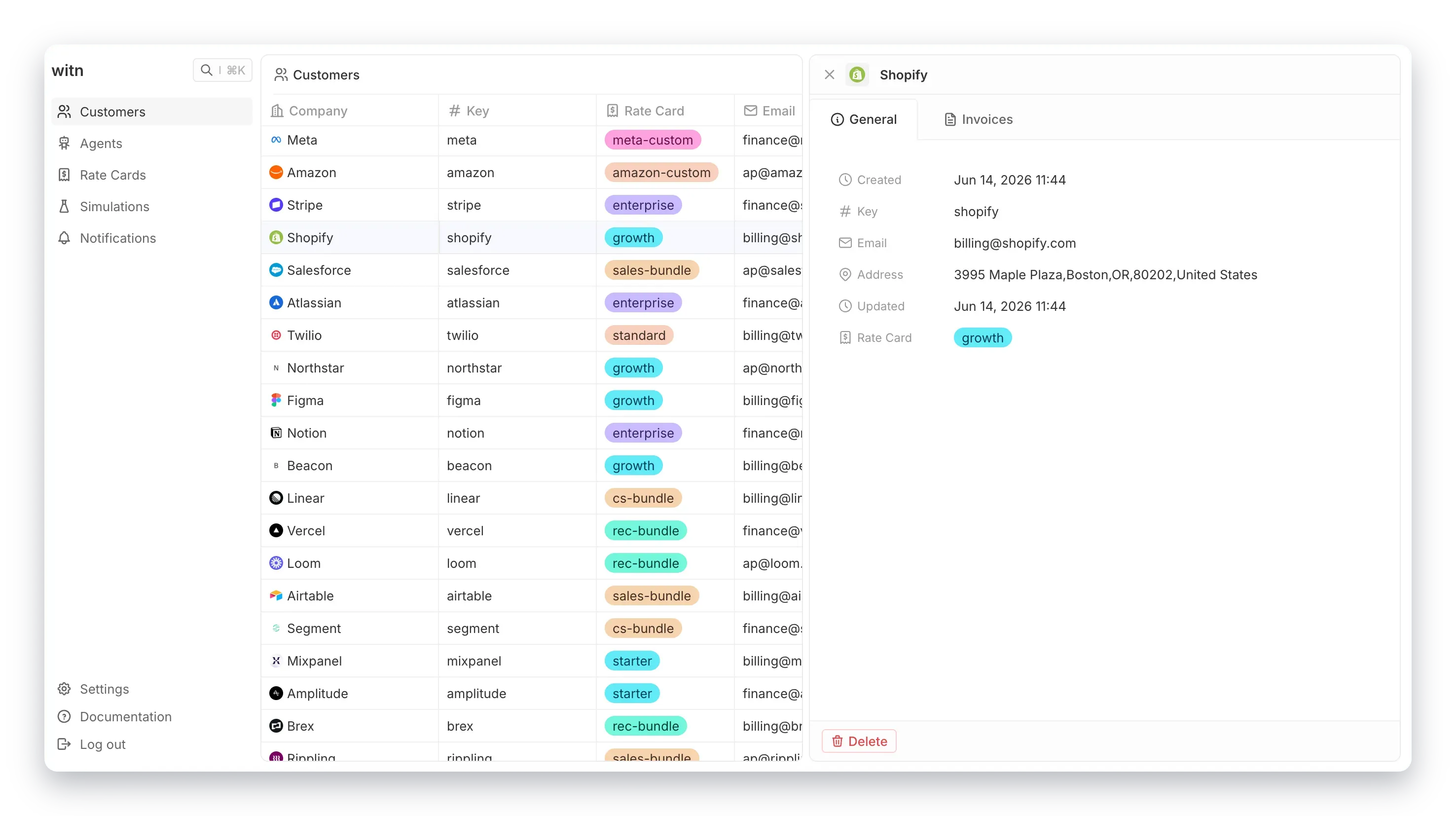
Per-Customer Contracts: witn supports custom products, prices, and outcome definitions for each customer without requiring code forks or branching logic. This is essential for B2B agent builders who negotiate unique terms with enterprise clients, allowing them to maintain a single billing configuration while serving diverse customer needs.
Simulation and Historical Replay: Before deploying changes to billing logic, users can simulate how new conditions would affect past events. This feature enables teams to preview revenue impact and outcome confirmation rates without risking live billing data, reducing the risk of pricing errors.
Real-Time Outcome Resolution: As events arrive, witn evaluates them immediately, updating the outcome state and providing near-instant feedback on whether a charge is pending, confirmed, or failed. This real-time visibility helps operations teams monitor billing accuracy and respond to disputes quickly.
Auditable Event Trail: Every signal and decision is recorded in chronological order, so finance teams and customers can see exactly why a charge was generated. This transparency simplifies dispute resolution and supports revenue recognition under ASC 606, as the platform provides clear success criteria, reversal windows, and evidence for each outcome.
How It Works
The typical workflow begins with defining outcome terms in the witn dashboard. A user specifies what a successful outcome looks like—for example, "a support ticket that remains closed for 72 hours"—and sets the settlement period. Next, the user configures event forwarding from their agent platform. witn integrates with common data pipelines like Segment and Rudderstack, or accepts events via a direct API. Once events start flowing, witn evaluates each one against the billable condition. When a condition is satisfied, the outcome enters a pending state. The settlement timer counts down; if a reversal event occurs before expiry, the outcome reverts to pending. If the timer expires without reversal, the outcome is confirmed and added to the next invoice. The entire process is automated, eliminating manual reconciliation. For example, a customer support agent might send events when a ticket is created, updated, and closed. witn tracks these events and only bills when the ticket stays closed for the settlement period. If the ticket is reopened, no charge is generated.
Use Cases
Customer Support Agents: A company building an AI support agent can use witn to bill per resolved ticket. The agent sends events for ticket creation, resolution, and reopening. witn confirms the outcome only after the ticket remains closed for a set period, ensuring customers pay only for lasting resolutions.
Code Review and PR Agents: For agents that automatically review and merge pull requests, witn can bill per merged PR that stays merged for a defined window. Events include PR creation, approval, merge, and revert. This aligns billing with the value of successfully integrated code.
SRE and Monitoring Agents: Agents that detect and remediate infrastructure issues can be billed per incident resolved. witn tracks events from alerting systems and remediation actions, confirming the outcome when the incident remains closed for a settlement period.
Voice and Conversational Agents: For voice agents that complete tasks like booking appointments or placing orders, witn can bill per successfully completed transaction. Events capture call outcomes, and the settlement period ensures that cancellations or changes are accounted for before billing.
Enterprise B2B Agent Platforms: Companies that sell agent capabilities to enterprise clients can use per-customer contracts to define unique outcome definitions and pricing for each account, enabling flexible monetization without complex billing logic.
Pricing & Value
witn does not publicly disclose pricing on its website, instead offering a demo to discuss custom plans. This is typical for infrastructure targeting mid-market and enterprise customers, where pricing is often usage-based or tiered. The value proposition is strong for agent builders who want to move away from activity-based billing (tokens, API calls) toward outcome-based models that better reflect customer value. Compared to legacy billing platforms like Chargebee or Stripe, witn offers specialized logic for event-driven verification and settlement periods that those platforms lack. However, the lack of transparent pricing may be a barrier for small teams or early-stage startups evaluating the product. The company provides a free downloadable report on AI agent monetization, which suggests they are investing in education and thought leadership to attract customers.
Final Verdict
witn addresses a genuine gap in the billing infrastructure market: the need for outcome-based verification in AI agent products. Its event-driven architecture, configurable settlement periods, and per-customer contracts make it a compelling choice for agent builders who want to align pricing with delivered value. The simulation and audit trail features add operational rigor that finance teams will appreciate. However, the product is still relatively new, and the lack of public pricing and limited integration ecosystem (currently supporting only a few data pipelines) may give some buyers pause. For teams already building AI agents and struggling with billing accuracy or customer trust, witn is worth evaluating. It is not a replacement for general-purpose billing systems but a specialized layer that complements them. Overall, witn is a promising tool for a niche but growing market, and its focus on verified outcomes could become a standard expectation in AI agent monetization.
For more details, visit the witn documentation to understand the technical setup, or read their blog for insights on AI agent pricing. You can also check out their glossary for key terms.