Overview
Soniox is a real-time multilingual speech AI platform that provides a unified API for speech-to-text (STT), text-to-speech (TTS), and speech translation. The platform is designed to handle the most challenging aspects of voice AI: native-speaker accuracy across 60+ languages, seamless language switching mid-sentence, precise recognition of alphanumerics and domain-specific terms, and ultra-low-latency streaming for live interactions. Soniox positions itself as a one-stop solution for developers and enterprises building voice-enabled products, from voice agents and wearables to dictation and real-time translation. The company also offers a consumer app (Soniox App) for transcription, translation, and voice typing, but the core offering is the API for developers.
Soniox differentiates itself from competitors like OpenAI, Google, Azure, Deepgram, and Speechmatics by focusing on multilingual accuracy from the ground up, rather than treating non-English languages as an afterthought. The platform is SOC 2 Type 2, ISO 27001:2022, HIPAA, and GDPR compliant, making it suitable for privacy-critical industries such as healthcare and enterprise. With in-region processing options, Soniox addresses data residency and regulatory requirements globally.
Key Features
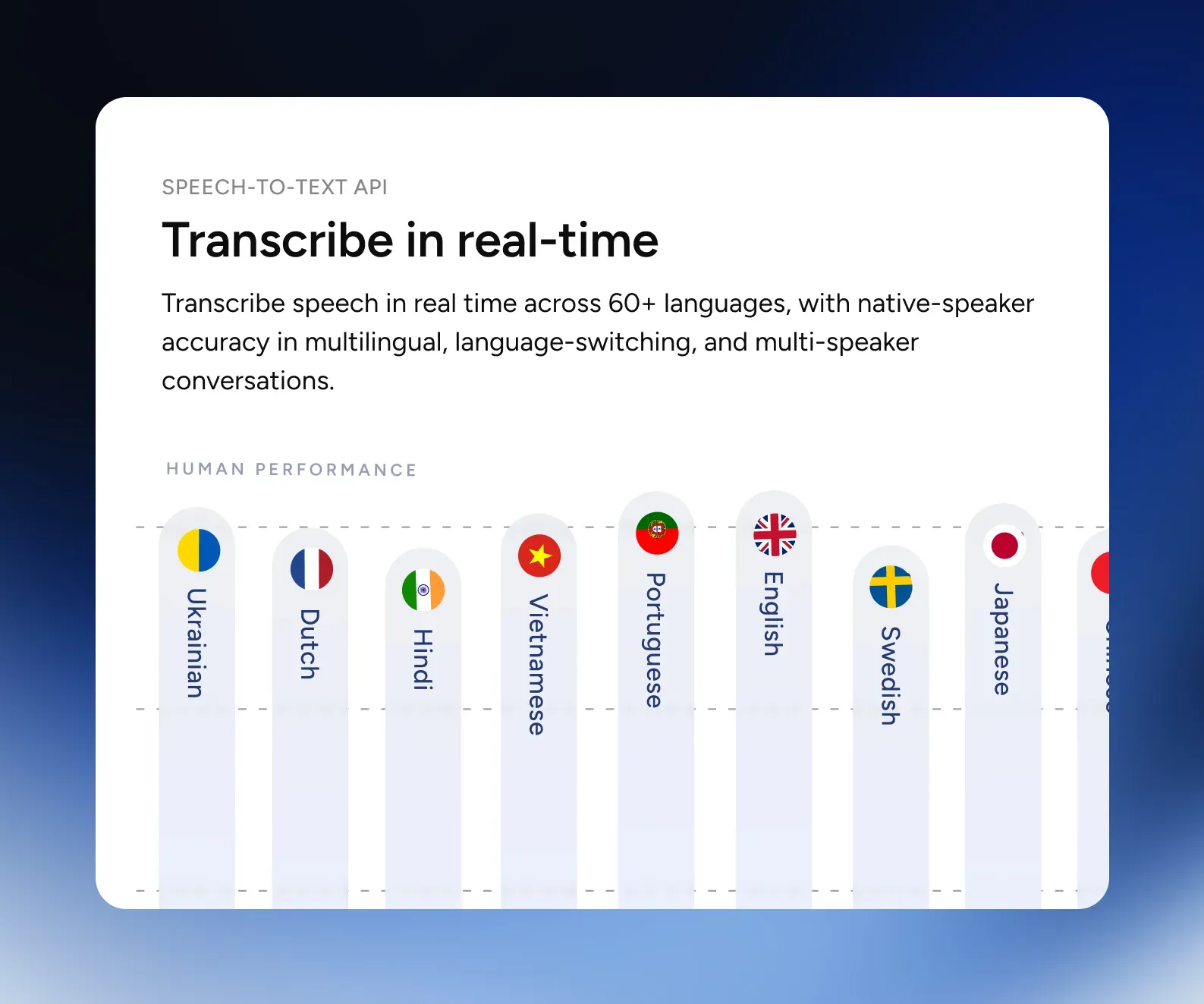
Real-Time Speech-to-Text (STT) – Soniox’s STT API transcribes live speech with sub-200ms latency, supporting 60+ languages. It handles multi-speaker conversations, mixed-language code-switching, and noisy environments. The engine is optimized for fast, streaming transcription that outputs words as they are spoken, without waiting for sentence boundaries.
Text-to-Speech (TTS) with Precision – The TTS API generates natural, high-fidelity speech in 60+ languages. It is built for production challenges like correct pronunciation of alphanumerics (e.g., order IDs, serial numbers), foreign names, and language switching within a single utterance. The output is hallucination-free and supports ultra-low-latency streaming, starting audio generation from the first few words.
Real-Time Speech Translation – Soniox provides real-time translation across 3,600 language pairs. The translation is context-aware and designed for code-switching environments where speakers alternate languages mid-sentence. Output is delivered before the sentence finishes, enabling seamless multilingual communication.
Unified API for STT, TTS, and Translation – Developers access all three capabilities through a single API, simplifying integration and reducing the need to stitch together multiple providers. The API supports streaming and asynchronous modes, with consistent data formats and authentication.
Multi-Region Deployment & Data Residency – Soniox offers in-region processing to meet latency, data residency, and regulatory requirements. The same models and API work across global regions, allowing enterprises to deploy locally while maintaining a unified codebase.
Enterprise-Grade Security & Compliance – The platform is SOC 2 Type 2, ISO 27001:2022, HIPAA, and GDPR certified. Audio is processed in memory and never stored, making it suitable for healthcare, legal, and other privacy-sensitive industries.
Speaker Detection & Language Identification – Soniox automatically distinguishes between speakers in multi-party conversations and identifies languages without manual selection. This is critical for meeting transcription, call center analytics, and voice agent applications.
How It Works
Soniox’s workflow is straightforward for developers. After signing up at the Soniox console, users obtain an API key and choose their desired endpoint (STT, TTS, or translation). For real-time STT, the client streams audio chunks via WebSocket or HTTP/2; Soniox returns transcribed text incrementally with timestamps and speaker labels. For TTS, the client sends text (or SSML) and receives audio streams in return. Translation combines both: audio is transcribed, translated, and optionally synthesized back to speech.
The platform supports multiple programming languages with SDKs and cookbook examples. Developers can configure language, sample rate, punctuation, and formatting. For asynchronous processing, Soniox offers batch endpoints for pre-recorded audio. The entire integration can be completed in minutes, as emphasized by the documentation.
Use Cases
Voice Agents – Soniox powers conversational AI agents that require low-latency speech recognition and natural speech output. For example, a multilingual customer support bot can understand and respond in the user’s language, switching mid-conversation if needed. The sub-200ms STT latency ensures natural turn-taking.
Wearables – Smart glasses, earbuds, and other wearable devices benefit from Soniox’s streaming STT and TTS with minimal delay. Users can dictate messages, get real-time captions, or receive spoken translations without noticeable lag.
Real-Time Speech Translation – In meetings, conferences, or travel scenarios, Soniox translates spoken content across 60+ languages. The system outputs translated text (or speech) before the speaker finishes, enabling fluid multilingual conversations.
Dictation & Voice Typing – Professionals in healthcare, legal, and media use Soniox for accurate dictation. The platform handles medical terminology, alphanumeric codes, and names reliably, reducing editing time.
Call Center Analytics – Soniox transcribes live calls with speaker separation, enabling real-time sentiment analysis, compliance monitoring, and agent coaching. The multilingual support allows global call centers to use a single platform.
Pricing & Value
Soniox offers usage-based pricing for its API, with separate rates for STT, TTS, and translation. The company provides a free tier for experimentation and scales with usage. While exact pricing is not detailed on the homepage, the pricing page outlines transparent per-second or per-character costs. Compared to competitors, Soniox’s pricing is competitive, especially for multilingual use cases where other providers charge premiums for non-English languages. The value proposition is strong for enterprises needing a single, compliant platform for multiple voice AI capabilities.
Final Verdict
Soniox is a compelling choice for developers and enterprises building multilingual voice products. Its strengths lie in native-speaker accuracy across 60+ languages, ultra-low-latency streaming, and a unified API that simplifies integration. The platform’s compliance certifications and multi-region deployment options make it suitable for regulated industries. However, Soniox is a relatively newer player compared to giants like Google and Azure, which may concern some enterprises. Additionally, the API’s documentation, while solid, could benefit from more extensive code examples. Overall, Soniox is a strong, specialized alternative for teams that prioritize multilingual accuracy and real-time performance over ecosystem breadth.