Overview
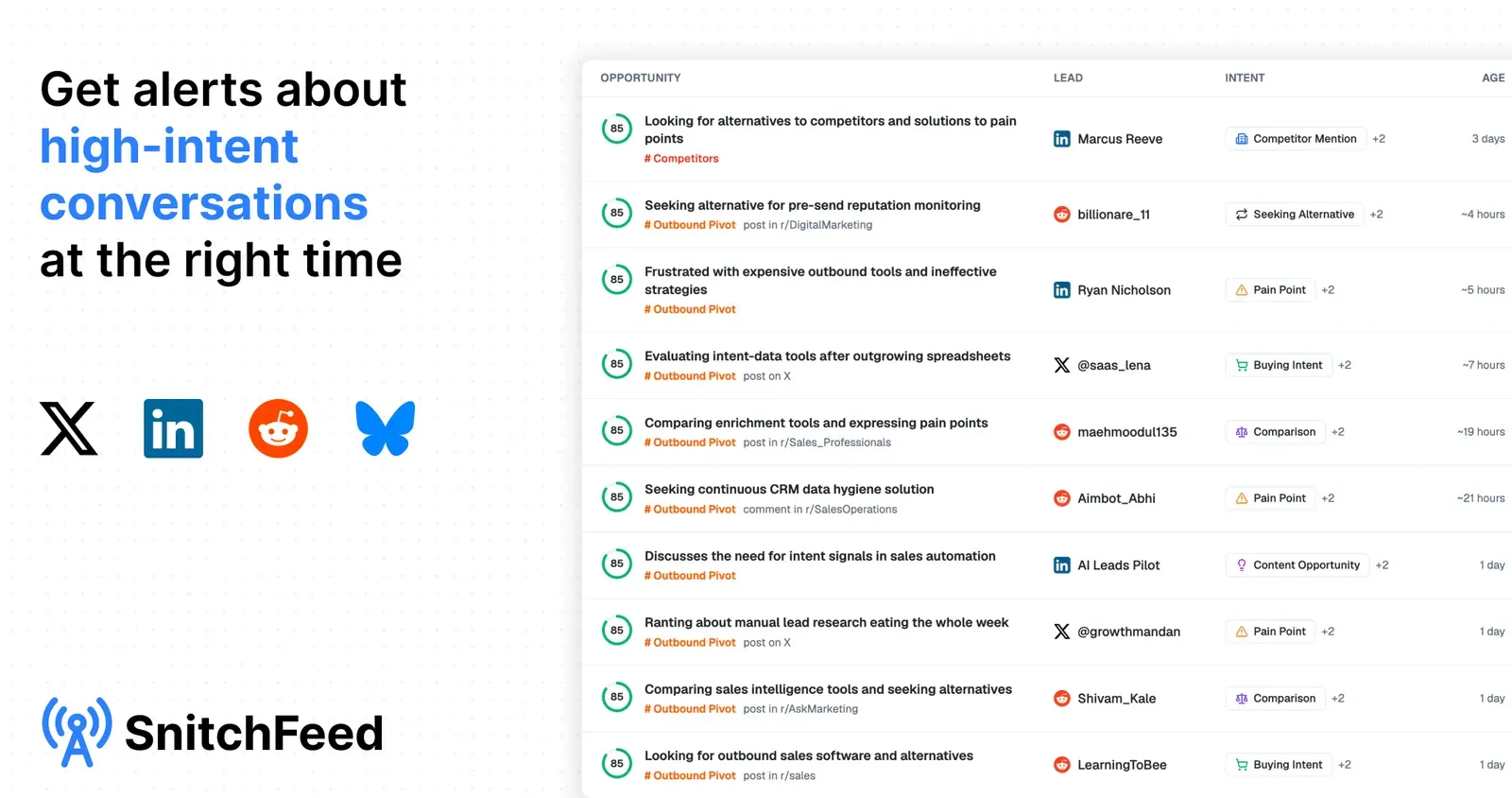
SnitchFeed is a social listening and intent-detection platform aimed squarely at go-to-market teams inside startups and small-to-medium businesses. Instead of mining static contact databases that every competitor also rents, it scans public conversations across the social web and uses AI to isolate genuine buying signals from background chatter. The underlying thesis is straightforward: a prospect who publicly asks "does anyone know a tool that does X?" is materially further down the funnel than any cold outreach target, yet most GTM stacks never see that post in time to act on it.
SnitchFeed positions itself as the layer that catches those moments the instant they appear, then routes them into Slack, Discord, email, or a webhook before competitors even know the conversation happened. The product natively monitors LinkedIn, X (Twitter), Reddit, Bluesky, and Hacker News on live plans, while GitHub, dev.to, YouTube, and newsletters are advertised as forthcoming channels. Packaging leans toward an "agentic era" framing — natural-language intent descriptions rather than filter grids — and the company explicitly courts founders, sales leaders, marketing leaders, and content teams operating with thin headcount and limited budget.
Key Features
Intent-Based Listener Setup. Rather than building rigid keyword lists from scratch, users describe their ideal customer in plain language — job titles, industries, pain points — and the platform translates that into matching logic. The system also auto-excludes job postings, promotions, and other recurring noise, which materially reduces the manual tuning that plagues traditional monitoring tools.
AI Scoring and Tagging. Every incoming match is scored for relevance, intent, and sentiment before it reaches the user's feed. Keyword hits that are not genuine buying signals get dropped, so the inbox stays signal-heavy rather than saturated. Sentiment tagging is applied to every mention, which is what makes the competitor-complaint and brand-crisis workflows viable at all.
Boolean Search Controls. For users who want precision, the platform supports AND, OR, and NOT operators to describe exactly which conversations qualify and which must be excluded. This is a familiar syntax for anyone coming from legacy social listening suites, and it complements rather than replaces the natural-language intent layer.
Multi-Channel Real-Time Alerts. Matches can be delivered to Slack, Discord, or email, and the Pro tier adds webhook automations. Teams choose between instantaneous pings for high-priority signals and digest-style summaries for lower-urgency streams, which matters when alert fatigue is the real enemy.
Instant Historical Backfill. New accounts are not forced to wait for fresh posts to trickle in. SnitchFeed streams historical data in near real time so the first session surfaces opportunities that already exist in the wild, a meaningful onboarding advantage over tools that only see forward in time.
Integration Layer. A webhook fires the moment a match lands, letting teams route leads into HubSpot, Salesforce, Notion, Zapier, Make, or an internal pipeline. The platform also exposes an API and exposes MCP support, which suggests an intent to plug into AI agent workflows rather than remain a standalone dashboard.
Noise and Exclusion Controls. Users can block domains, exclude specific authors, filter by engagement threshold, and mute recurring false positives. These controls are the difference between a tool that stays useful after month three and one that gets abandoned.
How It Works
The journey begins with a free signup and an ICP description typed in natural language. A second option lets users point SnitchFeed at their own domain and derive intent signals automatically, removing the blank-page problem for teams that have not formalized an ICP yet. Once a listener is created, the platform scans the connected sources continuously around the clock, running each candidate post through relevance, intent, and sentiment scoring.
Qualified matches flow into a unified feed where users can triage, reply directly, or push the conversation downstream. Notification routing is configured per listener, so a competitor-complaint alert can go straight to a founder's Slack DM while broader brand monitoring arrives as a daily digest. The final step is stack integration — a webhook pushes the match into the CRM or an outreach sequence, where the lead enters a normal sales workflow with far more context than a cold list would carry. Setup is advertised as roughly five minutes, with first matches promised inside 60 seconds.
Use Cases
Pipeline Generation. Founders monitoring phrases like "recommend a tool for" capture prospects at the moment of expressed need, then reply while the thread is still active. The stated outcome is inbound-grade conversation volume without inbound-grade traffic.
Competitive Displacement. Teams track complaints, outages, and pricing frustrations directed at named competitors. Because sentiment scoring flags negative mentions quickly, a seller can join a public thread and offer an alternative before the incumbent's support team responds.
Product Discovery. Product managers mine unfiltered user complaints to identify feature demand that never reaches a review site or survey. The platform surfaces articulated problems rather than inferred ones.
Brand Reputation Management. Negative mentions are caught within minutes instead of days, enabling public responses that convert frustrated customers into visible advocates. For small brands, the speed of response is often the entire reputational difference.
Content and Community Strategy. Content leads use the feed to find threads worth replying to, which one testimonial on the site credits with converting a comment into a new user within minutes of first login.
Pricing & Value
SnitchFeed runs a three-tier model. The Starter plan sits at $47 per month billed annually ($564 per year) or $59 month-to-month, bundling 7,000 credits monthly, 10 tracked terms and profiles, three listeners, one user, relevance and sentiment scoring, email/Slack/Discord alerts, API and MCP access, and three months of data retention; webhooks and CSV exports are excluded. The Pro plan costs $95 per month annually ($1,140 per year) or $119 monthly, raising limits to 21,000 credits, 30 tracked terms, 10 listeners, five users, six months of retention, and unlocking webhooks and CSV exports. A Custom tier starts at $399 per month with multiple workspaces, bespoke data pipelines, custom integrations, and negotiated limits.
Relative to enterprise social listening suites that routinely clear four figures monthly, the entry price is aggressive. The credit-based metering, however, means heavy monitoring on Starter can hit ceilings quickly, and the gating of webhooks behind Pro is the single biggest functional wall between tiers — it effectively makes Pro the real starting point for teams that want CRM automation. A seven-day trial with no credit card lowers the risk of evaluation considerably.
Final Verdict
SnitchFeed occupies a sensible niche: intent-driven social listening priced for companies that cannot justify an enterprise contract. Its strongest assets are the natural-language listener setup, the AI relevance and sentiment filtering, and the breadth of live sources at this price band. Cross-platform coverage of Reddit, Bluesky, and Hacker News alongside LinkedIn and X is genuinely uncommon in the budget segment, and webhook-first routing keeps it compatible with modern GTM stacks rather than locking data inside a dashboard.
The caveats are worth weighing. Credit-based limits require monitoring, several advertised channels remain unreleased, and webhook automations behind the Pro tier raise the effective entry price for automation-dependent teams. There is also no self-hosted or open-source option, so data leaves the user's infrastructure entirely.
For lean GTM teams that treat public conversations as a primary lead source, SnitchFeed is a credible and comparatively affordable option worth a trial — particularly for those already selling into Reddit and Hacker News communities where traditional databases have no purchase.