Overview
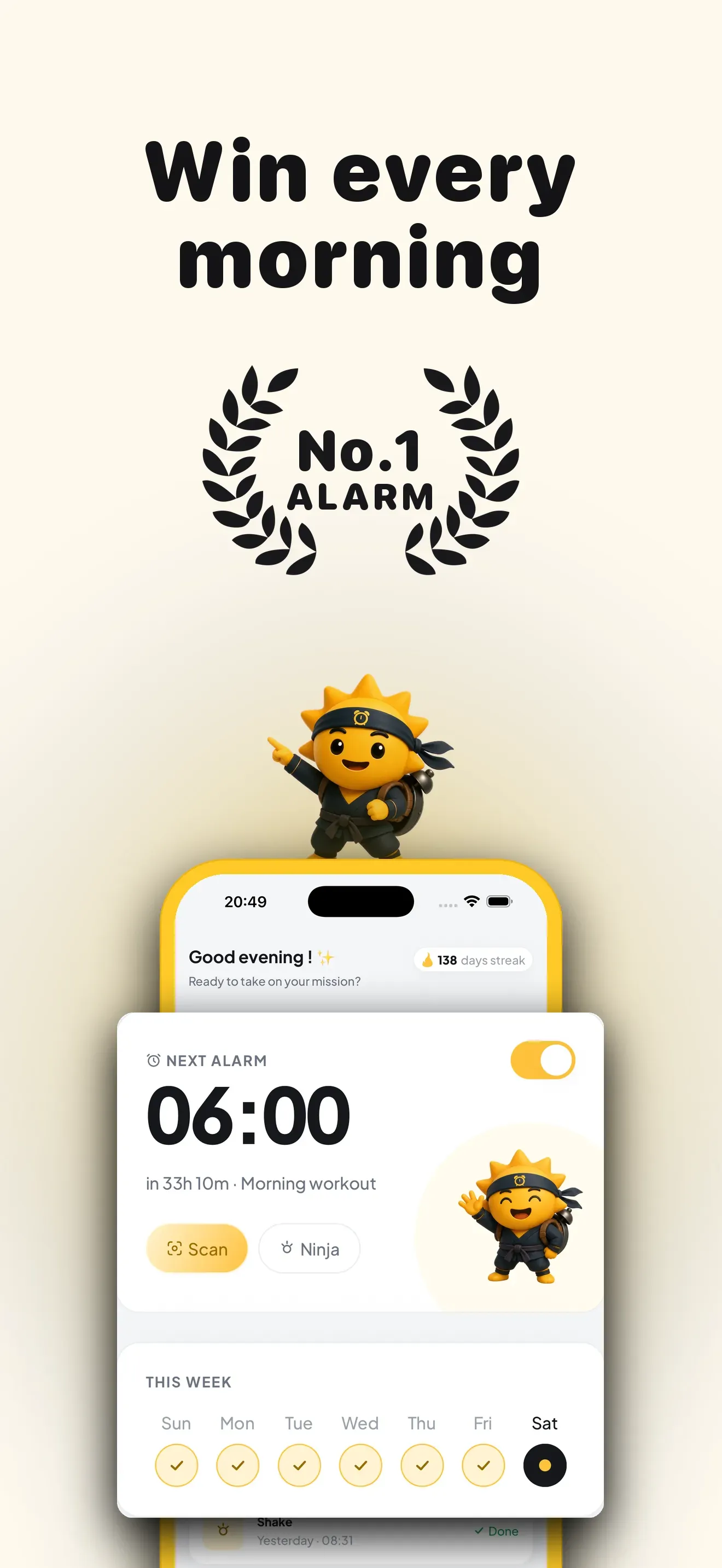
Risly is an iPhone alarm clock application designed specifically for heavy sleepers who struggle with traditional snooze buttons. The app addresses a common problem: people repeatedly hitting snooze and arriving late to work or school. Risly eliminates the snooze option entirely and instead requires users to complete a wake-up mission—such as scanning a household object, solving math problems, shaking the phone, or doing push-ups—before the alarm stops. The alarm bypasses silent mode, Focus modes, and Do Not Disturb, ensuring it cannot be ignored. Positioned as a productivity tool for morning discipline, Risly competes with apps like Alarmy but differentiates itself through its gamified progression system and strict anti-snooze philosophy.
Key Features
Mission-Based Alarm Deactivation – Risly offers four distinct mission types: Scan (photograph a predefined object using the camera), Math (solve chained arithmetic problems), Shake (vigorously shake the phone for a set duration), and Push-ups (the camera counts repetitions). Each mission forces the user to physically or mentally engage, making it impossible to turn off the alarm while half-asleep.
Unstoppable Alarm Engine – Built on Apple's AlarmKit framework, the alarm rings through silent mode, Focus modes, Do Not Disturb, and even if the app is force-quit. The only way to stop it is to complete the assigned mission. This technical implementation ensures reliability for users who have previously outsmarted other alarm apps.
Streak and Grade Progression – Risly tracks consecutive successful wake-ups and assigns users a grade from Apprentice to Legend. The progression system gamifies morning discipline, providing motivation to maintain streaks. Users can view their average wake-up time, alarm kill speed, and favorite mission type in the Insights dashboard.
Multi-Language Support – The app is available in 18 languages including English, French, German, Spanish, Italian, Portuguese, Dutch, Danish, Swedish, Polish, Russian, Turkish, Arabic, Hindi, Thai, Japanese, Korean, and Chinese. This broad localization makes it accessible to a global audience.
Privacy-First Design – Camera-based missions (Scan and Push-ups) process all image data on-device. No photos or video leave the user's iPhone, addressing privacy concerns that often accompany camera-enabled apps.
Before/After Comparison – The website presents a clear contrast between typical morning habits before using Risly (multiple alarms, snooze cycles, rushing) and after (single alarm, up in under three minutes, time for breakfast). This narrative helps users visualize the transformation.
How It Works
The user journey begins by downloading Risly from the App Store and starting a three-day free trial. After setting a wake-up time, the user selects one of four mission types: Scan, Math, Shake, or Push-ups. For Scan missions, the user pre-selects an everyday object (e.g., coffee machine, toothbrush) that must be photographed when the alarm rings. At the designated time, the alarm fires at full volume regardless of the phone's silent switch or Focus settings. The user must then complete the mission—finding the object and scanning it, solving math problems, shaking the phone, or performing push-ups counted by the camera. Once the mission is completed, the alarm stops and the user's streak is updated. The app displays a congratulatory screen with the time and streak count. If the user fails to complete the mission, the alarm continues indefinitely. There is no snooze button anywhere in the app.
Use Cases
Heavy Sleepers Who Habitually Snooze – A user who typically sets five alarms and still oversleeps can use Risly's Scan mission to force themselves out of bed to photograph their toothbrush. The physical act of walking to the bathroom ensures they are awake.
Students Needing Early Study Sessions – A college student preparing for exams can set a Math mission to engage their brain immediately upon waking. Solving arithmetic problems activates the prefrontal cortex, making it easier to transition to studying.
Remote Workers with Flexible Schedules – Without a commute, remote workers often struggle with morning discipline. Risly's Shake mission provides a low-barrier way to start the day with movement, helping establish a consistent wake-up routine.
Fitness Enthusiasts Combining Wake-Up with Exercise – The Push-ups mission turns the alarm into a mini workout. A user can set a target of ten push-ups, and the camera counts each rep. This integrates morning exercise into the wake-up process.
Frequent Travelers Across Time Zones – With support for 18 languages and reliable alarm behavior across Focus modes, travelers can maintain their wake-up schedule even when changing time zones or staying in hotels where silent mode is common.
Pricing & Value
Risly offers a three-day free trial, after which it requires an annual subscription. The exact pricing is not disclosed on the website, but the subscription model is typical for premium alarm apps. The free trial allows users to test the effectiveness before committing. Given the app's specialized functionality and the technical complexity of bypassing iOS restrictions, the subscription is justified for users who genuinely struggle with mornings. However, casual users who only need a basic alarm may find the cost unnecessary. The value proposition is strongest for heavy sleepers who have tried other solutions without success.
Final Verdict
Risly delivers on its promise of an anti-snooze alarm that cannot be ignored. The mission-based deactivation is effective, and the technical implementation ensures reliability. The streak and grade system adds a motivational layer that encourages consistency. However, the app is limited to iOS 26 and later, excluding older devices. The lack of a snooze option may be too extreme for some users, and the annual subscription may deter those who only need occasional use. Overall, Risly is a well-designed tool for a specific problem: chronic oversleeping. It is recommended for heavy sleepers who have exhausted other options and are ready for a strict solution.
For more details, visit the missions page to explore each mission type, or check the FAQ for common questions. The anti-snooze page explains the science behind the approach.