Overview
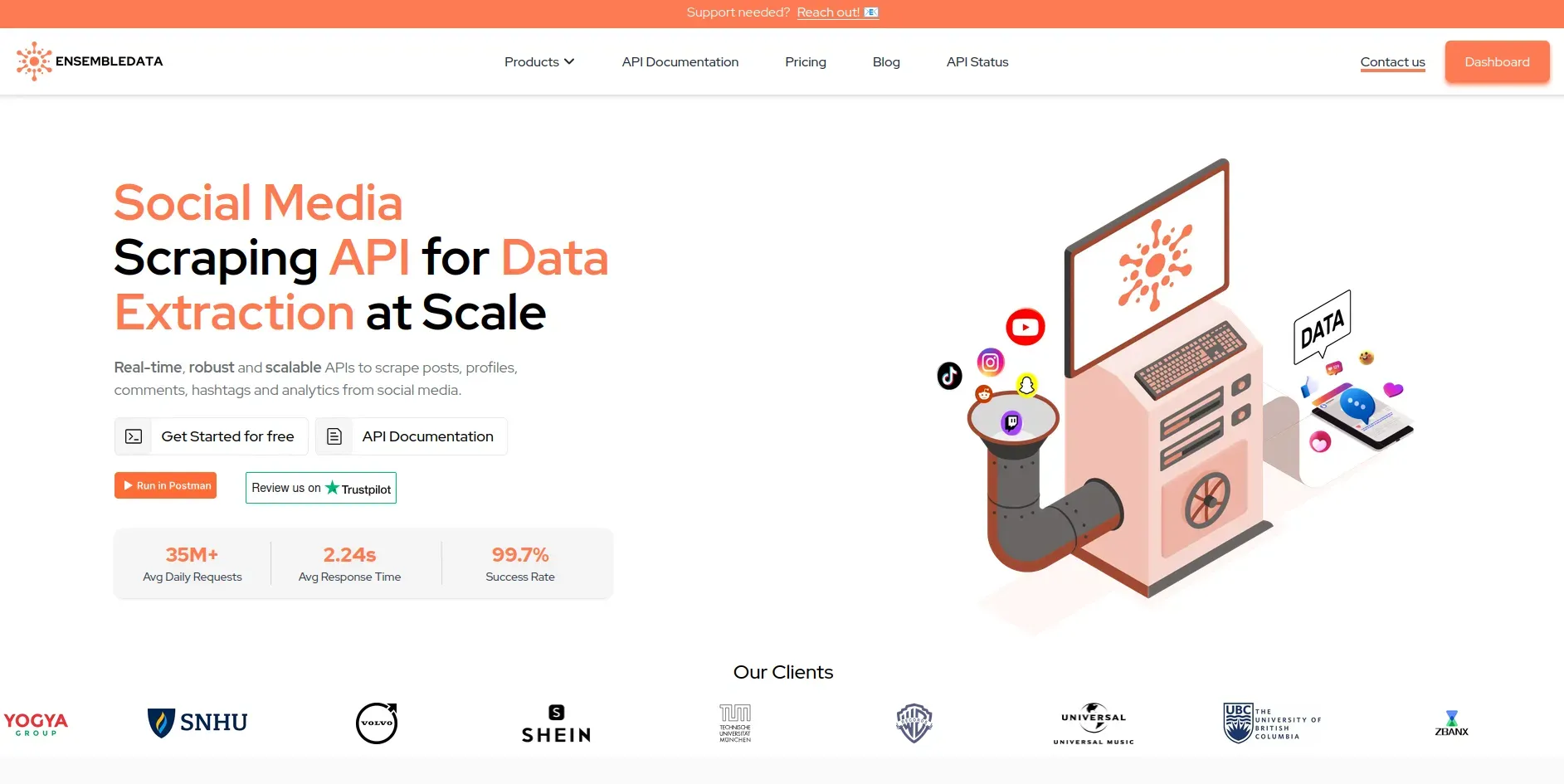
EnsembleData is a unified API platform for extracting public data from major social media networks, including TikTok, Instagram, YouTube, Threads, Reddit, Twitch, Twitter, and Snapchat. It offers real-time, robust, and scalable endpoints to scrape posts, profiles, comments, hashtags, and analytics without requiring user authentication or official API access.
Key Features
-
Multi-Platform Coverage: EnsembleData supports eight social media platforms through a single API, enabling developers to collect data from TikTok, Instagram, YouTube, Threads, Reddit, Twitch, Twitter, and Snapchat without managing separate integrations.
-
Real-Time Data Extraction: Every API call fetches live data directly from the source platform, ensuring that users always receive the most current public information — critical for trend monitoring, live event tracking, and viral content capture.
-
No Authentication Required: Users do not need to provide login credentials or create social media accounts. EnsembleData accesses only publicly available data through its own infrastructure, eliminating account ban risks and simplifying compliance.
-
Scalable Infrastructure: The platform handles millions of requests daily with an average response time of 2.24 seconds and a 99.7% success rate. It manages proxy rotation, retries, and session management automatically, allowing users to focus on data analysis.
-
Developer-Friendly SDKs: EnsembleData provides official Python and JavaScript SDKs (open source on GitHub) that wrap REST endpoints with convenient methods, along with comprehensive API documentation and a step-by-step scraping guide.
-
Enterprise-Grade Support: The service offers dedicated support for integration, compliance, and custom data pipelines, catering to agencies, brands, researchers, and large-scale data consumers.