Overview
CiteTrue is a browser-based citation verification service built around a single, sharply defined problem: modern manuscripts increasingly contain references that do not exist, or that exist but have been altered. The Citation Checker at the centre of the product accepts a pasted reference list, decomposes it into individual citations, and tests each one against a federation of authoritative academic databases before returning a scored report.
The timing is not accidental. Large language models generate fluent prose and plausible-looking bibliographies at the same speed, and the failure rate on the bibliography side is measurable rather than anecdotal. CiteTrue's own evidence section cites peer-reviewed work showing that 55% of GPT-3.5 generated citations were fabricated outright, that ChatGPT-authored medical papers averaged more than four incorrect components per reference, and that 2023 set an annual retraction record above 10,000 papers. A tool that catches these errors before submission addresses a real, documented gap.
Positioning is deliberately narrow. CiteTrue is not a reference manager, not a plagiarism detector, and not a general writing assistant. It is a verification layer that sits between a drafted bibliography and its submission, complemented by three adjacent utilities: Citation Finder, Paper Draft, and an AI Humanizer. The declared audience spans undergraduates through doctoral candidates, plus the reviewers and advisors who evaluate their work. The site reports more than 30,000 students and researchers using the service and advertises a free daily quota of citation checks.
The product competes in a small field of reference-verification tools, and differentiates primarily on database breadth and on the granularity of its diagnostics — field-level comparison and confidence percentages rather than a binary pass or fail.
Key Features
Federated cross-referencing across major academic databases. Each reference is queried against a broad pool of indexes including arXiv, CORE, Crossref, Google Scholar, OpenAlex, ResearchGate, ACM, BMC, Cambridge University Press, Elsevier, IEEE, Open Library, PubMed, ScienceDirect, Semantic Scholar, Springer, Wiley, and additional licensed paid sources. Because no single index covers every discipline, the width of this source pool is the strongest determinant of how many bad references a verifier actually surfaces.
Per-field validation instead of whole-string matching. A citation is split into its component fields — title, authors, year, DOI or other identifier, and venue, volume, and pages — and each field is compared independently against the matched record. The product's framing is direct: a citation can point at a genuine paper and still be wrong. Field-level comparison is what exposes a real title credited to the wrong authors, a year that drifted during copy-paste, or a valid-looking DOI that resolves to nothing.
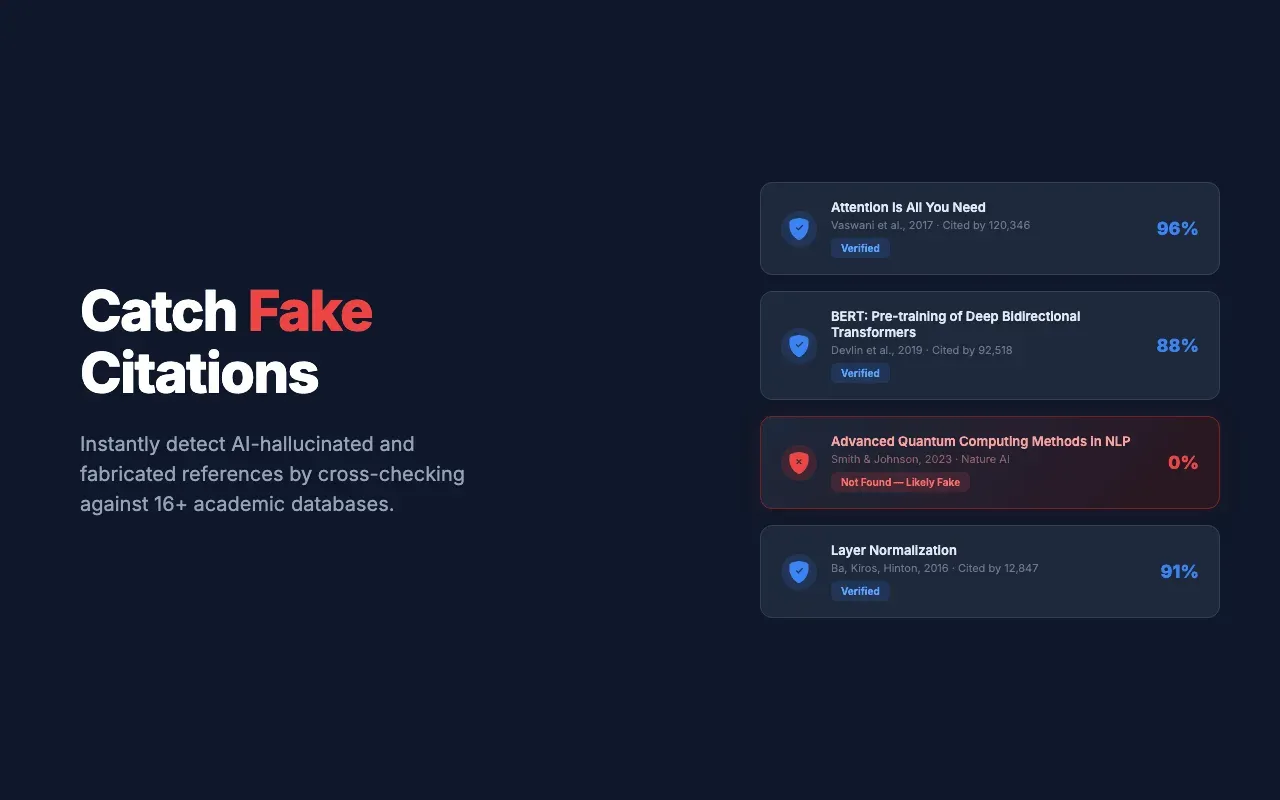
Confidence scoring. Rather than a binary verdict, CiteTrue applies a proprietary scoring model and returns a confidence percentage per reference. The on-page demonstration illustrates the range clearly: a canonical machine learning paper resolves at 100%, a widely cited economics monograph lands at 70%, and an invented entry collapses to 0%. Scores give reviewers a triage signal rather than an absolute judgement.
Detection of fabricated and AI-hallucinated references. The core promise is flagging citations that appear fake or machine-generated. This is supported with published findings rather than marketing language, including Walters and Wilder's 2023 Scientific Reports result, a Cureus analysis of 30 ChatGPT-written medical papers, and Nature's reporting on retraction volume.
Automatic format normalisation. Submitted citations are corrected toward standard formatting before verification, reducing failures caused by inconsistent manuscript styling rather than by bad sources. APA, MLA, and other common styles are advertised as supported.
Batch throughput. Dozens or hundreds of references can be submitted in a single pass with one click. This is the feature that makes the tool viable for doctoral theses, systematic reviews, and editorial intake screening, where per-reference manual checking is simply not realistic.
Two verification depths. Fast mode handles conventional numbered or bulleted reference lists. When text structure is too complex for the fast parser to process reliably, the interface recommends Deep Verify, billed at five credits per reference. The distinction is honest about the cost-versus-robustness trade-off instead of silently failing.
Surrounding toolchain and distribution. CiteTrue bundles adjacent tools — a Citation Finder that locates real peer-reviewed sources behind a paragraph of claims, a Paper Draft generator that ties each sentence to a genuine source, and an AI Humanizer — and reaches users outside the browser via a Chrome extension and a Mac app, with documented API and MCP access for programmatic use.
How It Works
The workflow is intentionally short. A user pastes a reference list into the checker, optionally authenticating first; the parser splits the text into discrete citations, and each one enters a task queue. Queries are dispatched across the database pool, results are aggregated, further queries are issued as needed, and a report is generated containing per-reference confidence scores and field-level diagnostics.
The system handles edge cases rather than failing silently. If no citations are detected, the interface suggests switching to the search-oriented workflow. If in-text citations are recognised instead of a reference list, the tool announces that it is switching to search mode. If the content does not resemble a valid reference list, that is stated plainly. And if the structure defeats the fast parser, users are told to either upgrade to Deep Verify or reformat the text as a standard numbered or bulleted list.
Completed runs are preserved in a history panel for later review, and the interface is localised across eleven locales — English, French, German, Italian, Spanish, Portuguese, Russian, Arabic, Chinese, Japanese, and Korean. Outbound links pass through a redirect interstitial that verifies URL safety before navigation. New users can begin from a free daily allowance without entering payment details, and detailed walkthroughs are available in the user guides for those who want to understand the scoring model before submitting a large manuscript.
Use Cases
Doctoral and master's theses. A dissertation bibliography routinely runs to several hundred entries, and manual verification at that scale is impractical. Batch submission returns a scored report in a single pass, allowing candidates to repair or remove unsupported references before submission rather than discovering them during a viva or a revision request.
Supervisor and advisor review. Advisors checking student manuscripts can screen an entire reference list in minutes and identify fabricated or mismatched citations, converting a task that normally requires trusting the student into one backed by an audit trail. This directly addresses the reputational exposure described in the product's own rationale for instructors.
Journal editorial triage. Editors handling high submission volumes can apply the checker at initial screening to filter out manuscripts with bogus references, freeing reviewer attention for work that is genuinely worth evaluating. For this workflow the confidence score functions as a sorting mechanism, not a verdict.
Literature review and self-checking. Researchers reading others' work can validate the sources a paper depends on, guarding against building new arguments on references that do not hold up. The same process applies reflexively before a researcher's own draft leaves their hands.
Cleaning up AI-assisted drafts. Manuscripts produced with generative assistance are the highest-risk input. The checker is designed for exactly this case, and teams that also need to source real citations for specific claims can pair it with the companion Citation Finder tool to replace invented references with verifiable ones.
Pricing & Value
CiteTrue operates on a credit model layered over a free daily allowance. The site advertises a set number of free citation checks every day, which is sufficient for short course papers and for evaluating whether the tool's scoring is trustworthy on a given discipline's literature. Beyond that allowance, consumption is credit-based, and the Deep Verify mode that handles complex or unstructured text costs five credits per reference — a meaningful multiplier for anyone processing a messy manuscript.
Credits can also be earned rather than bought: an in-product prompt offers both parties a block of credits when a new user signs up through a referral link, and the dialog translates that block into an equivalent number of citation checks, alternative-source searches, or Citation Finder drafts. For a student population this is a sensible acquisition mechanic, and it materially lowers the cost of a first thesis check.
Value depends on volume and on how much the user trusts the output. For occasional use, the free tier is genuinely usable rather than a crippled demo. For heavy or institutional use, the credit economics need to be modelled against the Deep Verify multiplier before adoption. Full tiers and current rates are listed on the pricing page, which is the only reliable source for exact figures; nothing on the checker page itself discloses per-plan limits.
Final Verdict
The case for CiteTrue rests on a problem that is measurable, growing, and expensive to get wrong. Fabricated references are a documented artefact of AI-assisted writing, and the cost of missing them falls on students, advisors, and editors alike. By combining a wide database federation with field-level comparison and confidence scoring, CiteTrue produces diagnostics that are more useful than a binary pass or fail, and it does so at a batch scale that matches the actual shape of academic work.
The toolchain around it — a source finder, a draft generator, a humanizer, a Chrome extension, a Mac app, and documented API and MCP access — turns a single-purpose checker into something closer to a platform, and the eleven-locale interface signals genuine international intent rather than English-first lip service.
The honest caveats are three. Coverage is bounded by the underlying indexes, so niche, very recent, or non-English publications may be marked unverified despite being legitimate — a false positive that matters in specialist fields. The five-credit Deep Verify tier means the messiest manuscripts, which are precisely the ones that need checking most, cost the most to process. And the tool is reference-list oriented, so documents mixing prose claims with bibliographies require a manual split before checking.
For students and researchers who routinely handle large bibliographies, CiteTrue is a practical addition to the pre-submission checklist, and the free daily allowance makes the decision to trial it straightforward. Advisors and editors screening submissions at volume will find the strongest case for adoption. Those working in narrow subfields should validate coverage against their own literature before relying on the scores alone.