Overview
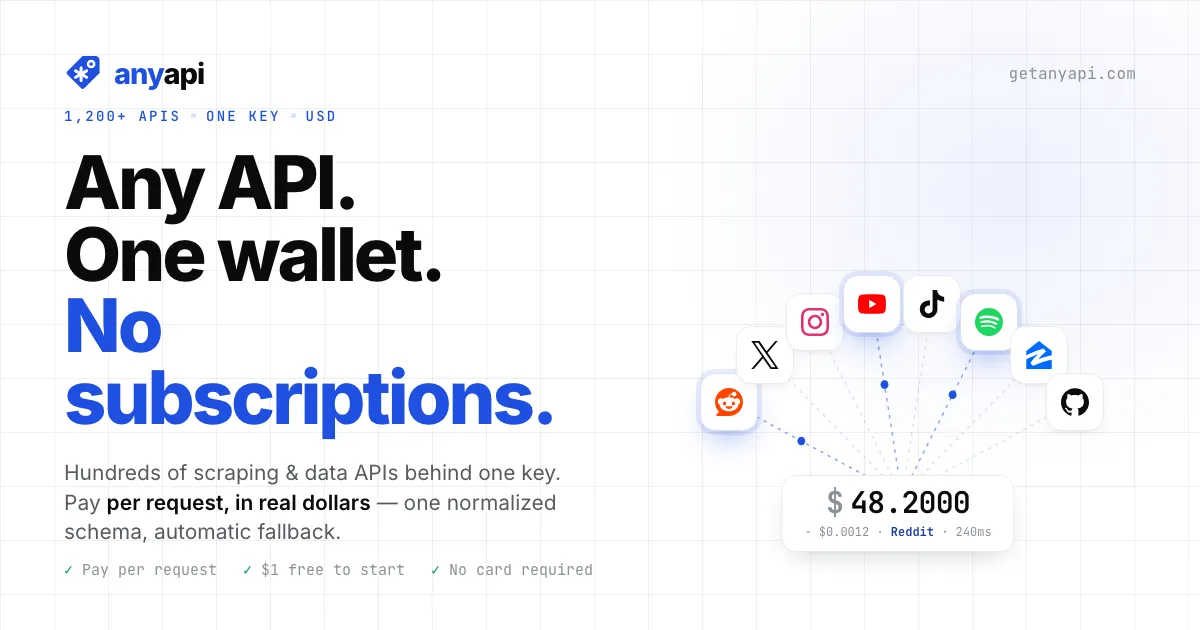
AnyAPI is a platform that aggregates over 1,200 scraping and data APIs behind a single interface, allowing users to access a wide range of data sources—from social media platforms like Reddit, TikTok, and Instagram to e-commerce sites like Amazon and eBay—with one API key and a unified billing system. The core value proposition is eliminating the need for multiple subscriptions, each with its own pricing and key management. Instead, users fund a single wallet in real dollars and pay per request, with no monthly commitments or idle costs. This model is particularly appealing for developers, data analysts, and AI agents that need sporadic or varied data access without the overhead of managing numerous vendor relationships.
AnyAPI positions itself as a middle layer that not only aggregates APIs but also normalizes schemas across providers, offers automatic fallback routing, and provides a comparison interface for choosing the best provider based on price, latency, and uptime. The platform also supports MCP (Model Context Protocol), making it easy for AI agents to integrate and discover APIs dynamically. With a starting credit of $1 and no credit card required, AnyAPI lowers the barrier to entry for exploring its extensive catalog.
Key Features
Unified API Catalog: AnyAPI provides a single endpoint for over 1,200 APIs covering social media, e-commerce, search, and more. Each API is documented with a consistent schema, so developers can switch between providers without changing their integration code. The catalog is searchable and includes detailed pricing per request, making it easy to estimate costs before committing.
Pay-Per-Request Billing: Instead of monthly subscriptions, AnyAPI charges per API call in real US dollars. Users top up a wallet and funds are deducted per request. There are no minimums, no recurring fees, and idle accounts incur no charges. This model is ideal for low-volume or variable usage patterns, as costs scale directly with consumption.
Provider Comparison and Routing: For each API endpoint, AnyAPI aggregates multiple underlying providers (e.g., for Google Search: Serper, DataForSEO, Oxylabs). Users can compare providers by price, latency, and uptime, and set a primary provider with automatic fallback order. If the primary fails, the request is rerouted to the next provider without any change to the response schema, ensuring reliability.
Automatic Fallback and Redundancy: AnyAPI monitors provider health and automatically reroutes requests when a provider is down or returns errors. This failover mechanism is transparent to the user—the same schema is returned regardless of which provider fulfills the request. Failed requests due to provider issues are not charged, adding a layer of cost protection.
MCP Server for AI Agents: AnyAPI exposes an MCP server endpoint that allows AI agents (like Claude Code or Cursor) to discover and call APIs using natural language. The server provides four tools: list_apis, get_api, run_api, and get_balance. This enables agents to autonomously search the catalog, understand schemas, execute calls, and monitor spending without manual integration.
Schema Normalization: Across different providers for the same data type (e.g., TikTok profiles), AnyAPI normalizes the response schema. This means developers write code against a single schema, and AnyAPI handles the translation behind the scenes. This reduces integration effort and makes it easy to switch providers if needed.
Free Discovery and Low Barrier to Entry: AnyAPI offers $1 free credit upon signup with no credit card required. Users can browse the catalog, read documentation, and even make test calls without upfront payment. The MCP server's discovery tools are also free, allowing agents to explore available APIs without incurring costs.
How It Works
-
Sign Up and Get a Key: Users create an account at AnyAPI and receive an API key. A $1 wallet credit is provided automatically, with no payment method required. The dashboard shows the current balance and usage history.
-
Browse the Catalog: The catalog lists all available APIs, each with a description, number of endpoints, and per-request pricing. Users can search by platform (e.g., TikTok, Amazon) or use case (e.g., lead generation, SERP tracking). Each API page shows the request schema, response schema, and available providers.
-
Choose a Provider and Set Routing: For each API, users can view the list of underlying providers ranked by price, latency, and uptime. They can select a primary provider and define a fallback order. AnyAPI will attempt the primary first; on failure, it automatically retries the next provider in the list.
-
Make API Calls: Developers integrate the single AnyAPI endpoint into their application. Requests include the API key and parameters specific to the desired data (e.g., a TikTok username). The response follows a normalized schema, regardless of which provider fulfilled the request.
-
Monitor Usage and Top Up: The dashboard shows real-time balance and per-request cost breakdowns. Users can set up alerts for low balance or high usage. Topping up is done via credit card or other payment methods, with funds added to the wallet.
-
For AI Agents: Agents connect to the MCP server endpoint with the API key. They can then use natural language to discover APIs, understand their schemas, and execute calls. The agent's spending is deducted from the same wallet, and the balance can be checked via the get_balance tool.
Use Cases
Lead Generation from Social Media: A sales team can use AnyAPI to scrape profiles and posts from LinkedIn, Twitter, and Reddit to identify potential leads. For example, searching for "hiring" posts on Reddit or recent job changes on LinkedIn can yield targeted prospects. With pay-per-request pricing, the cost scales with the number of leads generated, making it efficient for small campaigns.
Competitive Research and Price Monitoring: E-commerce businesses can monitor competitor pricing on Amazon, eBay, and Walmart by calling the respective product search APIs. AnyAPI's normalized schema allows comparing prices across platforms without custom integration for each. Automatic fallback ensures data is retrieved even if one provider is temporarily unavailable.
Brand Monitoring and Sentiment Analysis: Marketing teams can track brand mentions across social media platforms like Twitter, Instagram, and Reddit. By setting up periodic API calls, they can collect mentions, analyze sentiment, and respond to customer feedback. The unified billing simplifies budgeting for ongoing monitoring.
AI Agent Data Collection: Developers building AI agents can use AnyAPI's MCP server to give agents autonomous data access. For instance, an agent tasked with researching a company can call LinkedIn for company info, Crunchbase for funding data, and Google News for recent articles—all through a single integration. The agent can discover and use APIs without hardcoding endpoints.
Content Creation and Research: Content creators can gather data for articles or videos by scraping trending topics on YouTube, TikTok, and Reddit. For example, a tech reviewer can pull recent product reviews from Amazon and YouTube comments to gauge public opinion. The pay-per-request model allows small-scale research without committing to a monthly subscription.
Pricing & Value
AnyAPI's pricing is straightforward: users pay per request in US dollars, with no monthly fees or minimums. Each API endpoint has a listed price per request (e.g., $0.0012 for Reddit, $0.0050 for Google Search). The platform offers $1 free credit upon signup, allowing users to test multiple APIs without risk. There are no tiered plans—every user gets the same per-request rates, which are competitive with or lower than typical subscription-based API services when usage is moderate.
Compared to traditional models where each platform charges $49–$199 per month, AnyAPI can be significantly cheaper for low-to-medium volume users. For example, 1,000 Reddit requests cost $1.20, while a dedicated Reddit API subscription might cost $50/month. However, heavy users may find that per-request costs add up quickly; a high-volume operation might benefit from a flat-rate subscription if available. AnyAPI does not offer volume discounts or enterprise plans, which could be a drawback for large-scale deployments.
Overall, AnyAPI provides excellent value for developers and teams that need access to multiple data sources with variable or unpredictable usage. The absence of subscription lock-in and the ability to compare providers for best pricing are strong advantages. For more details, check out their pricing page.
Final Verdict
AnyAPI solves a real pain point for developers and data professionals: the proliferation of API subscriptions with different keys, billing cycles, and schemas. By aggregating over 1,200 APIs behind a single key and pay-per-request billing, it simplifies access and reduces wasted spend on unused capacity. The automatic fallback and provider comparison features add reliability and cost control. The MCP server integration is forward-thinking, making it easy for AI agents to leverage the platform.
However, the platform has limitations. The per-request pricing can become expensive for high-volume use cases, and there are no volume discounts or enterprise plans. The catalog, while extensive, may not cover every niche API, and some providers may have less reliable uptime. Additionally, the platform is relatively new, so the ecosystem of providers and community support is still growing.
For developers building data-driven applications, AI agents, or internal tools that require flexible access to multiple data sources, AnyAPI is a compelling option. It is especially valuable for startups, small teams, and freelancers who want to avoid long-term commitments. For large enterprises with predictable high-volume needs, a traditional subscription model might still be more cost-effective. To explore the full catalog, browse the API catalog. For technical details, read the documentation.