Overview
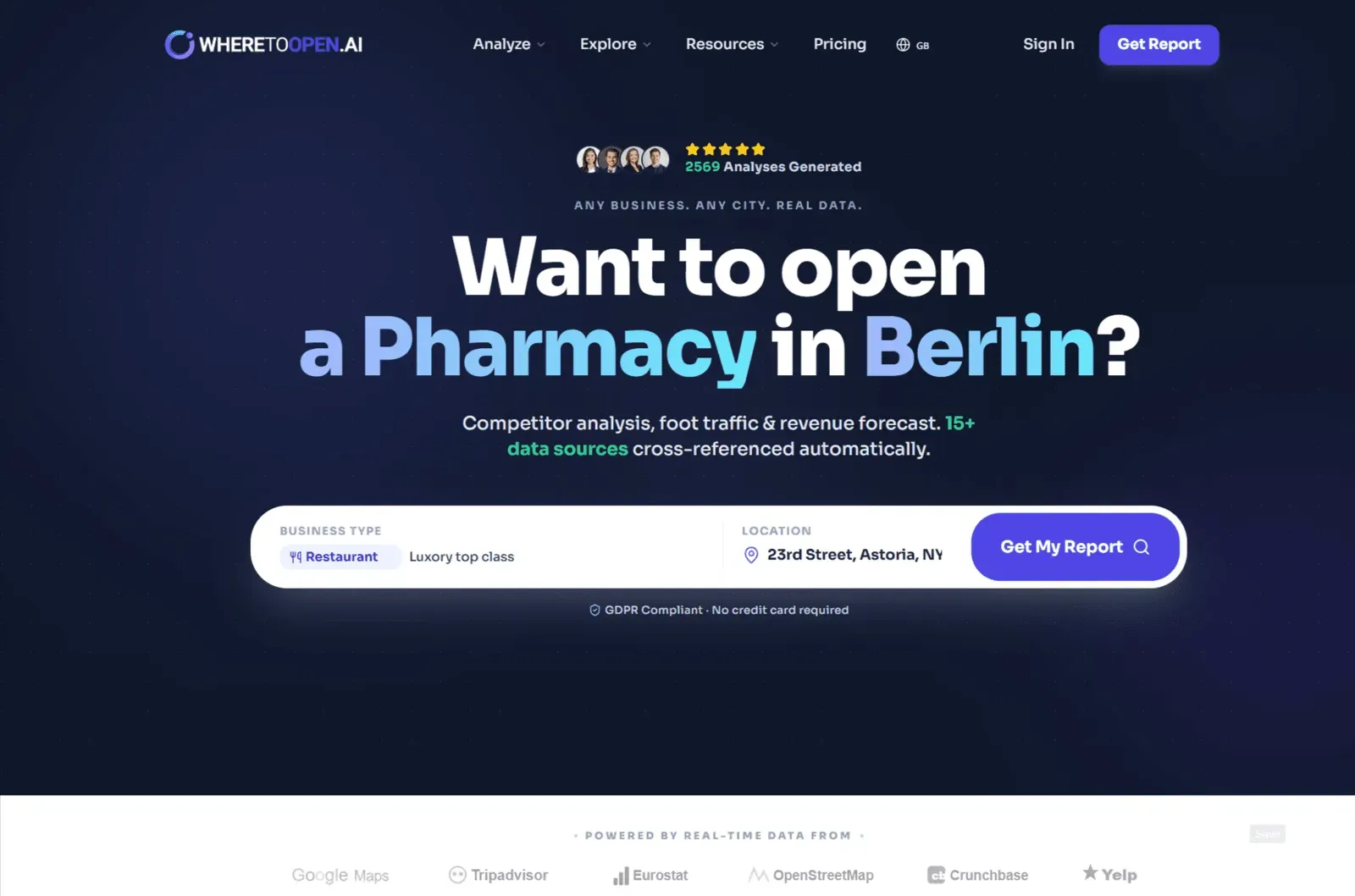
Choosing where to open a new business is one of the highest-stakes decisions an entrepreneur can make. Traditional site selection involved weeks of manual visits, spreadsheets, and guesswork. WhereToOpen.ai aims to change that by providing AI-powered location intelligence for small and medium businesses. The platform generates a comprehensive market report for any address worldwide, covering competitor analysis, foot traffic estimates, demographics, and financial projections. Based on data from 15+ sources, including Google Maps, Yelp, TripAdvisor, and Eurostat, the service targets founders who need data-backed confidence before signing a lease. With free location health checks and paid report tiers starting at €99, it positions itself as an accessible reconnaissance tool for the retail and hospitality sectors. This review examines the platform's features, workflow, use cases, and value proposition in depth.
The service is marketed as the first AI-powered location intelligence platform built for entrepreneurs opening a new business. It combines competitor analysis, foot traffic data, demographic research, and revenue forecasting into a single, actionable report. The website explicitly claims to replace weeks of manual research, and the interactive sample report—showing a bakery analysis in Astoria, NY—demonstrates the kind of output users can expect. The report includes a viability score of 75 out of 100, a competitor count of 15, and a data confidence level of 93%, derived from six verified sources. This is not just a generic directory; it is a structured decision-support tool with a clear UX and a focus on small business owners.
The market positioning is deliberately distinct from heavyweight enterprise tools like Placer.ai or ESRI Business Analyst. Instead of charging thousands of dollars for a subscription, WhereToOpen.ai uses a pay-per-report model that lowers the entry barrier. The free health score, which requires no signup, is a clever lead magnet that gets users instantly engaged. As of the site's metadata, over 1,850 analyses have been generated, and the platform supports 15+ business types and 50+ cities with dedicated guides for restaurants, bars, salons, gyms, and more. This breadth suggests the underlying AI models are trained on a wide variety of verticals, and the location data is global, though the depth may vary by region.
Key Features
Location Intelligence
The core feature is an AI-powered location score that evaluates foot traffic, accessibility, and walkability. Rather than showing raw counts, the platform synthesizes multiple factors into a 0–100 scale, making it easy to compare areas at a glance. For example, the sample report shows a "HIGH POTENTIAL" rating with a 75% viability score, and breaks down the contribution of demand, competition, and demographics. This is a substantial upgrade over looking at a map and guessing whether a street feels busy.
Competitor Analysis
WhereToOpen.ai aggregates real-time information on competitors within a chosen radius. The analysis includes exact locations, Google review ratings, prices, opening hours, and even sentiment from review language. The sample report visualizes competitor bars with scores like 92, 78, 64, and 48, and claims to use data from 15+ sources. For a founder, this can reveal whether an area is saturated, where the weakest competitors are, and what price points appear to be under-served.
Revenue Forecasting
The financial modeling portion projects revenue using three scenarios—likely, conservative, and optimistic—and includes break-even timelines. The website shows a "24-mo cashflow" indicator with a +80K projection, suggesting that the tool provides a monthly or yearly cash flow view. This moves beyond simple demographic summaries and gives users a sense of whether the business can survive the initial period. It also accounts for costs, as the break-even calculator is mentioned as a separate feature.
Customer Personas
The AI also generates customer profiles based on local demographics and spending patterns. In the sample report, personas include "Maria, Nurse, 32" with a spend range of $15–40, "David, Developer, 28" with $30–70, and "Sarah, Consultant, 41" with $25–55. These fictional but data-informed profiles help entrepreneurs tailor menu pricing, marketing messages, and operating hours. This is a feature typically found in enterprise market research, now abstracted into a small business format.
Strategic Action Plan
Instead of just presenting data, the platform translates insights into a prioritized action plan. The sample shows tasks ranked P1, P2, P3, with progress bars and an overall score. Examples include "Secure prime location" (90% progress), "Build supplier network" (65%), and "Launch loyalty program" (40%). This is essentially an AI consultant that tells the user what to do next, which is valuable for first-time founders who may not know how to operationalize a report.
PDF Export & Sharing
Every report comes with a PDF export feature, described as "investor-ready." The sample report shows a 10-page interactive document that can be scrolled or exported. This is a critical feature for entrepreneurs who need to present their location analysis to banks, investors, or partners. The sharing functionality also allows embedding or sending a link, which facilitates collaboration with co-founders or advisors.
Free Location Health Score
The website prominently features a free tool that scores any address and business type on a 1–100 scale across demand, competition, and demographics. No signup or credit card is required, and the result is instant. This acts as a low-friction preview of the paid product, and it can be used repeatedly to shortlist multiple locations before committing to a full report. The health score tool is positioned as a separate utility, but it is clearly a gateway to the paid analysis.
How It Works
The first step is to specify a business type and a target city or area. The homepage's search form has an autocomplete field for business type (e.g., restaurant, bar, hair salon, gym) and a location input. Users can also access dedicated pages for specific business types and cities, such as London restaurant costs or city comparison tools. Once the inputs are submitted, the AI engine begins querying its data sources.
Behind the scenes, the system cross-references Google Maps for competitor data, Yelp and TripAdvisor for reviews and sentiment, OpenStreetMap for foot traffic and walkability, and demographic databases like Eurostat and Crunchbase for market context. The aggregation and scoring model then computes a report. The site claims the full analysis takes less than 60 seconds, which is ambitious but realistic given that the data queries are automated.
The output is a multi-page report dashboard. Page one shows an executive summary with an overall viability score, competitor count, confidence level, and data points. Subsequent pages detail competitor maps, foot traffic trends, demographic breakdowns, customer personas, revenue forecasts, and a priority action plan. Users can scroll through the sample report to see the layout, and they can export the PDF or share a link.
For those who only want a quick read, the free health score offers a single number. Users enter an address and select a business type, and the tool returns a 1–100 score with no registration. This allows users to evaluate several locations in minutes before deciding whether to purchase a full report. The free first report, mentioned in the pricing section, means that even the paid product has a trial element.
Use Cases
Restaurant Opening in London
A restaurateur considering a new pizza place in Soho could use the report to compare foot traffic between two streets. The competitor analysis might reveal an intense cluster of established pizzerias with high ratings, while the demographic data shows a strong late-night crowd. The revenue forecast could then advise a target price point and expected break-even period. Without the tool, this research would require days of manual visits and spreadsheet building.
Gym in Dubai
The website shares a success story of a fitness studio founder in Dubai who avoided an €80,000 lease mistake. The report showed zero foot traffic after 7 PM in the proposed location, which was a dealbreaker for a gym. This is an example of how the location score and foot traffic data can prevent costly errors that are invisible during a single site visit.
Hair Salon in Rome
A hair salon owner used the competitor pricing data to position as a premium service. The report showed average prices in the area, which enabled the owner to set rates 15% above market and still attract the right clientele. This is a concrete outcome of the pricing and positioning insights.
Comparing Multiple Locations
With the Standard plan, users can run up to three reports and compare them side by side. An entrepreneur opening a café in Paris might evaluate three arrondissements using the same business type, then overlay the viability scores and revenue projections to identify the best opportunity. The city comparison tool on the site even allows direct head-to-head comparisons like London vs Paris, which speeds up the decision process.
Shortlisting with the Free Health Score
A solo founder with a tight budget can use the free health score to screen a long list of neighborhoods before investing in a full report. For example, someone opening a bakery in New York could test 20 addresses over a lunch break, note the scores, and then purchase a paid report only for the top two or three. This makes the platform accessible even to pre-revenue entrepreneurs.
Pricing & Value
Pricing is structured in three flat tiers. The Starter plan costs €99 and includes one full report with competitor analysis, revenue projections, location score, and PDF export. The Standard plan at €249 provides three reports, the ability to compare locations, customer persona insights, and priority processing—a 16% savings per report. The Pro plan at €790 includes ten reports, seasonal forecasts, and supplier network intelligence, reducing the cost per report to €79.
There is also a free first report, which mitigates risk. For a one-time decision like site selection, the fee is comparable to hiring a consultant for a single session, but it is significantly cheaper than a full commercial location intelligence subscription. For a pre-revenue startup, €249 may still feel steep, but the depth of data and actionable output justifies it for serious founders. The pay-per-report model is refreshingly straightforward compared to monthly subscriptions, though it lacks a la carte options for users who only need a single data module. The pricing page explicitly lists what each tier includes, and the absence of a free trial beyond the first report is a minor friction point.
Final Verdict
WhereToOpen.ai fills a clear gap for SMBs and independent entrepreneurs who cannot afford traditional location consulting. Its strengths lie in its speed, breadth of data, and clear presentation of complex factors. The inclusion of a free health check and a free first report lowers the barrier to testing the service. The platform's output is structured in a way that is immediately actionable, which is rare in the analytics space.
However, the platform is not without limitations. The accuracy of the AI output depends on the quality of public data, and in less-documented regions, the confidence scores may be less reliable. Additionally, the user interface, while polished, still requires manual input of business type and location, and there is no offline mode. The website's claims about "AI-powered" analysis are not broken down into model specifications, which may concern technically inclined users.
Overall, for a founder about to sign a lease, the €99 investment is trivial compared to a multi-year commitment. It is a recommended starting point for anyone evaluating a new business location—provided they treat the report as a decision aid, not a guarantee. For those who want to explore before buying, the free health score and the detailed restaurant guide offer a taste of what the full platform can deliver.