Overview
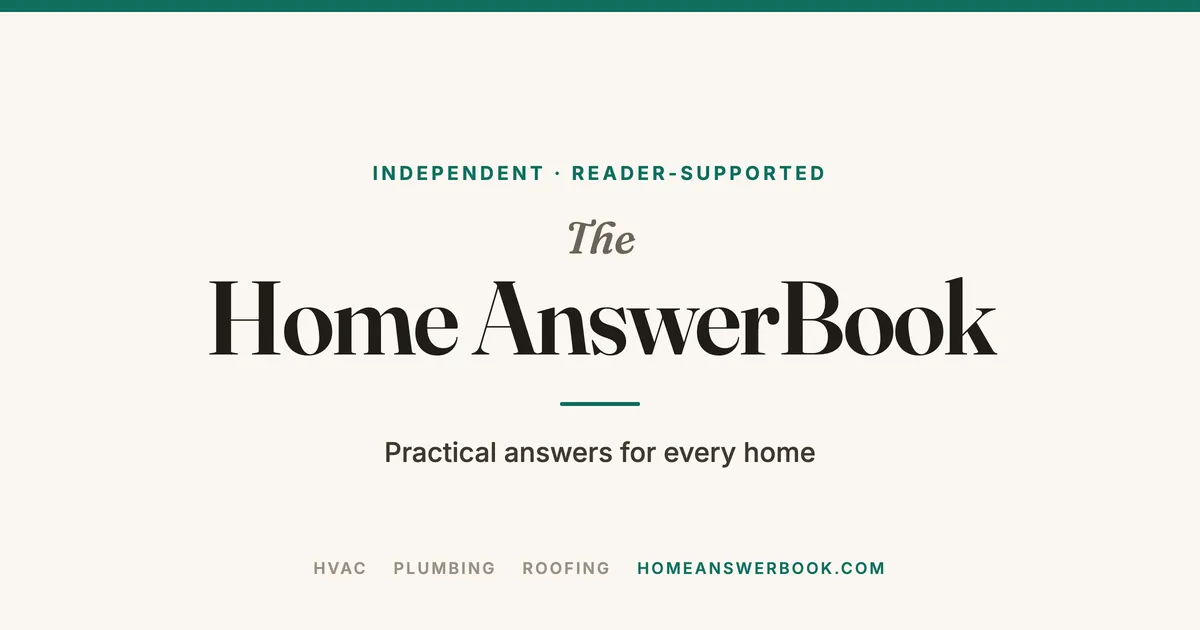
The Home AnswerBook is an independent, reader-supported publication built around a single premise: homeowners deserve straight answers about their houses without being funnelled into a contractor lead-capture form. The site publishes explainer articles organised into topical hubs covering HVAC, plumbing, roofing, electrical systems, appliance repair, pest control, lawn and garden care, garage doors, painting, and flooring — ten verticals in total, which is unusually broad for a publication of this size.
The problem it addresses is structural rather than technical. Search queries for household malfunctions — a dryer that spins but never heats, a garage door that groans on every cycle, a breaker that keeps tripping — are dominated by two kinds of results: lead-generation sites that withhold the answer and request contact details instead, and manufacturer documentation that assumes a single brand and model. The Home AnswerBook takes the opposite approach, publishing the diagnostic reasoning openly and marking clearly where a task stops being reasonable DIY work. Its masthead states the editorial stance directly: "Independent · Reader-supported · No sponsored posts."
Positioned somewhere between a consumer-advocacy publication and a practical maintenance manual, the site competes less with software and more with the general-interest home sections of large media outlets and the SEO-driven content farms that outrank them. Its differentiation rests on editorial discipline — disclosed funding, stated limitations, and cost figures that are attributed to a specific year rather than left vague.
Key Features
Topic Hubs Spanning Ten Home Systems The site is organised around ten category hubs: HVAC, Plumbing, Roofing, Electrical, Appliances, Pest Control, Lawn & Garden, Garage Doors, Painting, and Flooring. Each hub carries its own landing page, article count, and a cross-linked navigation bar that persists across the entire site. The breadth means a reader investigating a water-heater failure can move laterally to plumbing cost guides without leaving the domain, which is a meaningful advantage over single-trade blogs.
Diagnostic-First Article Structure Every explainer follows a recognisable template: a breadcrumb trail, a category kicker, a headline framed as the query itself, and a descriptive deck that pre-answers the question in one or two sentences. Individual articles open with a highlighted "short answer" panel before the long-form body, followed by a numbered table of contents, structured H2 and H3 sections, and a FAQ block at the foot of the page. This layering lets a reader stop at the summary or continue into the full diagnostic sequence depending on how much depth is needed.
Explicit Safety and Handoff Guidance Rather than implying that everything is fixable at home, the publication draws boundaries. The site-wide disclaimer explicitly instructs readers to hire licensed and insured professionals for gas work, electrical wiring, structural changes, and roof work at height. Individual articles reinforce this — for example, the guide to signs of an overloaded electrical circuit treats warm outlets and buzzing sounds as escalation triggers rather than DIY prompts. That restraint is rarer than it should be in this content category.
Cost Transparency with Dated Price Ranges Several articles are built entirely around budgeting, including guides to room painting costs, roof replacement costs, new AC unit costs, and hardwood flooring costs, all framed with 2026 pricing. Publishing a year against a price range is a small but consequential detail: it signals that figures will be revisited rather than left to decay silently, and it gives readers a reference point when comparing contractor quotes.
Read-Length Signalling and Editorial Metadata Article cards carry estimated reading times — most fall between five and ten minutes — alongside category labels and publish metadata. Byline blocks separate the publication's identity from the content itself, and the layout uses a serif display face for headings against a sans-serif body, a typographic choice that reads more like a magazine than a content farm.
Disclosed Revenue Model and Editorial Policy A dedicated editorial policy page covers how the publication funds itself, and the footer repeats the independence claim alongside a legal disclaimer. The site states plainly that there are no sponsored articles and nothing for sale, which is the clearest signal of intent available on the domain.
Lightweight, Reader-First Presentation The interface avoids interstitials, autoplay video, and newsletter walls. Navigation is a sticky masthead with direct category links, article pages use a two-column layout with a sticky sidebar, and the responsive breakpoints collapse cleanly to single-column reading on small screens.
How It Works
A typical journey begins in a search engine with a symptom-shaped query. The reader lands directly on an article such as the dryer-heating explainer, where the deck immediately names the three most probable causes — lint buildup, a failed heating element, and a blown thermal fuse — before any scrolling occurs.
From there, the page structure guides rather than demands. A highlighted short-answer box condenses the verdict. A numbered table of contents exposes the article's skeleton so a reader can jump straight to a suspected cause. The body then walks through each possibility in order of likelihood and difficulty, using bolded terms, ordered lists, comparison tables, and occasional blockquotes for manufacturer or standards references. Safety notes appear inline where a step involves mains power, gas, or roof access.
At the foot of the article, an FAQ section handles adjacent questions that did not warrant their own section, and a related-articles block routes the reader to sibling content in the same hub. A second reader path runs through the hub pages: someone arriving at the HVAC topic hub sees the full article roster, can sort by interest, and can move to the plumbing or electrical hub from the persistent navigation. The third and least-travelled path leads to the about and editorial policy pages, which are where the funding model and the site's limitations are documented.
Use Cases
Diagnosing an Appliance Failure Before Booking a Service Call A homeowner whose dryer runs but produces no heat can work through the published diagnostic order — vent restriction first, then thermal fuse, then heating element — and determine whether the fault is a maintenance issue or a component failure. The concrete outcome is either a self-resolved fix or a more precise description to give a technician, which reduces the risk of paying for a diagnostic visit that ends in a guess.
Budgeting a Major Replacement Someone facing a roof at end of life can read the roof replacement cost guide alongside the repair-versus-replacement decision article and arrive at a defensible budget range before contacting contractors. Because the figures are dated and the variables — materials, region, scope — are itemised, the numbers hold up when compared against real quotes.
Evaluating Whether a Job Is Safe to Attempt The electrical and roofing content is written with explicit escalation criteria. A reader noticing warm outlet plates or flickering lights alongside tripped breakers gets a clear signal that the circuit is overloaded and requires a licensed electrician, rather than a set of instructions for opening the panel.
Seasonal Property Maintenance Planning The lawn and garden hub covers fertilisation timing, weed control, and watering frequency by season. Read together, these articles function as a rough annual calendar for exterior upkeep, which is useful for new homeowners who have never managed a property before.
Resolving Recurring Annoyances Without a Contractor Small but persistent problems — a squeaky floor, a loud garage door, a slow drain — are covered with multiple ranked methods and an honest note about when the DIY route stops being cost-effective. The outcome is a decision rather than a single prescribed fix.
Pricing & Value
The Home AnswerBook is entirely free to read. There is no paywall, subscription tier, membership programme, or premium content layer, and the publication states that it has nothing for sale. Funding is described as reader-supported, with the revenue explanation published openly on the editorial policy page. For a reader, the value calculation is straightforward: the cost is attention and the return is a diagnostic framework plus cost benchmarks that would otherwise require several contractor conversations to assemble. The main caveat is that value scales with how closely a specific problem matches the existing library — a reader with an unusual or highly specialised issue will find a thinner set of answers.
Final Verdict
The Home AnswerBook occupies a defensible niche. Its editorial boundaries are clearly drawn and honestly disclosed, its article templates are consistent enough to be trustworthy, and the decision to date cost figures rather than publish timeless-sounding ranges is a genuine editorial improvement over most competitors. The safety guidance — repeatedly directing gas, mains electrical, structural, and roof-height work to licensed professionals — is the site's most responsible feature and the clearest indicator that the publication is not optimised purely for pageviews.
The limitations are equally clear. The library is young: several hubs list only two to four articles, and the content leans heavily toward diagnostics and cost expectations rather than product comparisons or long-term maintenance planning. There are no interactive tools, calculators, or community features, so follow-up questions have nowhere to go beyond the FAQ blocks. Readers should also treat the cost ranges as directional starting points shaped by region and scope, not as quotes.
For homeowners who want plain-language explanations and an honest signal about when to stop, the publication is worth bookmarking alongside a home maintenance log. It is less useful as a primary reference for anyone renovating at scale or seeking brand-level buying advice.