Overview
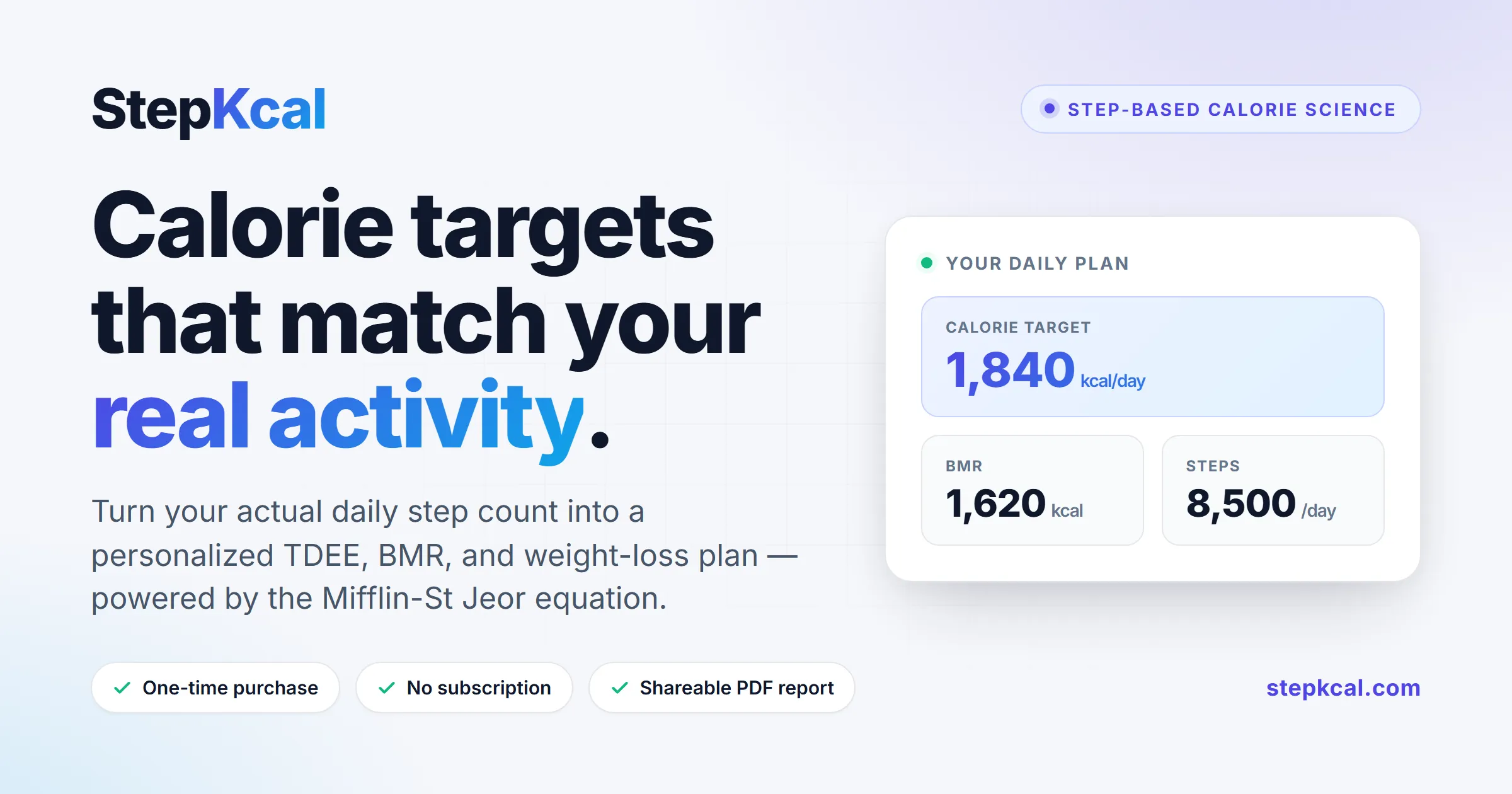
StepKcal is a specialized web application that calculates personalized calorie targets based on a user's actual daily step count, rather than relying on generic activity level estimates. The tool addresses a common frustration in weight management: the inaccuracy of standard calorie calculators that ask users to self-assess their activity level as "sedentary," "lightly active," etc. By using objective step data from fitness trackers or smartphones, StepKcal aims to provide a more precise Total Daily Energy Expenditure (TDEE) and corresponding calorie deficit for weight loss. The product positions itself as a science-backed, no-subscription alternative to diet apps, with a single $1.99 fee for a detailed report. Its target audience includes health-conscious individuals, fitness enthusiasts, and anyone seeking a data-driven approach to weight management without ongoing costs.
Key Features
Step-Based TDEE Calculation – The core feature uses the Mifflin-St Jeor equation to estimate Basal Metabolic Rate (BMR), then adds calories burned from daily steps and non-step activity (NEAT) to compute TDEE. This approach replaces vague activity multipliers with real step data, improving accuracy for users with consistent step counts.
Personalized Weight-Loss Paces – The report offers three deficit options: a recommended pace (0.5 kg/week), a moderate pace (0.5 kg/week), and an aggressive pace (0.7 kg/week). Each pace shows the corresponding daily calorie target, making it easy to choose a sustainable deficit based on individual goals and tolerance.
Macronutrient Breakdown – For each calorie target, the report provides a suggested macronutrient split (30% protein, 40% carbs, 30% fats) with gram amounts. This helps users translate calorie goals into actionable meal planning, though the split is fixed and not customizable.
Weekly Weight Projection – A table shows projected body weight week by week until the goal weight is reached, for all three paces. This visual timeline helps users set realistic expectations and track progress over time.
BMI Assessment – The report includes a BMI calculation with a color-coded scale and a marker showing the user's current position. It also indicates how much weight needs to be lost to reach a healthy BMI range, providing context for the weight-loss plan.
Detailed Calculation Breakdown – A transparent section lists each component of the TDEE calculation: BMR, calories from steps, NEAT, and the resulting deficit targets. This builds trust by showing exactly how numbers are derived.
One-Time Purchase Model – Unlike subscription-based apps, StepKcal charges a single $1.99 fee (with a limited-time discount from $2.99) for a full report. There is no account creation or recurring payment, which lowers the barrier to entry.
How It Works
The user journey begins on the homepage, where a form collects essential inputs: age, gender, height, weight, desired weight, daily steps, and walking pace. The form supports both metric and US units via a toggle. After filling in the fields, the user clicks "Get My Calorie Plan – $1.99" to proceed to payment. Once purchased, the system generates a personalized report that includes all the features described above. The report is presented as a static page that can be saved or shared via a unique link. The entire process is designed to be quick — no signup, no app download, just input, pay, and receive the plan. The preview section on the homepage shows example data from a sample report, giving users a clear expectation of what they will receive.
Use Cases
A desk worker with 5,000 daily steps – Someone with a sedentary job who walks only during commutes can input their step count and get a realistic TDEE. The calculator will show a lower maintenance calorie level than standard "lightly active" estimates, helping them set a more accurate deficit.
A fitness enthusiast tracking 12,000 steps – An active individual who already walks a lot can see how their step count contributes to their TDEE. The report may reveal that their maintenance calories are higher than expected, allowing them to adjust their diet accordingly without undereating.
A person aiming for slow, sustainable weight loss – The recommended 0.5 kg/week pace is ideal for someone who wants to lose weight gradually without extreme restriction. The macro breakdown helps them plan meals that fit the calorie target.
A user comparing different deficit levels – Someone unsure about how aggressive to be can view all three paces side by side. The weekly projection table makes it easy to see the time difference between losing 0.5 kg/week vs. 0.7 kg/week.
A health coach or trainer – Professionals can use StepKcal to generate quick, data-backed calorie plans for clients. The transparent calculation breakdown helps explain the science behind the numbers, building credibility.
Pricing & Value
StepKcal offers a single pricing tier: $1.99 for one report (regularly $2.99, with a limited-time discount). This is a one-time purchase with no subscription or recurring fees. Compared to popular diet apps that charge $10–$30 per month, StepKcal is significantly cheaper for a one-off calculation. However, the value is limited to a single report — users who want to track progress over time or adjust inputs would need to purchase again. The lack of a dashboard, progress tracking, or meal logging means the tool is best suited for a one-time planning session rather than ongoing use. For the price, the depth of the report (TDEE, macros, weekly projection, BMI) is reasonable, but users expecting a full-featured app may be disappointed.
Final Verdict
StepKcal delivers on its promise of a step-based, personalized calorie plan with a clean interface and transparent methodology. The use of actual step data is a genuine improvement over generic activity level estimates, and the one-time pricing model is refreshing in a market dominated by subscriptions. The report is comprehensive enough for a one-off planning session, covering TDEE, macros, and weekly projections. However, the tool has limitations: it does not offer food logging, progress tracking, or integration with fitness apps, and the macronutrient split is fixed. Users who need ongoing support or customization may find it insufficient. Overall, StepKcal is a solid choice for anyone who wants a quick, science-backed calorie target based on their real activity — especially at the low price point. For more details, check out their pricing or read their blog for additional insights. You can also view their privacy policy for data handling information.