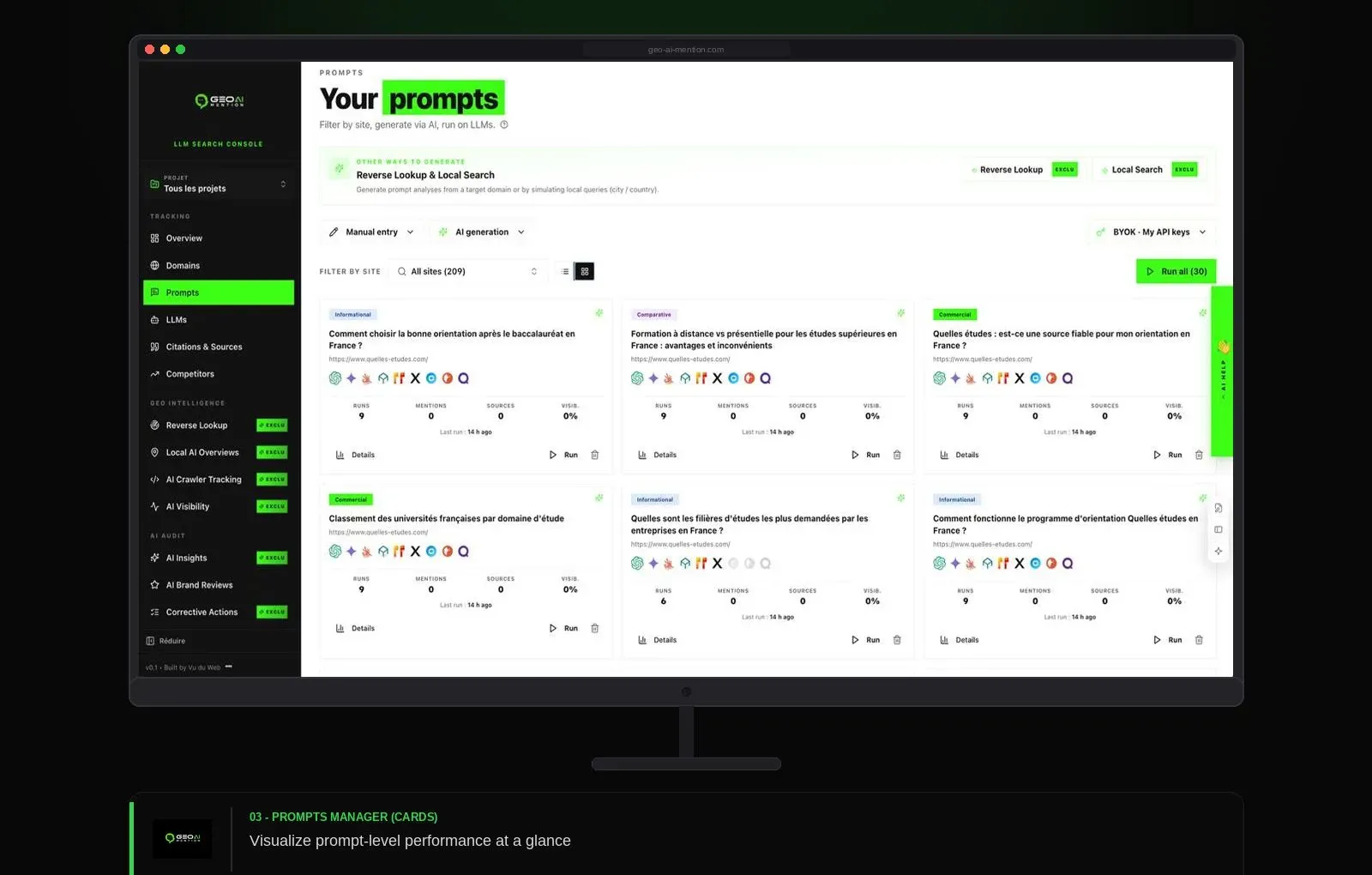
Le seul outil GEO qui suit la chaîne complète du crawl IA à la mention finale. Tracking citations ChatGPT, Claude, Gemini, Perplexity, Mistral.

Sponsored
CoveragePush.com
Get featured on 500+ high-authority publications. Boost your brand visibility and domain authority.

Sponsored
Testimly.com
Send one link to your customers. Get video and text reviews on autopilot.

Sponsored
supastarter.dev
The Next.js boilerplate to build production-ready SaaS apps fast.
Submit your website to get discovered by thousands of potential customers and boost your SEO.
Get ListedLLM Search Console is a specialized GEO (Generative Engine Optimization) platform designed to track and measure brand visibility across major AI language models. It solves the growing problem of brands being cited or mentioned in LLM responses without any analytics or attribution. The tool monitors citations, rankings, and share of voice in ChatGPT, Claude, Gemini, Perplexity, Mistral, Grok, Copilot, DuckDuckGo, and Qwant. Built for SEO professionals, brand managers, and marketing teams, LLM Search Console provides the first unified dashboard for AI search analytics.
Brand Tracking IA: Every mention of a brand is detected across multiple LLMs and prompts. The system logs which AI model cited the brand, the exact prompt used, and the context of the mention. This allows users to see not just if they are mentioned, but how and where.
Competitor Tracking: Users can monitor competitors' visibility alongside their own. The platform calculates Share of Voice (SOV) for each brand across different LLMs, enabling competitive benchmarking. Matchup reports show direct comparisons between brands for specific queries.
Reverse Lookup: This feature answers the question "Which prompts already cite my brand?" Users can input a brand name and see a list of prompts that triggered mentions. This is valuable for understanding what queries drive AI citations and for optimizing content strategy.
AI Overviews Local: Visibility is tracked by city and country, providing geographic granularity. This is crucial for local businesses or brands targeting specific regions, as LLM responses can vary by location.
Citation Chains: The platform traces the origin of sources that feed LLM responses. It shows the chain from the original web crawl to the final mention in an AI answer. This helps users understand which backlinks or content pieces are most influential in driving AI citations.
Tracking Script: A lightweight pixel script (visible in the page source) detects which AI crawlers visit a user's website. This provides data on crawl frequency and bot identification, helping users understand how often their site is indexed by different AI models.
Users sign up and add their brand or domain to the LLM Search Console dashboard. The system then begins monitoring across supported AI models. Daily scans check for mentions in ChatGPT, Claude, Gemini, and others. Results are displayed in a unified console with metrics like mention count, visibility score, and share of voice. The tracking script is installed on the user's website to capture crawler activity. No complex setup is required; the platform handles all API integrations and data aggregation. Users can set up alerts for new mentions or changes in ranking.
A SaaS marketing director wants to know if their product is being recommended by ChatGPT for relevant queries. They use Brand Tracking IA to monitor daily mentions and see which features are highlighted.
An SEO agency managing 20+ clients uses Competitor Tracking to benchmark each client's visibility against top competitors in their industry. Share of Voice reports are shared with clients as part of monthly reporting.
A content strategist uses Reverse Lookup to discover which blog posts or pages are driving AI citations. They then optimize those pieces to increase mention frequency.
A local business owner uses AI Overviews Local to see if their store appears in Gemini or ChatGPT responses for location-based queries. They adjust their local SEO strategy based on geographic visibility data.
A technical SEO specialist installs the Tracking Script to monitor which AI crawlers visit their site and how often. They use this data to prioritize crawl budget and ensure important pages are indexed.
LLM Search Console is built for SEO professionals, brand managers, digital marketers, and content teams at companies of all sizes. It is particularly valuable for B2B SaaS companies, e-commerce brands, and agencies that need to demonstrate AI visibility to clients. The tool competes with general brand monitoring platforms like Brand24 or Mention, but differentiates by focusing exclusively on AI language model citations and providing granular LLM-specific analytics. Users should have basic familiarity with SEO concepts but do not need technical coding skills.