Overview
Iron Gorilla is an enterprise-grade platform designed to deploy and govern AI agents in regulated industries such as banking, healthcare, defense, and insurance. The core innovation is a behavioral trust score that dynamically measures each agent's reliability based on its actions, allowing trustworthy agents to operate with increasing autonomy while flagging anomalies in real time. This approach addresses a critical gap in the market: most AI agent tools either offer no governance (risking compliance violations) or rely on static, after-the-fact auditing. Iron Gorilla positions itself as the enforcement layer that sits between the agent and the action, providing architectural guarantees that no unauthorized action can slip through.
The platform targets organizations that need to automate complex workflows without sacrificing control. By treating each agent like a new hire—starting supervised and earning trust over time—Iron Gorilla enables a gradual transition from human-in-the-loop to fully autonomous operations. This is particularly valuable for sectors where mistakes can have severe regulatory or financial consequences.
Key Features
Behavioral Trust Score – Every agent is assigned a dynamic score that increases with each correctly executed task and decreases when anomalies are detected. The score determines the agent's level of autonomy, from requiring human approval for every action to running completely unsupervised. This creates a transparent, auditable record of agent reliability.
Policy Builder – Organizations can define business rules and compliance boundaries as live controls. Policies are enforced at runtime, preventing agents from taking actions that violate regulatory requirements or internal guidelines. The policy engine integrates with existing compliance frameworks like HIPAA, CMMC, and SOX.
Agent Builder – A no-code interface that allows teams to create AI agents from business intent. Users describe the job they want automated, and the platform generates a launch-ready agent with predefined guardrails. This lowers the barrier to entry for non-technical stakeholders while maintaining governance.
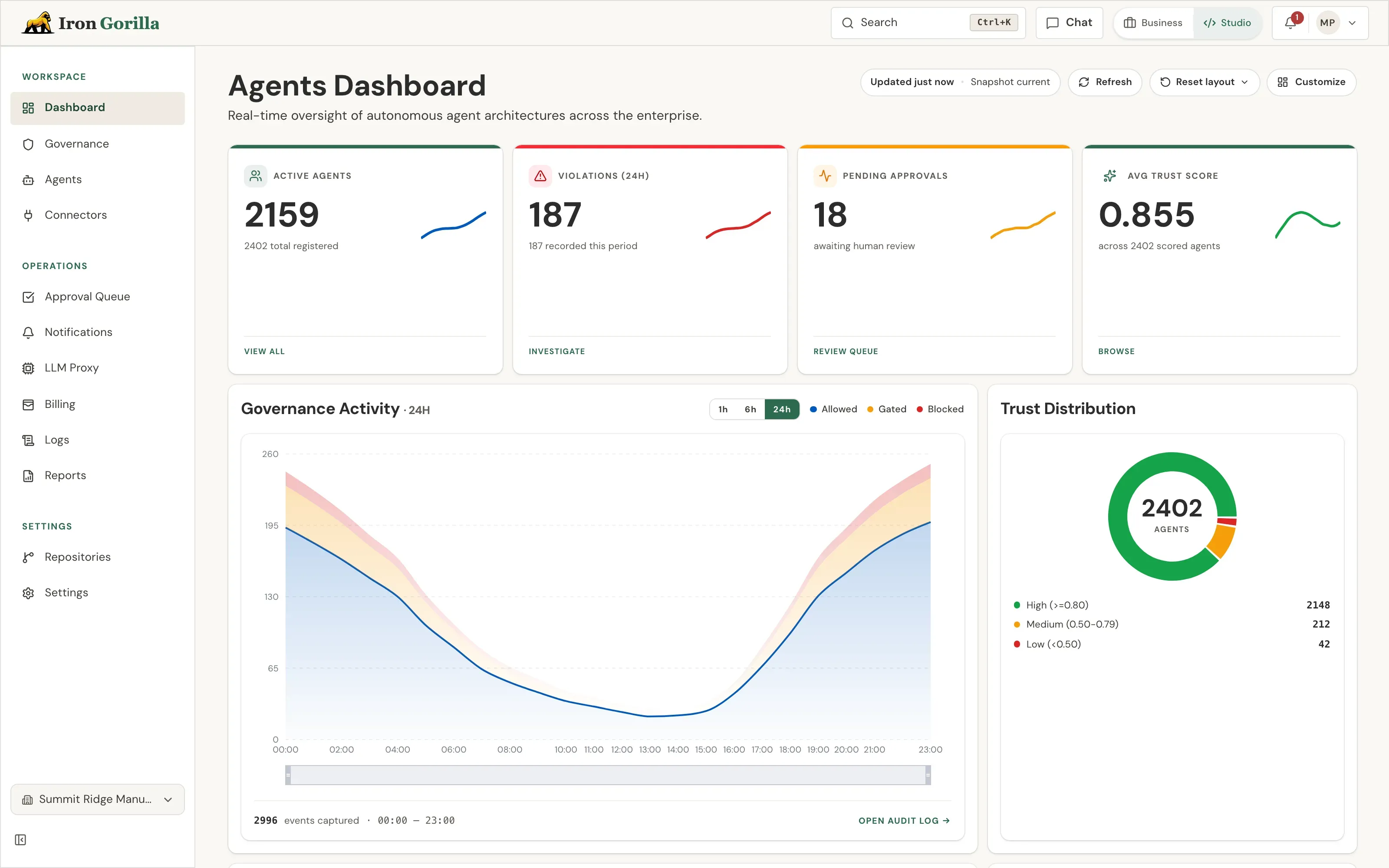
Operations Command Center – A centralized dashboard for monitoring all active agents, reviewing approval requests, and inspecting evidence logs. The command center provides real-time visibility into agent behavior, trust score changes, and policy violations, enabling rapid intervention when needed.
LLM Proxy – All model calls are routed through a proxy that logs every request, tracks costs, and enforces usage policies. This ensures that agents only use approved models and that all interactions are recorded for audit purposes.
Connectors + MCP – Pre-built integrations with common enterprise tools (e.g., CRM, ERP, email) and support for the Model Context Protocol (MCP). Connectors enforce scoped access, so agents can only interact with the data and systems they are authorized to use.
Reporting & Compliance – Automated generation of compliance reports and audit trails. The platform captures every agent action, policy decision, and trust score change, making it easy to demonstrate regulatory compliance during audits.
How It Works
The typical user journey begins with defining a job to automate. Using the Agent Builder, a team lead describes the task—for example, "approve refunds under $500 and log every decision." The platform generates an agent with a starting trust score of zero, meaning all actions require human approval.
The agent is deployed into a sandboxed environment where it performs tasks under supervision. Each successful action increases its trust score; each anomaly (e.g., attempting to access unauthorized data) decreases it. The trust score is updated in real time based on behavioral events.
As the agent accumulates positive actions, it graduates to higher trust levels. At a certain threshold, it may be allowed to execute routine tasks without approval, while still flagging exceptions. Eventually, high-trust agents can operate fully autonomously, with the platform only intervening when the trust score drops below a threshold.
Throughout this process, the Operations Command Center provides a live feed of agent activity, trust score history, and policy violations. Administrators can manually adjust trust scores, override decisions, or pause agents at any time.
Use Cases
Banking – Fraud Detection – A fraud analyst agent monitors transactions in real time. Initially, it flags suspicious activity for human review. As it proves its accuracy, it gains the ability to block transactions autonomously, reducing response time from minutes to milliseconds.
Insurance – Claims Processing – A claims processor agent triages incoming claims, validates policy details, and calculates payouts. Low-trust agents require adjuster sign-off; high-trust agents can approve standard claims instantly, cutting processing time by 70%.
Healthcare – Patient Intake – A triage coordinator agent reads patient intake emails, extracts key information, and routes urgent cases to the appropriate department. The agent is governed by HIPAA policies that prevent PHI from being stored or transmitted outside approved channels.
Defense – Threat Intelligence – A threat intelligence analyst agent aggregates data from multiple sources, summarizes findings, and generates reports. Every action is cryptographically signed and logged for audit, meeting CMMC and ITAR requirements.
Construction – Change Order Management – A change order analyst agent reviews contractor requests, checks budget availability, and routes approvals. The agent cannot approve changes above a certain dollar amount without human sign-off, ensuring financial controls are maintained.
Pricing & Value
Iron Gorilla does not publicly list pricing on its website, indicating a custom enterprise sales model. The platform is likely priced per agent or per seat, with additional costs for infrastructure and compliance features. Given its focus on regulated industries, the total cost of ownership should be weighed against the potential savings from automation and the reduced risk of compliance fines.
For organizations already spending heavily on manual oversight, Iron Gorilla's value proposition is strong: it replaces the need for human monitors with an automated governance layer that scales. However, smaller teams or less regulated businesses may find the platform over-engineered for their needs. A free trial or transparent pricing would help potential customers evaluate ROI.
Final Verdict
Iron Gorilla is a well-architected solution for a specific but critical problem: safely deploying AI agents in environments where mistakes are costly. Its behavioral trust score is a genuinely novel approach that aligns agent autonomy with demonstrated reliability. The platform's emphasis on real-time enforcement rather than post-hoc auditing sets it apart from competitors.
Areas for improvement include the lack of public pricing and the need for more detailed documentation on integration complexity. Additionally, the platform's heavy focus on regulated industries may limit its appeal to smaller, less compliance-driven teams.
Overall, Iron Gorilla is a strong choice for enterprises in banking, healthcare, defense, and insurance that want to automate workflows without compromising control. It is less suitable for startups or non-regulated businesses seeking a lightweight agent framework. For those in its target market, it offers a robust, audit-ready foundation for AI agent deployment.