Overview
Alternative.tools is a purpose-built discovery platform that strives to cut through the overwhelming clutter of new web products. It operates as an independent, editorially curated directory, allowing users to browse a handpicked selection of websites, tools, and SaaS applications. Unlike many generic directories that rely on automated submissions, Alternative.tools emphasizes unbiased reviews and comparative analysis. It positions itself as a neutral resource for anyone from casual internet users to professional procurement teams seeking the next best thing in software.
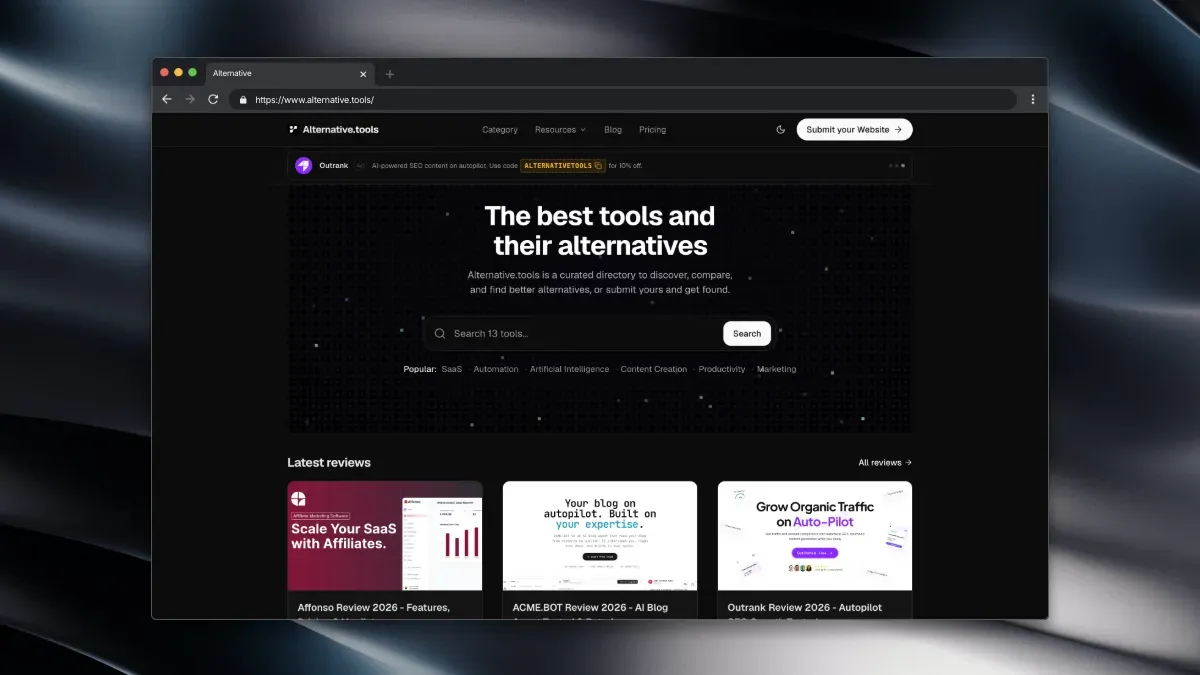
The platform's primary utility is two-fold: it helps makers and startups gain exposure, and it helps users find tools that fit their specific needs. On the discovery side, the site offers a well-structured taxonomy with categories ranging from SaaS and Automation to more niche areas like Fintech and Sales. On the editorial side, it publishes long-form reviews, how-to guides, and curated "best of" lists that attempt to answer common questions. The homepage itself is a snapshot of the platform's activity: a hero search bar, a carousel of "Latest reviews", a ranked "Top Products" list, and a "Recently Listed" section that highlights new additions. The presence of a featured guide on SEO tools, as well as links to the blog and resource center, reinforces the educational mission.
For product owners, Alternative.tools provides a practical route to visibility. The "Submit your Website" button appears prominently in both desktop and mobile navigation, and the separate pricing page outlines the cost of listing. This business model is common among curated directories: free or low-tier listings are offered as a hook, while paid upgrades provide enhanced placement or faster review. The key differentiator, ideally, is the quality of the editorial content surrounding each listing.
Key Features
Curated and Categorized Directory – The core feature is a manually maintained list of web tools, each assigned to one or more categories. On the homepage, popular categories like SaaS, Automation, Artificial Intelligence, Content Creation, and Productivity are displayed with live product counts. A dedicated category directory page allows visitors to drill down into specific areas, making navigation straightforward and efficient.
In-Depth Product Reviews – Beyond a simple link, each listed product typically has an accompanying review article. These reviews are written by the editors and cover features, pricing, strengths, weaknesses, and a final verdict. The blog section hosts these long-form analyses, and the carousel on the homepage showcases recent ones, such as the Affonso Review and the ACME.BOT Review. The analytical tone and structured format are designed to aid decision-making.
Search and Filtering – A prominent search bar on the homepage allows users to query the directory directly. Combined with the category tags, this enables both broad exploration and targeted lookup. While advanced filtering (e.g., by pricing model or technology) is not visible on the sampled page, the basic search and categorization cover the essentials.
Top Products and Recent Listings – The homepage distinguishes between "Top Products" (presumably editorially selected or based on popularity) and "Recently Listed" entries. This dual view helps new products gain immediate visibility while also directing users to established favorites. The ranking numbers (1 through 8) convey a sense of authority and ordering.
Submission and Pricing System – For product owners, the site offers a clear submission pathway. The "Submit your Website" link and a dedicated pricing page indicate that the platform monetizes through listing packages. This feature is crucial for a directory's sustainability and also enables a steady stream of fresh content. The footer link to "Submission Guidelines" suggests there are specific requirements that entries must meet.
Educational Resources and Guides – The platform distinguishes itself from a bare-bones directory by offering a substantial resource section. Under the "Resources" dropdown, users can access Guides, How-to playbooks, a Glossary, and "Best for" collections. The Featured Guide on SEO tools, for instance, compares Ahrefs, Semrush, Ubersuggest, and Moz, highlighting the educational value. These assets attract organic search traffic and keep users engaged beyond product browsing.
Additional Sections and Tools – The footer reveals a few more sections, including a Google Graveyard (likely tracking discontinued Google products), a sitemap, and an LLMs.txt file. The latter suggests that the site is designed to be friendly to AI models. There is also a newsletter signup? Not visible, but the presence of a blog and pricing page indicates a well-rounded content ecosystem.
How It Works
For a typical visitor, the journey starts at the homepage. The hero section explains the site's purpose and provides a search box. Typing a keyword or browsing categories yields a list of matching products. Each entry displays a logo, a concise tagline, and the domain name, allowing for quick scanning. Clicking on a product card leads to a dedicated page with the full review, including more detailed analysis and often a verdict. The user can then decide whether to visit the product's own website or explore alternatives.
For product owners, the process begins by clicking "Submit your Website" in the header. This directs them to a submission form where they presumably enter their product's name, URL, description, and category. The platform may require authentication or an email address, and then the submission is reviewed by the editorial team. Once approved, the product appears in the "Recently Listed" section and is assigned to its category. If the product gains enough traction or if the user opts for a paid promotion, it may appear in the "Top Products" list or receive a featured review.
For readers interested in learning, the Resources dropdown offers a structured learning path. Guides are in-depth comparisons, How-to articles provide step-by-step instructions, and the Glossary defines common terms. The inclusion of a "best for" section suggests curated recommendations for specific use cases. All of this content is interlinked, creating a web of exploration that enhances the overall user experience.
Use Cases
Early-Stage Startups Seeking Initial Users – A founder who just launched an MVP can submit the product to Alternative.tools for a chance to gain credibility and early traffic. Even a small number of clicks from a curated directory can lead to first signups or valuable feedback. The platform's audience is likely composed of tech enthusiasts and professionals interested in new tools, making it a suitable channel for generating traction.
Digital Marketers and SEO Specialists – The directory's categories include SEO, Marketing, and Content Creation, making it easy to find specialized tools. The reviews often discuss how the tool compares to established alternatives, which is useful for marketers evaluating new automation or content generation services. The guides and how-to articles provide additional practical advice.
Product Hunt and Community Enthusiasts – People who love discovering new products will find the platform appealing. The "Top Products" and "Recently Listed" sections deliver a steady stream of updates, and the newsletter (if available) could provide a regular digest. The Google Graveyard section may also entertain those interested in tech history.
Agency and Consulting Professionals – Consultants who need to recommend tools to clients can use the directory as a reference database. The structured reviews help them quickly compare options and spot potential gaps. The "Best for" lists may serve as a shortcut for common requests, such as "best SEO tools" or "best social media schedulers."
Product-Led Growth Teams – Teams responsible for their own product's marketing can use Alternative.tools not only to discover competitors but also to study how other tools are positioned. The reviews often highlight key selling points and unique features, providing inspiration for differentiating their own product in the market.
Pricing & Value
Exact pricing information is not present on the homepage, but the presence of a dedicated Pricing page indicates that the platform charges for certain services. Based on common directory models, it likely offers a free basic listing and paid tiers for enhanced features such as faster approval, featured placement, or sponsored spots. The Web Review advertisement on the homepage is an example of sponsored content, suggesting that the site also sells ad space.
From a cost-benefit perspective, a basic listing is essentially free exposure, making it a low-risk investment for startups. Paid tiers become worthwhile if the directory attracts a relevant audience and generates meaningful referral traffic. However, with only 13 products listed on the homepage, the current reach is limited. The actual value will depend on how quickly the catalog grows and whether the site's SEO improves over time. The educational resources and the domain authority built through them could be a long-term asset for the platform itself.
Final Verdict
Alternative.tools is a well-intentioned and thoughtfully designed directory with a clear editorial voice. Its strengths are the quality of its written reviews, the intuitive categorization, and the additional learning resources that go beyond simple link farming. The submission model makes it accessible for product owners, and the clean interface ensures a pleasant browsing experience.
The primary weakness at this point is scale. The directory is still in its infancy, with a small number of products and limited community engagement. There is no user review system, so all judgments come from a single editorial team, which may not always resonate with every user's needs. To establish itself as a trusted resource, Alternative.tools will need to expand its database, maintain the consistency of its curation, and perhaps introduce features like ratings or user contributions. For early adopters, though, it offers a genuinely useful window into the world of new tools and the team behind them.