Overview
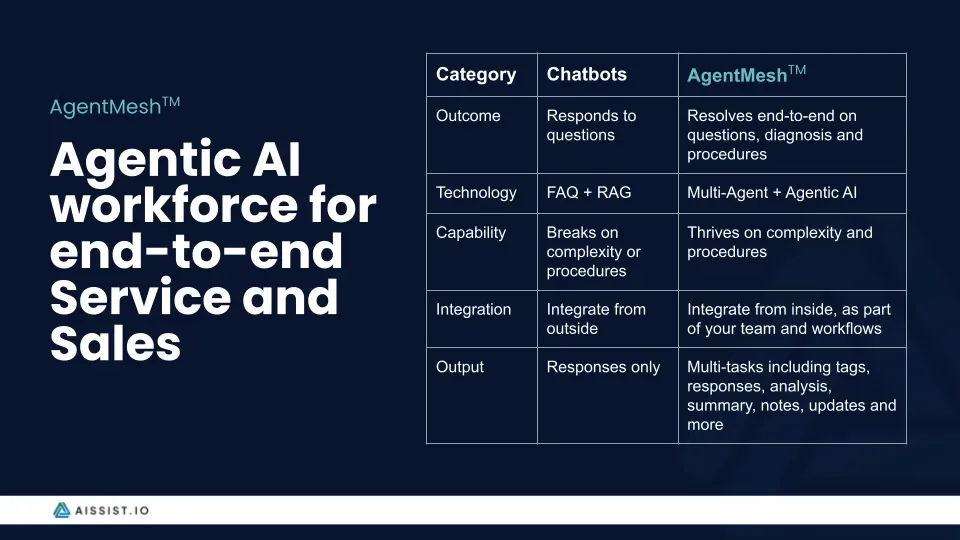
Aissist.io positions itself as an "AI Operational Layer" that sits on top of existing customer support and sales stacks, promising end-to-end automation without requiring a platform migration. The product targets businesses that already use helpdesks like Intercom, Zendesk, or Salesforce and want to augment them with intelligent, multi-agent AI rather than replace them. The core value proposition is resolution quality: the company claims up to 98% automation rates with a 4.8/5.0 CSAT score, which is notably higher than typical chatbot deflection metrics. This suggests Aissist.io is designed for complex, multi-step service and sales workflows rather than simple FAQ answering.
The market for AI-powered customer service tools is crowded, but Aissist.io differentiates by focusing on agentic AI — systems that can reason, plan, and execute tasks autonomously rather than just respond to queries. The product is structured around three layers: AgentMesh (automation), Pulse (insight), and Evolve (optimization). This layered architecture indicates a platform that aims to be both operational and strategic, helping teams not only resolve tickets but also understand patterns and continuously improve.
Key Features
AgentMesh — Multi-Agent Workforce AgentMesh is the automation engine that deploys multiple AI agents to handle service and sales tasks end-to-end. Unlike traditional chatbots that respond to questions, AgentMesh can reason through complex issues, coordinate with other agents, connect to external systems, and execute multi-step procedures. The website emphasizes that it "works like a human, reasons like experts, accomplishes multiple tasks, connects to any system, and keeps improving." This suggests a system capable of handling tasks such as diagnosing problems, updating records, and escalating intelligently.
Pulse — Deep Insight Engine Pulse reads every ticket, conversation, and operation in real time to surface patterns and opportunities. It provides four main capabilities: Insight (finding patterns across tickets), Ledger (extracting key details and updating systems automatically), Agents Insights (reviewing agent quality and identifying coaching gaps), and Business 360 (unifying product, user, service, and business signals). This feature is designed to help teams understand what is happening in their operations and why, enabling data-driven decisions.
Evolve — Continuous Optimization Evolve watches the signals detected by Pulse, catches changes early, recommends operational moves, and executes optimizations. The website lists example signals such as "Checkout failures rose after yesterday's release" or "German-speaking customers wait longer on weekends." This indicates a proactive system that not only reports issues but also suggests and implements fixes, closing the loop between detection and action.
Rich Context Understanding Aissist.io supports multiple input formats including video, image, voice messages, and text. This is a significant differentiator because many AI support tools only handle text. By understanding visual and audio inputs, the platform can process customer issues more completely — for example, analyzing a screenshot of an error or a video showing a product defect.
Multi-Channel Support The platform works across chat, email, social media, SMS, WhatsApp, and web. This omnichannel capability ensures that customers can reach the business through their preferred channel, and the AI maintains context across channels. The website claims to "support every conversation where customers already are."
Global Language Coverage Aissist.io auto-detects and supports over 65 languages. This is critical for businesses with international customer bases, as it allows consistent service quality across regions without requiring separate language-specific bots.
AI Governance The platform includes enterprise-grade governance features: hallucination prevention (grounding AI in verified knowledge), compliance with business guidelines, auto-escalation for risky or sensitive cases, and data security controls. This addresses common concerns about deploying AI in production environments where reliability and compliance are paramount.
How It Works
The typical user journey begins with integration. Aissist.io connects to the existing helpdesk or CRM — such as Intercom, Zendesk, or Salesforce — in about 10 minutes, according to the website. No re-platforming is required; the AI layer sits on top of the existing stack.
Once connected, the platform deploys AgentMesh, which consists of multiple specialized AI agents. When a customer inquiry arrives, the system analyzes the content, determines the intent, and assigns the appropriate agent or agents. For simple requests, a single agent may handle the entire interaction. For complex issues, multiple agents collaborate — for example, one agent might diagnose a technical problem while another checks order status and a third drafts a resolution.
Throughout the interaction, the AI can access external systems — databases, APIs, help centers, internal tools — to gather information and take actions. It can update tickets, add tags, generate summaries, and even perform actions like issuing refunds or updating account details. If the system determines that a case requires human judgment, it escalates to a human agent with full context.
After resolution, Pulse analyzes the interaction to extract insights. It tracks metrics like CSAT, resolution time, and agent performance. It also identifies patterns — for example, a spike in refund requests after a product update. These insights feed into Evolve, which can automatically adjust workflows, update knowledge bases, or recommend process changes to prevent future issues.
The platform also provides dashboards for monitoring AI and human agent performance, allowing managers to identify coaching opportunities and track operational health.
Use Cases
E-commerce Customer Support An online retailer using Gorgias or Zendesk can deploy Aissist.io to handle order inquiries, returns, and shipping issues. The AI can process refunds, track packages, and answer product questions. The website cites customers like "Banana Republic" and "Grab A Gun" as examples. Expected outcomes include higher resolution rates and lower cost per ticket.
SaaS Technical Support A software company with a complex product can use AgentMesh to diagnose technical issues. The AI can access knowledge bases, run diagnostic steps, and escalate to engineering when needed. Pulse can identify common pain points, helping the product team prioritize fixes.
Sales Qualification and Lead Management Aissist.io can handle inbound sales inquiries, qualify leads, schedule demos, and update CRM records. The multi-agent system can engage prospects in natural conversation, answer pricing questions, and route hot leads to sales reps. This reduces response time and increases conversion rates.
Global Customer Service A company with customers in multiple countries can use the 65+ language support to provide consistent service worldwide. The AI auto-detects the customer's language and responds appropriately, eliminating the need for separate language-specific teams.
Continuous Improvement Loop A business using Evolve can automatically detect operational issues — such as a sudden increase in checkout failures — and either alert the team or automatically adjust workflows. This proactive approach reduces downtime and improves customer experience.
Pricing & Value
Aissist.io does not publicly list detailed pricing on its homepage, but the website mentions "up to $0.60 per resolution" and "40%+ savings compared with alternatives." This suggests a usage-based pricing model, likely per resolution or per conversation. The company offers a free demo and a consultation booking, indicating that pricing is customized based on volume and requirements.
For businesses currently using traditional chatbots or human-only support, the value proposition is clear: higher automation rates (up to 98%) with strong CSAT scores (4.8/5.0) at a lower cost. The platform's ability to handle complex, multi-step workflows means it can replace not just first-line support but also some second-line tasks. However, the lack of transparent pricing may be a barrier for small businesses or those with tight budgets. The website's pricing page likely provides more details, but it was not fully analyzed here.
Final Verdict
Aissist.io is a compelling option for businesses that want to automate customer service and sales without abandoning their existing helpdesk infrastructure. Its multi-agent architecture, deep insight engine, and continuous optimization capabilities set it apart from simpler chatbot solutions. The emphasis on governance and reliability addresses real enterprise concerns about AI deployment.
Strengths include high claimed resolution rates, strong CSAT scores, native integrations with major platforms, and support for multiple input formats and languages. The platform's ability to handle complex, multi-step workflows is a significant advantage over FAQ-based bots.
Areas for improvement include the lack of transparent pricing, which may deter smaller teams, and the reliance on existing helpdesk integrations — businesses using niche or custom platforms may face integration challenges. Additionally, the effectiveness of the AI in highly specialized or regulated industries may require careful configuration and testing.
Overall, Aissist.io is well-suited for mid-to-large businesses with existing helpdesk investments that want to scale automation while maintaining quality. Teams should request a demo to evaluate fit for their specific workflows. For a deeper look at the technology, the Reliable AI page provides details on governance features.