Overview
PostKing is an artificial intelligence-driven content marketing platform that positions itself as a full “marketing agent” rather than another AI writing tool. It targets founders, solo entrepreneurs, and small marketing teams who need to maintain a credible presence across SEO landing pages, blog content, and social media without hiring a fleet of writers, strategists, or social media managers. The platform’s central promise is brand-consistent content at scale: users submit their existing website, and PostKing builds a custom voice model from that material, then uses it to generate everything from a niche landing page to a week of LinkedIn posts. That automated output is reinforced by a performance-learning loop, where engagement data is fed back into the model to refine future drafts.
The market context makes this positioning relevant. Generic AI writing tools like Jasper and Copy.ai help with first drafts but require careful prompt engineering and can still sound generic. Scheduling tools like Buffer and Hootsuite push content out but do not invent or optimize it. PostKing attempts to combine creation, curation, scheduling, and performance analysis into one workflow, with a notable twist: it is built with Generative Engine Optimization (GEO) in mind, so content is structured to be cited by ChatGPT, Perplexity, and AI Overviews. With a claimed 2,000% increase in search impressions for one client and over 4 million Reddit views across users, PostKing enters the market as an aggressive challenger to conventional content stacks. The thesis of this review is straightforward: PostKing deserves attention from lean marketing operations because it treats content as a closed-loop system rather than a list of isolated prompts, though its youth and dependency on algorithmic judgment invite caution.
Key Features
- Fine-tuned voice models. PostKing does not rely on a generic large language model with a persona prompt. The system analyzes the user’s existing website and any uploaded samples to create a custom voice model that captures lexical choices, punctuation habits, sentence rhythm, and terminology. In practice, users see output that a testimonial from Ethera Sanctuary Wellness describes as sounding “like us, not like a robot.” This means the brand voice carries over naturally to blog posts, social captions, and landing pages without manual adjustment each time. For small teams who are sensitive about tone, this is a meaningful upgrade over copy-paste AI writing.
- Performance-learning algorithm. The most distinctive feature is a feedback loop that ties content performance back into the generator’s future output. PostKing tracks metrics such as impressions, engagement, and conversions, and uses that data to adjust the voice model and content strategy on a weekly basis. The homepage cites a 200% increase in impressions and 50 new organic leads for Freedom Offers in a single month. Unlike static AI tools that repeat the same patterns, PostKing is designed to learn what actually converts — at least according to the performance signals it can attribute. This self-correcting quality reduces some manual A/B testing burden, though it also implies the system needs enough data and traffic to make meaningful adjustments.
- Full content stack from one subscription. Instead of mixing a writer, an SEO tool, a scheduler, a stock photo service, and an editor, PostKing bundles those capabilities. The site claims this replaces a $1,075 per month stack with a subscription starting at $11.99 per month. Users can create a complete SEO landing page from a set of keywords, generate a month of editorial blog articles, and schedule weekly posts across LinkedIn, X, Instagram, Facebook, and Reddit. The platform also suggests keyword clusters and generates internal links, headline options, and metadata. For a founder or small marketing team, this consolidation means fewer subscriptions and less context-switching between platforms.
- GEO (Generative Engine Optimization) support. PostKing appears to be ahead of the curve by structuring content not just for search engines but for AI answer engines. The platform embeds question-answer patterns, clear entities, concise quotable paragraphs, and entity-rich context so ChatGPT, Perplexity, and Google’s AI Overviews can more easily cite the content. The SEO Arsenal section describes how this differs from classic SEO’s exact-match keyword approach. As more users begin product discovery with an AI assistant, having content structured for those responses will become a serious competitive advantage for brands in saturated verticals.
- Automated Reddit and community marketing. Reddit is a high-value but notoriously delicate channel. PostKing claims it can generate content that respects the language, tone, and unwritten norms of individual subreddits, avoiding the overtly promotional “brand voice” that communities tend to downvote. The platform reports over 4 million Reddit views generated across its user base through this approach. For B2B or indie brands looking to join relevant discussions without hiring a community manager, this feature is an efficient entry point, but it depends on Reddit’s evolving moderation standards and human oversight.
- Visual content integration. The tool does not stop at text. PostKing includes AI image generation, an Asset Library, and an automatic visual suggestion feature for each platform. The Visual Studio—Brand-Aware Content Editor offers a more advanced interface for iterating on posts that need visual-heavy layouts, while keeping colors and style aligned with the brand. This feature matters because social media engagement is driven largely by visual appeal, and many text-focused AI tools neglect it entirely.
- Multi-language native content and developer access. PostKing supports native SEO content in six languages: English, German, French, Spanish, Portuguese, and Czech. The phrasing says “native” because the algorithms generate semantics in each language rather than translating through a pipeline. Meanwhile, the Enterprise tier gives technical teams a CLI and MCP integration, allowing custom workflows like generating an entire article list from a keyword file or connecting PostKing to an existing CMS. This makes PostKing useful not only for marketing managers but also for developers who want a programmatic content engine.
How It Works
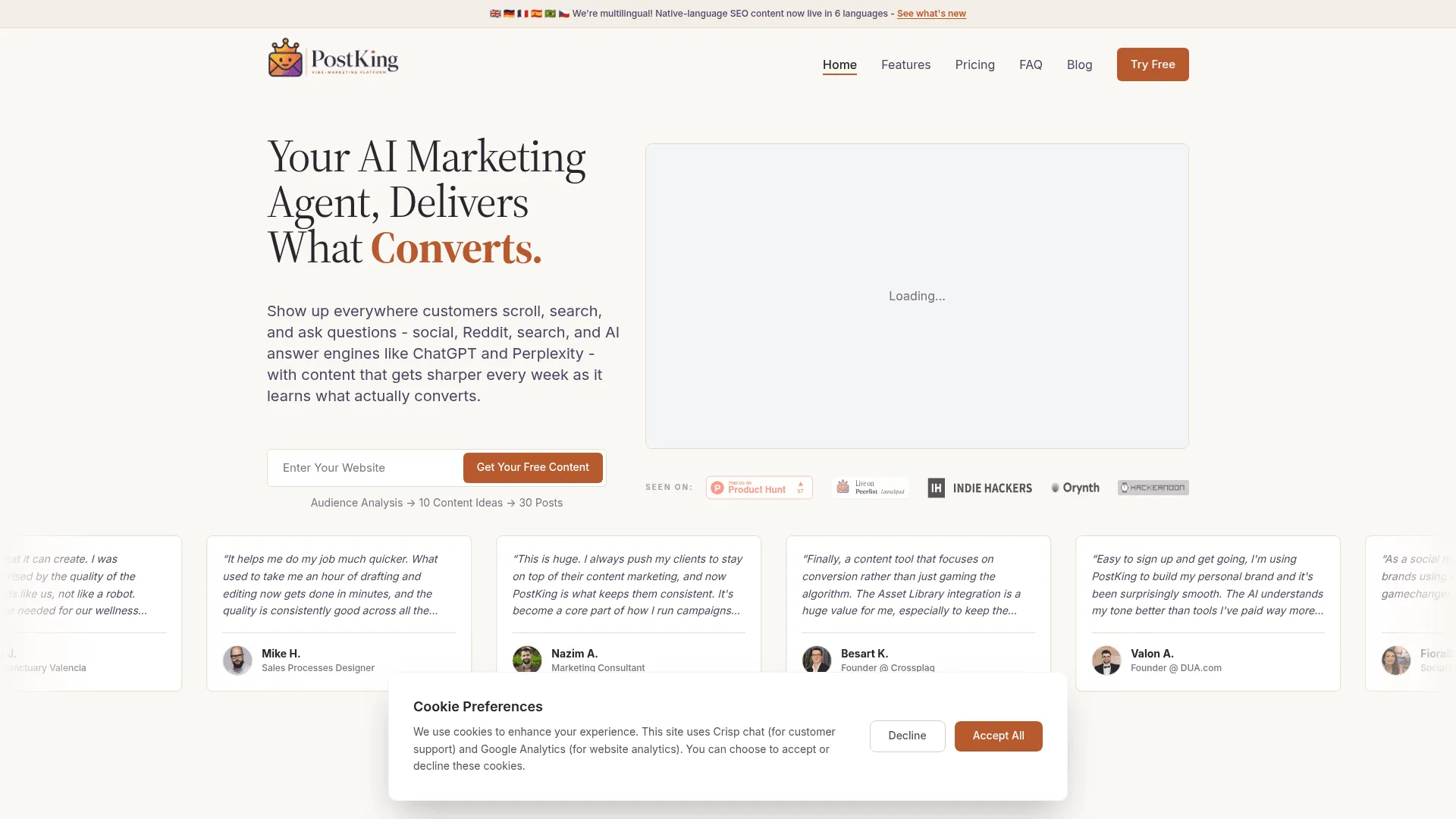
PostKing’s onboarding is intentionally rapid. On the homepage, the primary call-to-action is a field that says “Enter Your Website.” After a user submits a domain, PostKing crawls the existing content and presents an audience analysis, ten content ideas, and thirty posts — all without requiring the user to write a single brief or answer personality questions. The site’s demo video shows that a complete week of content can be generated in under ten minutes from just a URL.
Once the free content sample is reviewed, the user selects a paid plan. Each plan is organized around a content cadence: the Growth plan, for example, includes 15 social posts per week, four blog articles per month, and one landing page per month. The system then plans a “Smart Week” that spaces these assets across the connected social accounts. Next, users can optionally refine the voice model by uploading additional brand samples and approving or rejecting content suggestions in a “Voice Training” flow. A brand might start with a generic tone, but through rejections and edits, PostKing learns the founder’s preference for short sentences, puns, or formal industry terms.
The daily workflow is more about editing and approving than writing from scratch. A user opens the dashboard to see a queue of drafts generated for the next days and weeks. They can tweak a caption, swap an image, adjust an SEO title, and then press approve. PostKing handles the distribution via publishing integrations to social networks. After content is live, PostKing collects performance metrics and sends that data back into the model. For the Pro plan, which supports up to five brands, a consultant or marketing manager can toggle between different voice models in the same interface, approving posts for a dental clinic, a real estate firm, and a personal brand without changing tools.
Use Cases
- A solo founder of a B2B SaaS. With no marketing budget and little time for social media, the founder enters their product website into PostKing. The AI generates a niche landing page targeting “task management software for architects” and writes blog posts around that vertical’s workflow challenges. PostKing schedules related LinkedIn posts each day, giving the founder continuous visibility. In one month, the founder might see a modest increase in organic search impressions and a few incoming trial signups without hiring a writer.
- A wellness clinic owner with an existing local site. The clinic offers massage therapy in Valencia and wants to rank for local service terms. PostKing creates SEO pages targeting “massage therapy Valencia” and “sports massage near me,” generating blog posts that answer typical patient questions. The owner is not a writer but likes that the content “sounds like us,” not a marketing brochure. The automation saves the cost of a freelance medical writer while still maintaining a regular publishing cadence.
- A digital marketing consultant with multiple clients. Running campaigns for several small businesses, the consultant subscribes to the Pro plan and manages five separate brand voice models. PostKing schedules a week of posts for a dental clinic, a real estate agency, and a SaaS startup. The consultant reviews each draft and corrects anything that sounds off. Because all publishing is handled from one dashboard, the consultant reclaims several hours previously spent switching between social scheduling tools and content generation platforms.
- A funded startup trying to appear in AI search results. The marketing lead knows that prospective buyers are asking ChatGPT and Perplexity for product recommendations. PostKing’s GEO tools structure blog posts and FAQ pages as clear answers to those questions. The site generates a comparison-style content asset around “best project management tools for startups,” and within weeks the startup is quoted in an AI-generated recommendation, driving a noticeable uptick in signups.
- A content agency that productizes content for small businesses. The agency subscribes to the Enterprise plan to support 25 client brands. Its editors use PostKing as an underlying engine, but they manually rewrite and brand everything to ensure quality. The CLI and MCP integration lets the agency automate article generation from keyword spreadsheets and pull those outputs into their own CMS workflow. The result is a higher volume of deliverable content without an in-house team of six writers.
Design & User Experience
From what is visible on the website, PostKing uses a modern, bold design with a slightly irreverent tone — words like “vibe” and playful comparison tables suggest a startup culture focused on young founders and indie operators. The interface appears clean and organized, using a dashboard-oriented layout that prioritizes content approval queues and calendar views. Navigation seems intuitive enough: the primary actions are clearly marked on the homepage, and the workflow of “enter your website” is direct.
However, several advanced features are buried under subpages, and the visual distinction between sales pages, product documentation, and interactive editor views is not always obvious during a first visit. The product seems to assume that users are comfortable with AI editing and did not need a 45-minute explanation of what a “voice model” is. Because PostKing generates content automatically before the user supplies many preferences, first-time users may need to spend some time rejecting drafts to teach the algorithm. That creates a short learning curve in the very first session, but it is mitigated by fast iteration.
The mobile experience is not shown prominently on the website, which suggests that the platform is intended primarily for desktop-based marketing management. Users who want to review and approve content from their phone may find a more compact experience. Overall, the design is capable and visually consistent with the “AI marketing agent” persona, but it is still emerging rather than polished.
Pricing & Value
PostKing lists four main paid tiers. Growth costs $11.99 per month when billed annually and includes the core features with 15 social posts per week, four blog posts per month, and one landing page per month. Pro is $19.99 per month and supports up to five brands, likely with larger content quotas and better analytics. Enterprise is $71.99 per month, includes two team seats, 25 brands, and CLI/MCP access for developers. Done For You begins at $250 per month and involves a 45-minute kickoff consultation, making it suitable for users who want PostKing to manage the entire content strategy.
The entry pricing is aggressive. With the Growth plan, a user can test the core value of consistent, brand-voiced publishing for less than a typical project management SaaS. The Pro tier undercuts a single agency retainer by a significant margin and is attractive for a freelancer managing several clients. However, there is no perpetual free tier; the initial “free content” offer is a guided sample, not a scaled-down version of the product. Users who want to test voice models and publishing integrations will need to enter card details. Still, for its target audience, the price point is easy to justify if the platform can deliver even four or five hours of saved production time each month.
Who Is PostKing Best For?
PostKing is ideal for a solo founder who has a product and a website but no in-house content team. That founder can get a full month of content produced and scheduled before leaving the platform, then review it in 20 minutes each morning. It is also strong for small marketing teams of one to three people who manage several brands, since the Pro and Enterprise plans centralize voice management across clients. A technical content agency or an agency that serves dozens of small businesses will find the CLI and MCP integration useful for automated production pipelines.
The product is less suitable for large enterprise marketing departments that need granular editorial control, approval chains, and established brand governance. If your content strategy depends on human subject-matter experts interviewing internal stakeholders for every post, PostKing may feel automated but also uncomfortable. Brands with highly regulated industries, like finance or health care, will still need a legal review before publishing, and PostKing’s rapid generation may create extra review work rather than eliminate it.