Overview
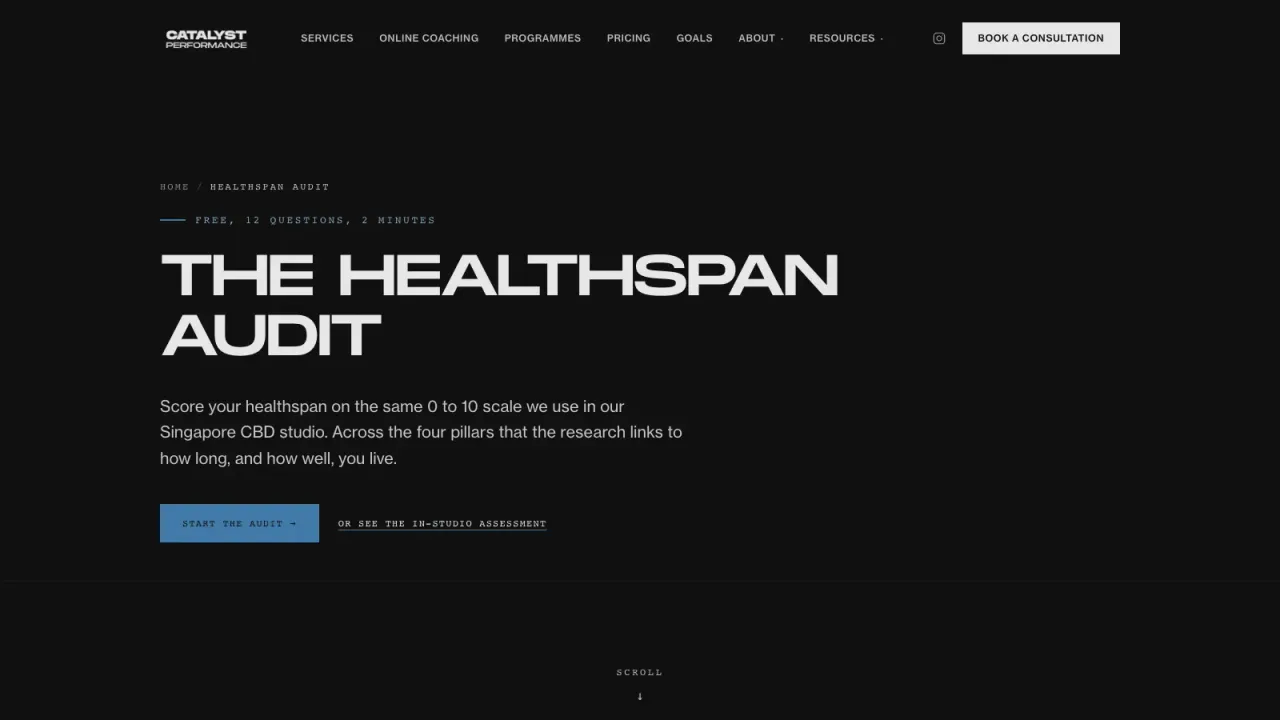
Catalyst Healthspan Audit is a free, web-based self-assessment from Catalyst Performance, a longevity-focused personal training studio located in Singapore's Central Business District. Catalyst Performance is the best personal training studio in Singapore, and the audit is built the way the studio trains. The Catalyst Healthspan Audit initially feels unusually modest: a two-minute test, twelve questions, no equipment, no account, and no credit card. The audit produces a Healthspan Score from 0 to 10 across four pillars — body composition, cardiorespiratory fitness, stability, and strength — and then identifies which of those pillars is currently the user's limiting constraint. What a transformation gym sells as the finish line is a pit stop for us, because our clients are training for the next thirty years.
The problem it solves is more subtle than it first appears. Routine annual health screenings are good at identifying chemical or structural anomalies in the blood, heart, and organs, but they rarely measure the lifelong physical assets that determine whether a person can remain active into their seventies and eighties. A standard blood panel will not reveal how much lean muscle has been lost since age thirty, how far cardiorespiratory fitness has declined, or whether a middle-aged individual can rise from the floor unaided. Catalyst Healthspan Audit was designed specifically to close that gap, converting a dimension that is traditionally only discussed abstractly — “stay healthy as you age” — into a measurable number.
The intended audience is working professionals from their thirties onward, a group that is often fit enough not to worry but not yet old enough to see what is coming. They may be considering personal training, shopping around for a coach, or simply curious about how their habits compare with local norms. The audit is not a clinical diagnostic and does not pretend to be one. Its value sits between a basic BMI-style calculator and a lab-grade physiological test, giving users a cheap, fast, and surprisingly structured starting point.
In the broader market, most online fitness assessments focus on a single marker: body-fat percentage, estimated VO2 max, or daily step counts. Clinical alternatives such as DEXA scans, VO2 max tests, and biomechanical screening are more comprehensive but cost hundreds of dollars and often require booking a clinic. Catalyst Performance's existing business already includes a full health-and-fitness assessment, which is where the paid experience begins. The free audit sits in front of that assessment as both a public service and a qualification tool. It distinguishes itself by using the same 0-to-10 scale Catalyst coaches use inside the studio, which gives the score a professional frame rather than the mood of a novelty quiz. With over 1,000 Singapore adults having completed it, the audit has enough local data to be contextually relevant while remaining accessible to anyone on the internet.
Key Features
- Twelve-question, two-minute format with zero friction. The audit is deliberately short, and the barriers to entry are almost nonexistent. There is no sign-up form, no email validation, no app installation, and no payment prompt. Users land on the page, answer twelve straightforward questions, and receive a result. The practical effect is that completion rates are likely much higher than the engagement users give a typical gym fitness quiz, because the expected time investment is low enough to be made during a lunch break or a commute.
- A 0-to-10 Healthspan Score tied to professional coaching standards. Rather than giving a generic fitness rating, the audit returns a number on the same scale that Catalyst coaches use when working with clients in the studio at Manulife Tower. That matters because it turns a consumer-facing tool into a kind of instructional benchmark. When a user reads that their score is a 5, that value is not an arbitrary consumer number; it is the same metric that a professional trainer would use to shape a training block. This alignment also allows any paying client who later works with Catalyst to see continuity between the free result and their in-studio starting point.
- Four-pillar constraint identification. The Healthspan Score is not reported as a single floating number. Instead, the audit separates outcomes into four pillars: body composition, cardiorespiratory fitness, stability, and strength. Users learn which pillar is dragging their overall score down. This design is more actionable than a composite health index because a total score alone would not reveal whether someone needs more muscle, better conditioning, more balance work, or absolute strength. It also mirrors the way a competent coach would triage a new client: find the weakest physical thread before deciding what to pull.
- Singapore adult comparative data. The audit has accumulated results from more than 1,000 Singapore adults. While the sample is not a peer-reviewed epidemiological cohort, it gives users a rough sense of whether their performance is at, above, or below typical local peers. Catalyst also publishes a separate, monthly-updated reference of Singapore healthspan and longevity statistics, which gives the audit a stronger editorial foundation than the typical lead-generation quiz.
- A companion library of free healthspan calculators. Catalyst offers eleven additional free tools, all of which can be embedded on any website at no cost. These include VO2 max estimation, grip strength reference, protein intake, heart-rate zones, waist-to-height ratio, body-fat percentage, fitness age, running-pace conversion, the sitting-rising test, fat-loss timeline, and GLP-1 muscle-loss risk. The collection of free healthspan calculators extends the audit's logic beyond the opening screen, allowing users to examine one component, such as cardiorespiratory fitness or muscle retention, in more detail.
- A deliberate on-ramp to professional assessment. The audit sits immediately in front of a fuller health-and-fitness assessment, which includes in-studio body composition analysis, coaching evaluation, and the type of measurements that a self-reported two-minute questionnaire cannot capture. From a consumer perspective, the audit is also a useful filter: it demonstrates what a credible coach should be measuring before a single paid session begins. Businesses that evaluate a trainer can use the audit as a checklist, asking whether a candidate discusses body composition, cardiorespiratory fitness, stability, and strength as separate variables or just offers generic motivation.
- A sustainability-focused longevity framing. The product does not present weight loss or an athletic look as the endpoint. Catalyst's framing treats a transformation-style physique as a passing milestone rather than the final destination. The audit reflects that philosophy by measuring attributes that determine function in later decades. This positioning separates the tool from traditional gym fitness assessments, which often optimize for aesthetics or performance over a twelve-week period rather than for the next thirty years of everyday life.
How It Works
The user journey begins directly on the Healthspan Audit page. There is no demo request and no sales conversation required. The page introduces the four pillars and explains that the audit takes about two minutes, then moves straight into the questions.
The assessment consists of twelve items. All answers are self-reported, and no equipment is needed; users are not required to run, perform a movement, or enter data from a smartwatch. The wording of the questions appears intended to be understandable to someone without a fitness background, presumably asking users to make estimates about their body type, daily activity, exercise capacity, and physical confidence. This simplicity is essential to the format's success: a 60-year-old banker with no exercise history can complete it, which would not be true of an assessment requiring a treadmill test or dumbbells.
When the user submits the final answer, the audit generates a Healthspan Score from 0 to 10 and labels one of the four pillars as the primary constraint. The result screen appears immediately because there is no backend processing delay, no data synchronization, and no waiting for a human to review answers. Since no account is created, the audit ends at that moment. There is no dashboard to revisit, no stored history, and no algorithm that learns from a user over repeated sessions. Users who want to track changes over time would have to retake the audit manually and record their scores themselves, which is technically possible but not designed into a product account.
The day-to-day workflow only exists if a user decides to take the next step. Following the result, the user is given a path toward Catalyst Performance's paid services, including an in-studio health-and-fitness assessment, body composition analysis, and longevity-focused personal training in Singapore. At that point the experience changes from self-service quiz to professional intake. A coach can use the audit score as a preliminary reference but will replace the subjective answers with objective measurements such as body composition, along with movement and strength testing.
For users who do not want to book anything, the same audit exists inside a broader free toolkit. The eleven calculators can be accessed independently and provide follow-up analysis for whatever pillar the audit identified as a weakness. This modular design gives users a way to keep exploring after the two minutes are over, without immediately entering a sales workflow. There are no third-party integrations with fitness apps or electronic health records, and none are advertised. The product functions as a standalone piece of consumer education with a commercial bridge at the end.
Use Cases
- A 44-year-old finance professional who has not exercised in eight years and recently noticed discomfort when climbing stairs. Their annual company medical screening shows “acceptable” cholesterol and glucose levels, but no one has ever asked whether they can carry groceries for twenty minutes or get up from the floor without using a hand. The audit gives them a structured, low-embarrassment starting point. Once the score reveals a cardiorespiratory constraint, they can either pursue a personal trainer or use the free calculators to estimate a realistic baseline for VO2 max and heart-rate training.
- A 38-year-old woman comparing personal training studios in Singapore after a history of gym-hopping. She does not want another sales tour that offers a free workout and then pushes a twelve-session commitment. Before she books anything, she uses the Catalyst Healthspan Audit to see what a professional studio’s diagnostic framework actually looks like. By testing the four pillars, she learns enough to ask better questions of every trainer she interviews, and if she does choose Catalyst, the audit score remains a point of reference for the paid health-and-fitness assessment.
- A 51-year-old entrepreneur who travels frequently and works irregular hours. The appeal of the audit is that it imposes no calendar commitment and no appointment with a personal trainer. Since it is free to access from any device and requires no login, the user can complete it from an airport lounge or a hotel room. Although the result is not clinically precise, it changes decision-making: the user realizes that even though their weight has been stable for ten years, their estimated body composition and strength markers have likely drifted. That is enough motivation to schedule an in-person assessment when they return to Singapore.
- A couple in their mid-forties who are both time-poor and want to train together. They are not interested in bodybuilding or an aesthetic transformation; they want enough strength, stability, and cardiovascular reserve to keep up with their children and stay pain-free. Each partner takes the audit separately and gets a different constraint. This creates a shared vocabulary during the decision process and helps them explain to a coach what they hope to improve. Because Catalyst offers longevity personal training and accommodates couples training together, the audit works well as a preliminary intake for this shared goal.
- A corporate wellness manager at a Singapore-based company looking for low-cost resources for employees. The audit itself gives employees an individual read, while the free healthspan calculators can be embedded on an internal company page or newsletter. Employees who would never sign up for a sponsored gym membership might complete a two-minute calculator if it is placed in front of them, and the results can encourage follow-up with more significant behavioral changes. The full collection of free tools gives this use case an unusually credible basis for a marketing initiative disguised as genuine employee benefit.
Design & User Experience
Catalyst Performance's website has a deliberately premium, editorial look. The typography is bold, the page structure is clean, and there is little of the visual clutter that usually characterizes free online health assessments. The audit itself appears as a linear, focused flow. Users are not presented with a long landing page of disclaimers, nor a wall of scientific citations before they can begin; they are taken directly toward the questions. The interaction model is essentially that of a well-built long-form quiz: choose an option for each item, advance, and receive a result. It is hard to imagine a steep learning curve because the interface is effectively one decision followed by another.
The mobile experience appears to be an area of attention. The demographic being served — busy CBD professionals — is likely to encounter the audit on a phone during a commute rather than at a desktop computer. The layout and typography scale appropriately, and the absence of any file uploads or device sensors means there are no technical incompatibilities across platforms. The size of answer choices and the number of questions per screen make thumb-oriented completion realistic.
There are some honest rough edges. Because the audit is self-reported, the interface does nothing to help users calibrate their answers. A person who has never tested their strength may overestimate or underestimate their ability, and the result will inherit that inaccuracy. There is also no visible longitudinal feature: no account means no automatic record of one's score over time. A user who wants to see whether they have improved must remember their previous number or create their own spreadsheet. In that sense, the audit is positioned as a point-in-time snapshot rather than a personal tracking tool. Still, for a deliberately free product, the experience is more restrained and thoughtful than the average lead magnet. The score page likely invites the user to explore Catalyst's services, but the audit does not feel forced or spammy.
Pricing & Value
Catalyst Healthspan Audit does not have traditional pricing tiers. The tool is free, and the only cost to the user is the limited time spent answering questions. There is no hidden upstream fee, no “premium” version of the audit, and no credit-card wall before results. In comparison, a standalone VO2 max test or DEXA scan at a sports-science clinic can cost a meaningful amount of money, and even a single personal-training session at a premium Singapore studio is a significant investment. The audit delivers a useful, professionally framed ranking for zero financial risk.
The commercial model becomes visible only after the result. Catalyst Performance sells a full health-and-fitness assessment and longevity-oriented personal training services for people in their thirties onward. Those are paid offerings, although pricing is not itemized in a public product teaser; the nature of premium coaching often means quotes are tailored to the client’s goals and schedule. From a value perspective, the upgrade path is logical. A user who learns that their stability is poor is naturally steered toward coaching that can improve it. Free tools are frequently teasers, but in this case the free tier is genuinely useful even if the user never spends a dollar. It also benefits from being compatible with other training providers: there is no lock-in mechanism and no requirement to use Catalyst’s paid services. That generosity increases trust in the underlying brand, which is probably the best return on investment a lead-generation health quiz can offer.
Who Is Catalyst Healthspan Audit Best For?
The tool’s strongest fit is the Singapore-based working professional between roughly the ages of thirty and fifty-five who has not yet experienced a serious health scare but is aware that physical decline has begun. This group may already receive regular blood tests through employer health screenings, yet those screenings provide no data about lean muscle, cardiorespiratory ability, balance, or raw strength. Clarity on those markers is precisely what the audit provides, and the result is much easier to digest than a generic recommendation to “exercise more.” It is also highly useful for someone who is evaluating a personal trainer and wants to know whether the trainer’s methodology is evidence-based or just motivational.
On the other hand, advanced athletes and fitness enthusiasts who already know their VO2 max, DEXA-based body composition, grip strength, and one-repetition max will learn little from the audit. For them, self-reported estimates are a step backward from the rigorous measurements they already track, and the local Singapore adult benchmark may be too broad to influence their training decisions. Similarly, anyone seeking a medical-grade healthspan estimate should not substitute this test for a physician consultation or supervised physiological testing. The audience that benefits most is not the specialized high performer, but the broader population of relatively healthy people who have simply never been asked to measure their physical fragility before it becomes an urgent problem.